“The Car Plays” drives theater to the heart of personal experience

It’s not like me to gush. I might like something. I might even really, really enjoy it, but since having seen The Car Plays last Saturday, I cannot stop talking about it to everyone I know with the enthusiasm of an infatuated 13-year-old girl talking about Justin Bieber.
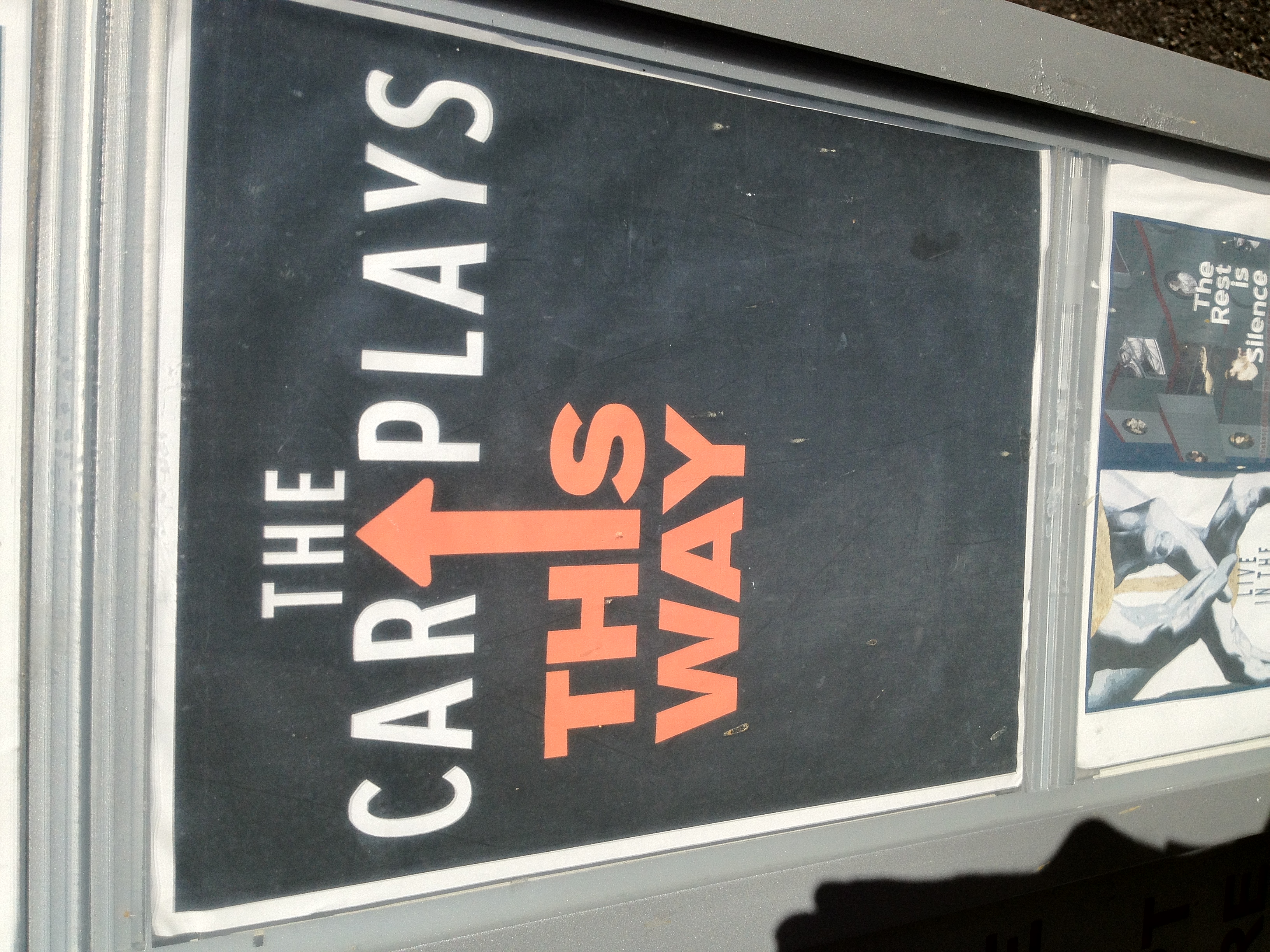
Sign for "The Car Plays" at La Jolla Playhouse. (Photo by M Dryja.)

The Car Plays is a grouping of 10-minute plays. Each play takes place in a different car. The audience members go two-by-two into the backseat or front seat of a real vehicle to watch the plays. And each program consists of five different ones so, by the end of an hour, they have seen five different plays.

What makes The Car Plays so different is that everything takes place in a car and during any given play there are only two audience members. This creates an intimacy and familiarity which makes the experience immediate and very personal. For example, in “Dad”, the play about a father who pulled over on the side of the road to discipline his fighting children, the actor was in the front seat speaking to us in the backseat, as if we were his kids. It was a story about someone we never met and, yet, it could not have been more familiar. I don’t know about you, but I can remember a number of times as a kid being threatened with “Don’t make me pull over this car!” As the play went on, layers were peeled back to reveal the deeper story about the dad. It was a touching, sometimes funny, story that almost anyone can relate to.
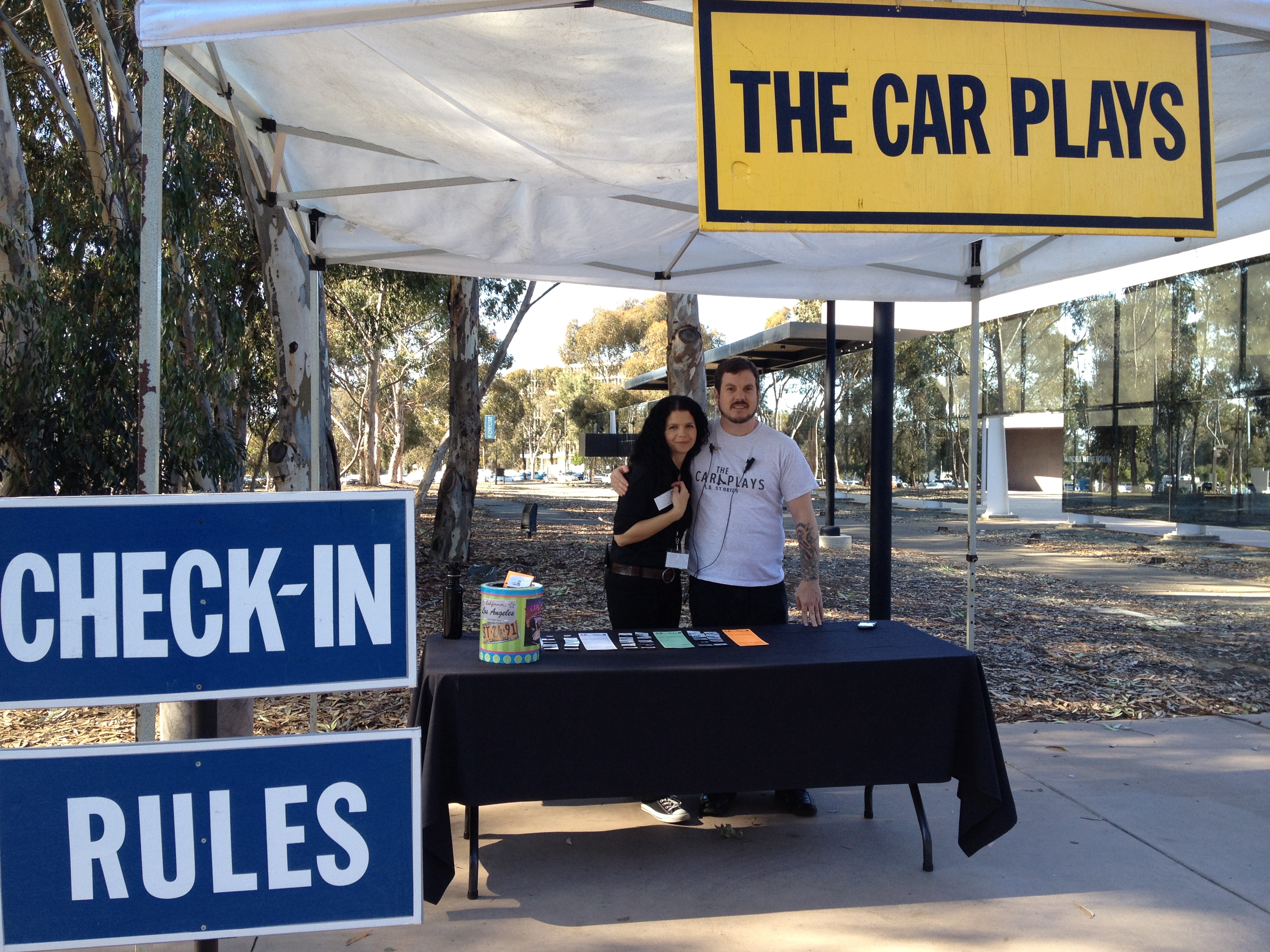
Checking in at The Car Plays we got our rules of the road and met two producers in the process, Kim Glann and Steve Lozier.

That’s the way all the plays were, too. They started out with a surface-level glimpse at the characters and, with every minute that went by, another layer was removed to reveal something even more familiar and, at times, more funny, or more painful than I could have imagined when stepping into the seat of that car.

Magically, it would seem, when the ten minutes were up and I got out of one car to go to another, the feeling I was left with was that I had spent time with friends who had told me something important, personal, and perhaps secret, about their lives. There was a leftover feeling of trust that their stories and secrets were somehow real and that their lives would go on. It’s like when you finish reading a good book and you miss the characters. Even though, intellectually I knew the characters were fictitious, my heart wanted to stick around and find out how things shaped up afterwards. I rooted for Batman and Robin in “The Duo” to win the contest they had entered, and cried in “Before We Go Home” with Rich and Sue because their loss is a loss I know all too well myself. Adam and Mike had me in stitches and squirming like a worm in hot ashes in “The Audience”. Their car, in particular, was one that I got out of wishing it could have been real so we could go have dinner together and talk about The Car Plays.
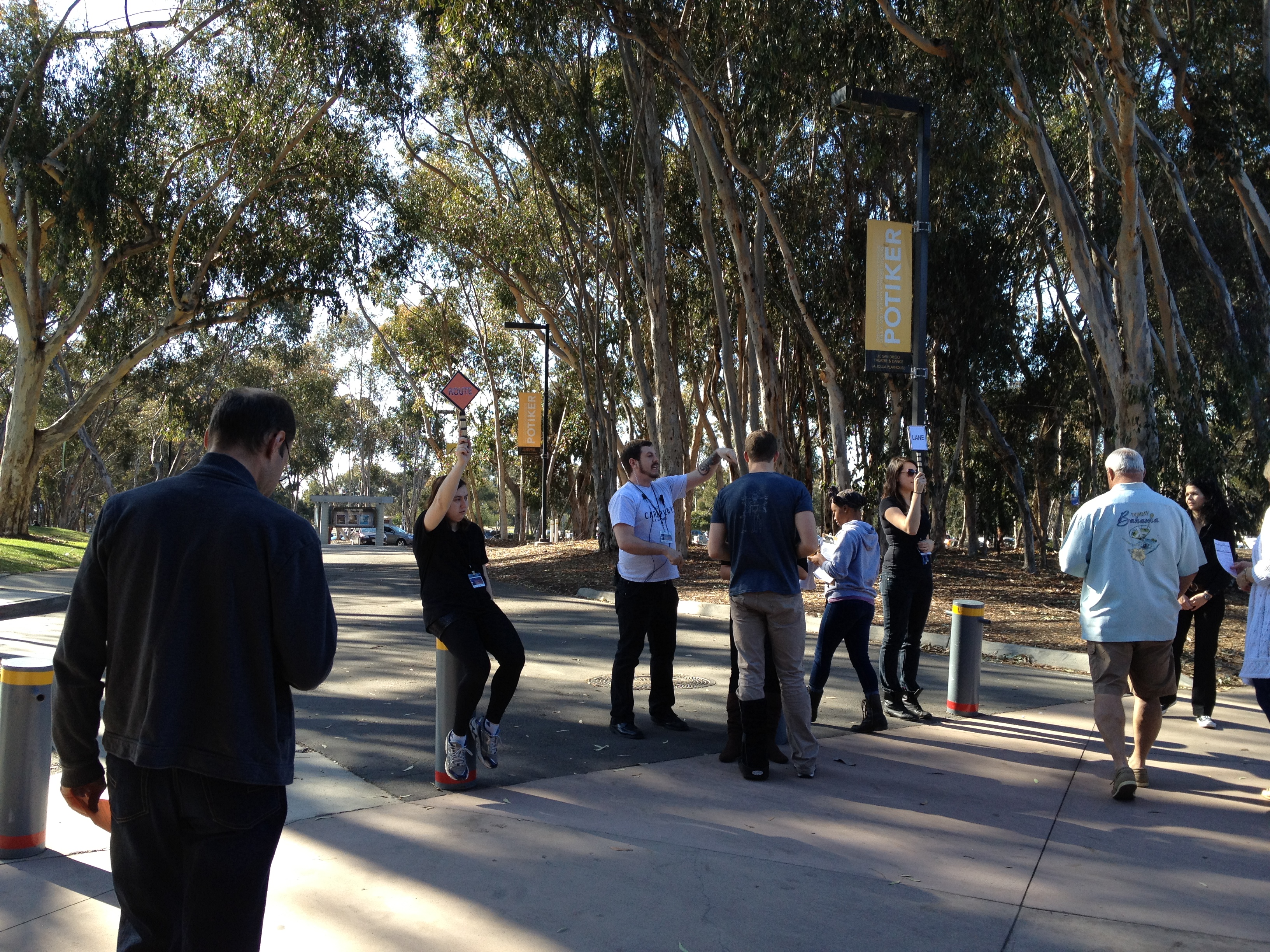
We lined up two-by-two in three lines behind the road sign with our play series name on it.

Finally, another part of what made The Car Plays so personal was that, when the plays were over and we got out of our final car, we not only clapped for the actors, producers, and director, but we had the opportunity to actually interact with them. I wanted to go hug David Youse and Ron Morehouse for their parts in “The Audience”. I did go up to them, but at the last minute I got nervous and just told them how much they had made me laugh. I was thankful to get to tell Peter James Smith from “The Duo” how much I enjoyed seeing him play Batman. And it was a thrill to talk with Michael Shutt from “Before We Go Home” and learn about his experience of having to cry five times an hour. (You would never know, either, that he has to do that over and over again. His performance was as fresh when I saw it as if his character was experiencing that loss for the first time.)
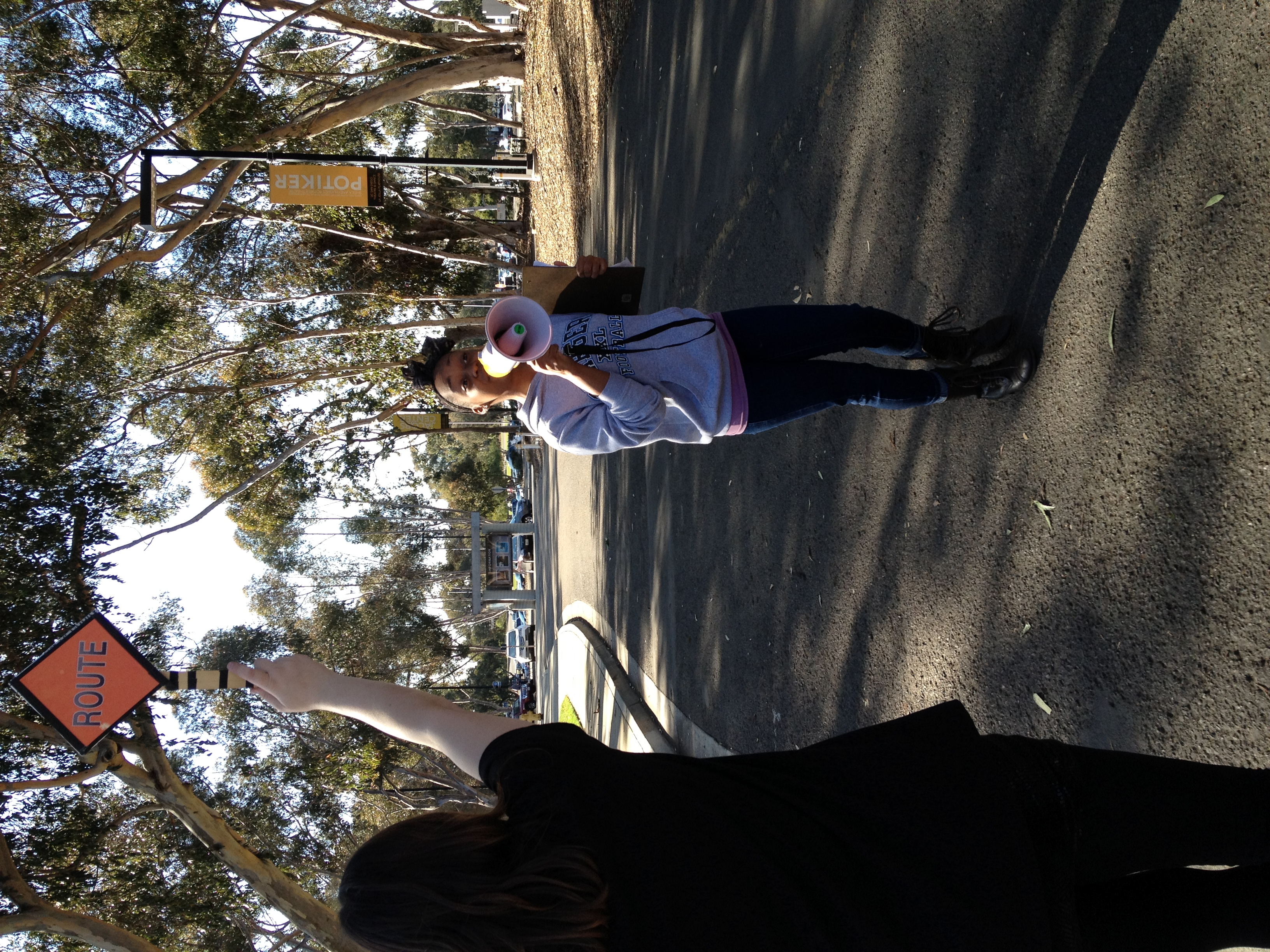
Our Car Plays tour guide, Cashae Monya, gave us an unforgettable and entertaining introduction as she led us to the cars.

I hope you do get to experience The Car Plays. I hope I get to see The Car Plays again, too, quite frankly. It was playing as part of the Without Walls program at the La Jolla Playhouse in La Jolla, California, and it is still open this coming weekend. Once it is done there, though, I’m not sure where Moving Arts, the production company who brought it to La Jolla, will drive it to next. I’m rooting for Phoenix.

The playbill and our tickets for Car Plays. (That little car is an old Avon aftershave bottle in the shape of a VW Beetle. It was my grandfather's and still has aftershave in it.)
Go Red! for Women hosts a red-hot night of cocktails and shoe fashion in Tempe

The Halle Heart Children’s Museum in Tempe, Arizona was a sea of red dresses and sparkly shoes last Wednesday night as a group of ladies (and a few gentlemen, not in red dresses and sparkly shoes) came together for a cocktail party fundraiser for the Go Red! for Women program affiliated with the American Heart Association.

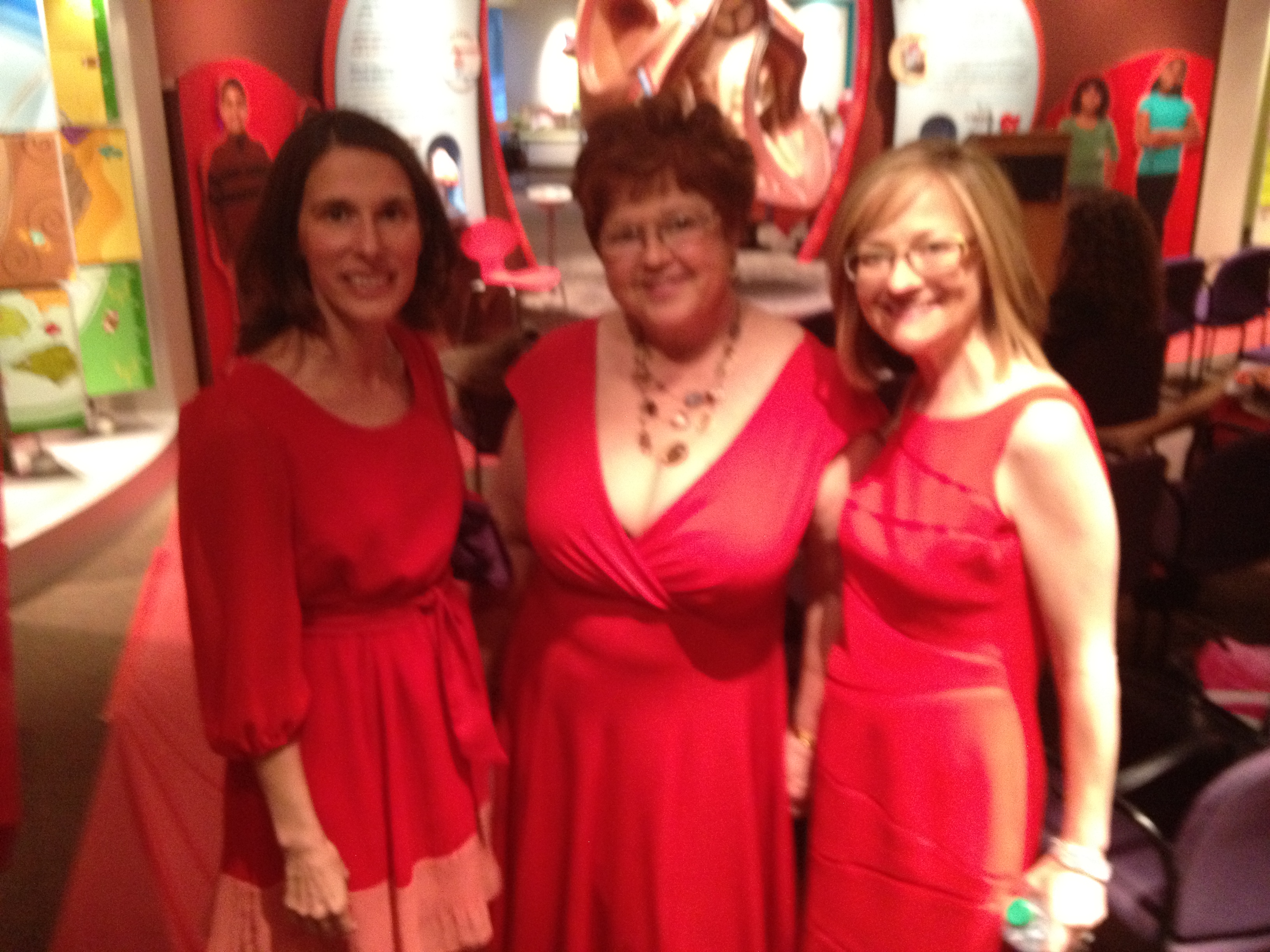
Margo, Carol, and I at the American Heart Association Red Dress Cocktail Event.

We all knew going there that heart disease is a serious issue. Who doesn’t know someone who has either had a heart attack or stroke? We also knew that the American Heart Association takes on the hard work of educating the public about heart disease and helps to fund research into the causes of heart-related diseases. In fact, as my friends and I were on our way to the event by way of pre-event manicures, a woman who looked to be in her 60s noticed our red dresses and told us her life had been saved by the American Heart Association, thanks to a surgery she received when she was a child. She thanked us for participating in the ongoing work of the organization and gave me goosebumps in the process of telling her story.

Maria Benson and the Go Red! Ambassadors somehow managed to balance those serious truths with some light-hearted fun. We were surrounded by the colorful and informative Halle Heart Children’s Museum, where we could push buttons to light up the giant heart at the center of the museum, or listen to how the brain is impacted by the health of the heart. We could even compare the sizes of hearts in other mammals, such as dogs, cats, and elephants! The museum itself is already a colorful, vibrant setting in which to have a party, but Maria and her team turned the Children’s Museum into a rocking fashion show and cocktail party that got the Go Red! message across with great fun and lots of laughs.

Those who went were treated to a fabulous spread of food and wine sponsored by Whole Foods, Urban Tea Loft, Citizen Public House, and Paletas Betty. Several tables were lined with valuable treasures, such as home decorating baskets, gift certificates, theater tickets, and spa baubles, all of which were raffled at the end of the evening to great success. Between the raffle and the donations, they raised almost $4000. E&J’s Designer Shoe Outlet in Scottsdale sponsored a fabulous fashion show, complete with shoes from the Spring lines of Coach, Cole Haan, and Anne Klein, and we each got a coupon for even larger discounts from the shoe outlet.

Margo won two raffles!

No one went home empty-handed, even those of us who didn’t win in the raffle. We each got a goodie bag filled with coupons and travel packs, but my favorite take-home treasure was my very own Go Red! for Women lapel pin. Now I feel official.

My very own Go Red! for Women lapel pin! I love it!

The fundraiser brought in a good amount of cash for the American Heart Association, but perhaps more importantly, it made countless supporters in the process. I know I, for one, will be back next year, sporting my red dress and red dress lapel pin. Congratulations to Maria and the ladies on the Go Red! Ambassadors team for a successful event!

A return to bees

When Hubby and I are not traveling, we call Arizona home. It is delightfully warm and sunny during the winter months and the summer months give us more reasons to travel–to get away from the heat!

After this last trip to Palm Springs, we were welcomed home by a swarm of bees that was perched in a pepper tree in our backyard. For those of you not familiar with this part of the world, we have several varieties of bees that can take up residence, and one of those varieties is the infamous Africanized bee, also lovingly known as the “killer bee”.

Our bee visitors. (Photo by M Dryja.)

The Africanized bee is most known for being incredibly aggressive. Stories abound about people being killed by swarms that felt threatened. Whether the stories are all true or partially exaggerated is unknown. Still, I can’t think of anyone who would come home to a swarm of bees in their tree and not at least consider it a little dangerous.

Hubby and I discussed what we should do. Neither of us wanted to have them killed. It’s not in us to take action against nature unless it threatens us real, undeniable harm. I do not kill spiders in my house, for example. I have killed ants in my kitchen only because I know no other way to lure them permanently outside. Beyond that, I try to make my home inhospitable to creatures that might want to live inside. Outside, we have to figure out a way to live together.

Fortunately, Hubby found the answer to our questions when he did some research online to find a Pest Control Guy. He learned that swarms of bees in vegetation, such as trees, often are there to rest the queen and not to stay permanently. Swarms mean that they are looking for a new home, but treehouses are not usually what they consider suitable real estate. Also, we learned that they can be in the trees sometimes up to a week before leaving, depending on what their scouts find further out. And, when left alone, bee swarms are usually harmless. They’re too busy with the work at hand. Throwing rocks at them, poking them with sticks, and otherwise making their lives difficult are acts of aggression and, if bees attack a person for doing that, that’s not the bees’ fault. Pretending to be a cloud and floating up on a balloon in an attempt to steal honey is also not a good idea, for those out there named Winnie the Pooh.

Truth be told, I was scared of the swarm. I never went out, like my husband, to stare at it from underneath the tree. (He, by the way, decided to name them all “George”. If memory serves, he may wish to change that to “Georgette” since most worker bees are female.)

The closest I came to them was the back patio, which is across the pool from the pepper tree. Still, I was equally fascinated. From my desk at home, I can see the pepper tree. I watched the bees and, although I could not make out the minute details of each bee, I could see the activity of their scouts who ventured from the group to look for resources or the next place to land. I watched the shimmer of their mass as they moved around and around to protect the queen at their center. I imagined what it must be like to be a bee in the midst of all those other bees, to not have my own space to stretch and rest, to have other little legs and wings crawling and fluttering over me, on me, and around me. ACK! Of course, I am not a bee and doubt very much that bees think like that. All I’ve got, though, are my own thoughts and those were mine.

The view of the pepper tree (and Hubby's silhouette) from my desk.

We returned on Sunday to The Georges in our tree. On Monday a windstorm blew through. The bees clung to the tree heroically. They were in a large clump, about the size of a basketball. One wind gust was particularly strong, however, and when I looked up from my writing, the large clump had broken apart into three smaller clumps! It was amazing how it ripped, as if the bees were all one piece of fabric and the wind had cut it in thirds! As the afternoon progressed and the wind did not die down, the bees pressed back together, but formed a longer, sturdier structure along the branch. The wind finally faded by Tuesday and, the next morning they were back in their oblong basketball shape.

The bees as they reformed on the branch from the windstorm. (Photo by M Dryja.)

The bees left us yesterday. Although I am glad the danger is no longer so present, I miss them in a way. They were really fun to watch. Our theory as to why they stayed as long as they did is that the stress of the windstorm on Monday wore everybody out. How honored I was to get to see them do their work together for a couple of days. I also sort of felt like I was in on a special secret as I watched them “packing their bags” yesterday. The outer bees were much busier than before, actively buzzing around, as if to tug the others away. One minute they were there, the next they were gone!

Farewell, dear bees, all named George! May you live long and prosper, do no one harm, nor be done harm to.

La Casita Palm Springs: a home away from home

If you have been following this blog over the last week, you know Hubby and I were in Palm Springs for Modernism Week. While we were there, we stayed at a great little Vacation Rental By Owner (VRBO) called “La Casita“. It truly is a “little house”, and an adorable one at that.

Below are photos with more information about a great place to stay in Palm Springs.

We rarely needed our car. La Casita is within walking distance to all the restaurants and shops we visited.

La Casita is well situated, just two blocks from Palm Canyon Drive, the main road where all the restaurants and shops are. Palm Springs Art Museum is just a quarter of a mile from this house. It is a mile to the Convention Center. Trio restaurant, along with the art galleries and vintage shops in that area are about a mile away. We are big walkers, walking about 5 miles a day, so when we had Modernism Week activities that took us a mile or mile and a half from the downtown corridor, we walked that too. This could not have been a better location for us.

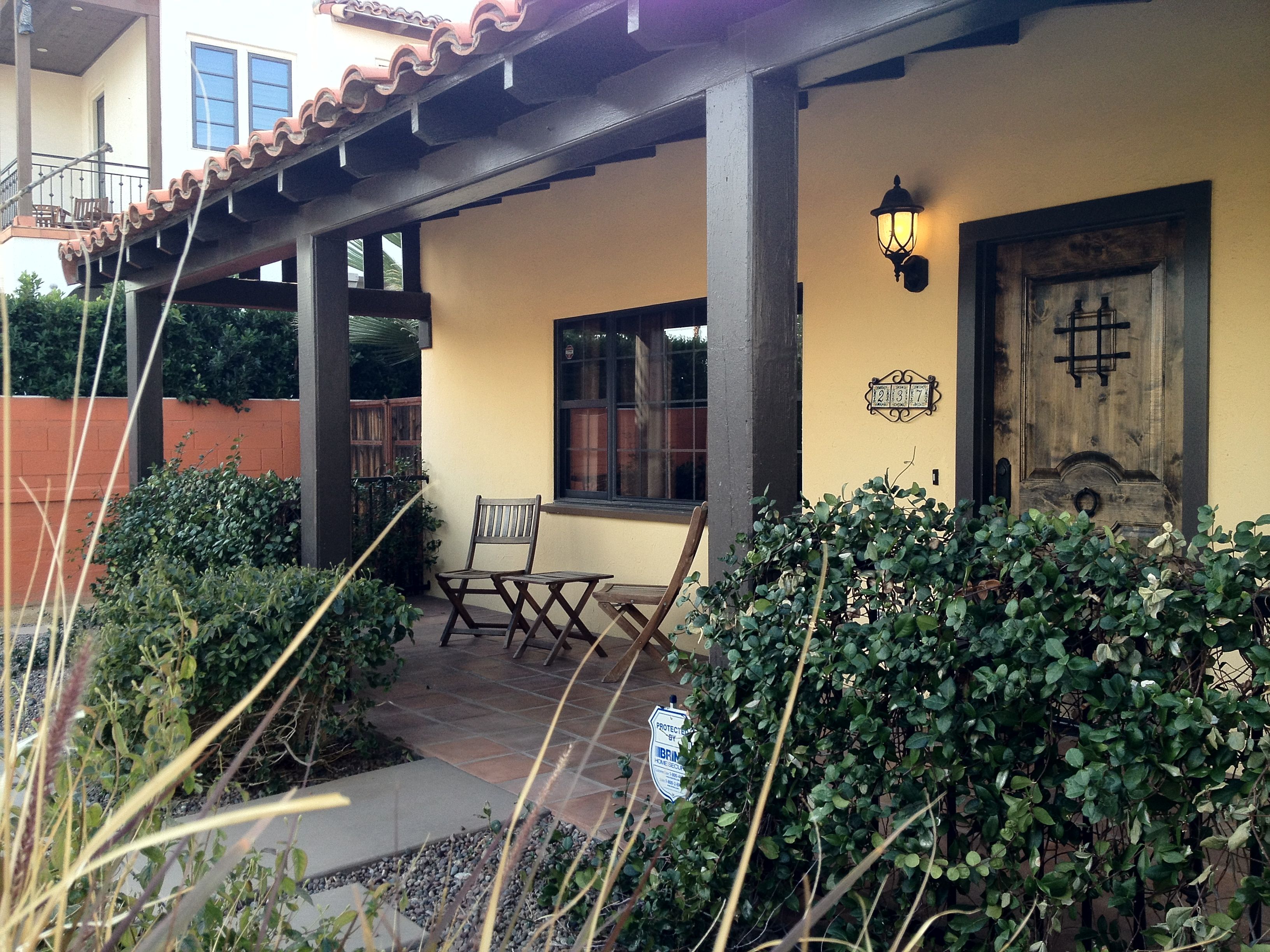
Shaded front porch.
The owner did a great job with the curb appeal.
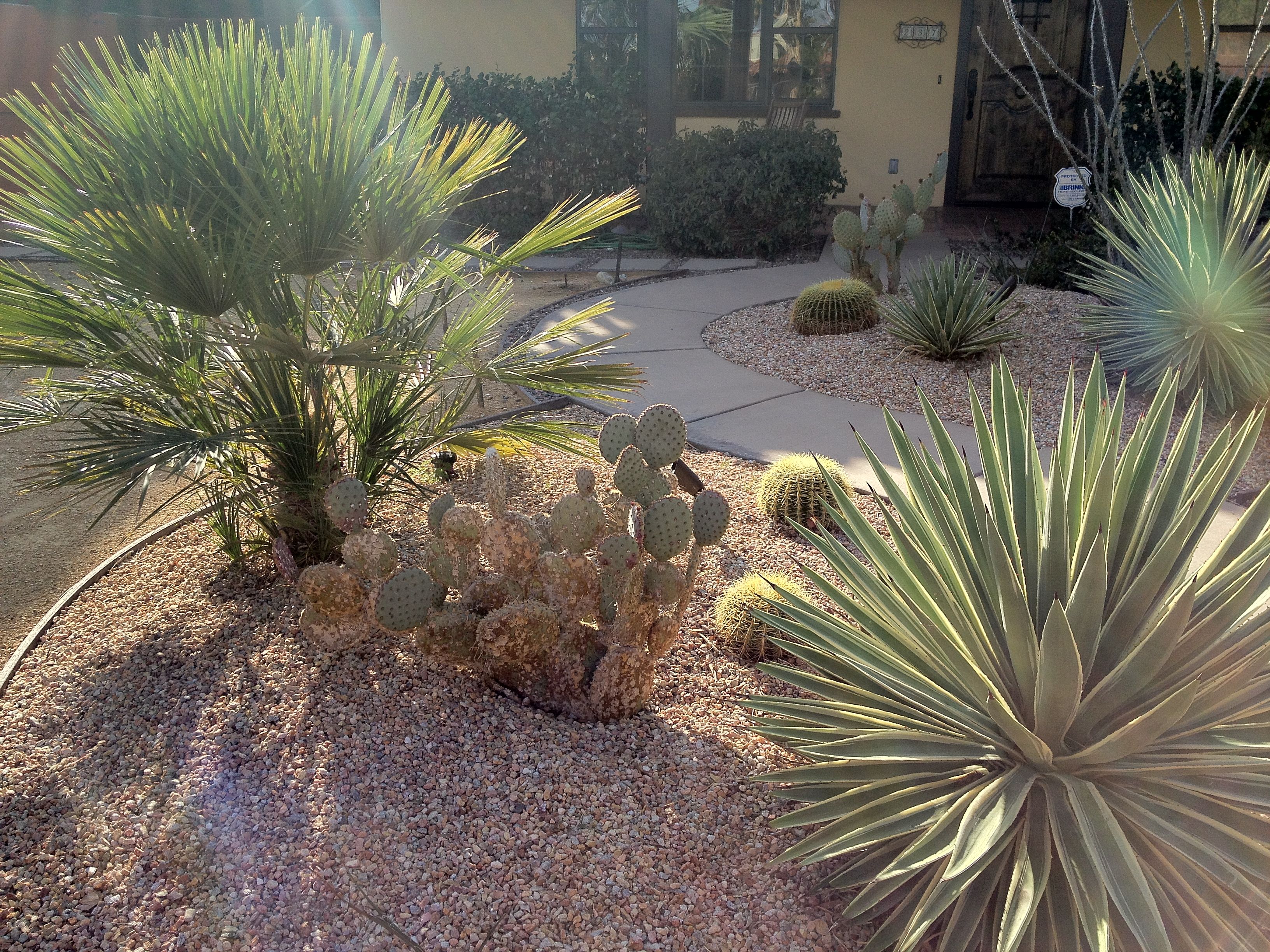
Great landscaping. Love the winding sidewalk leading to the front door.

There are lots of special little touches in La Casita that make it unique, homey and inviting.

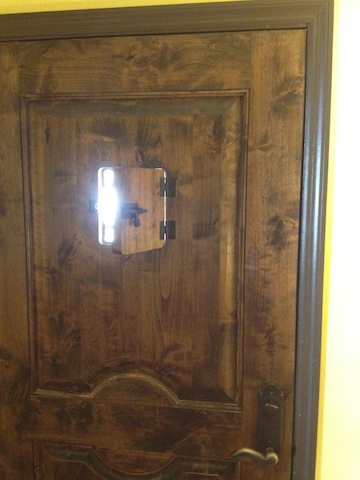
The front door has a sweet speakeasy door for the rumrunners in your group.
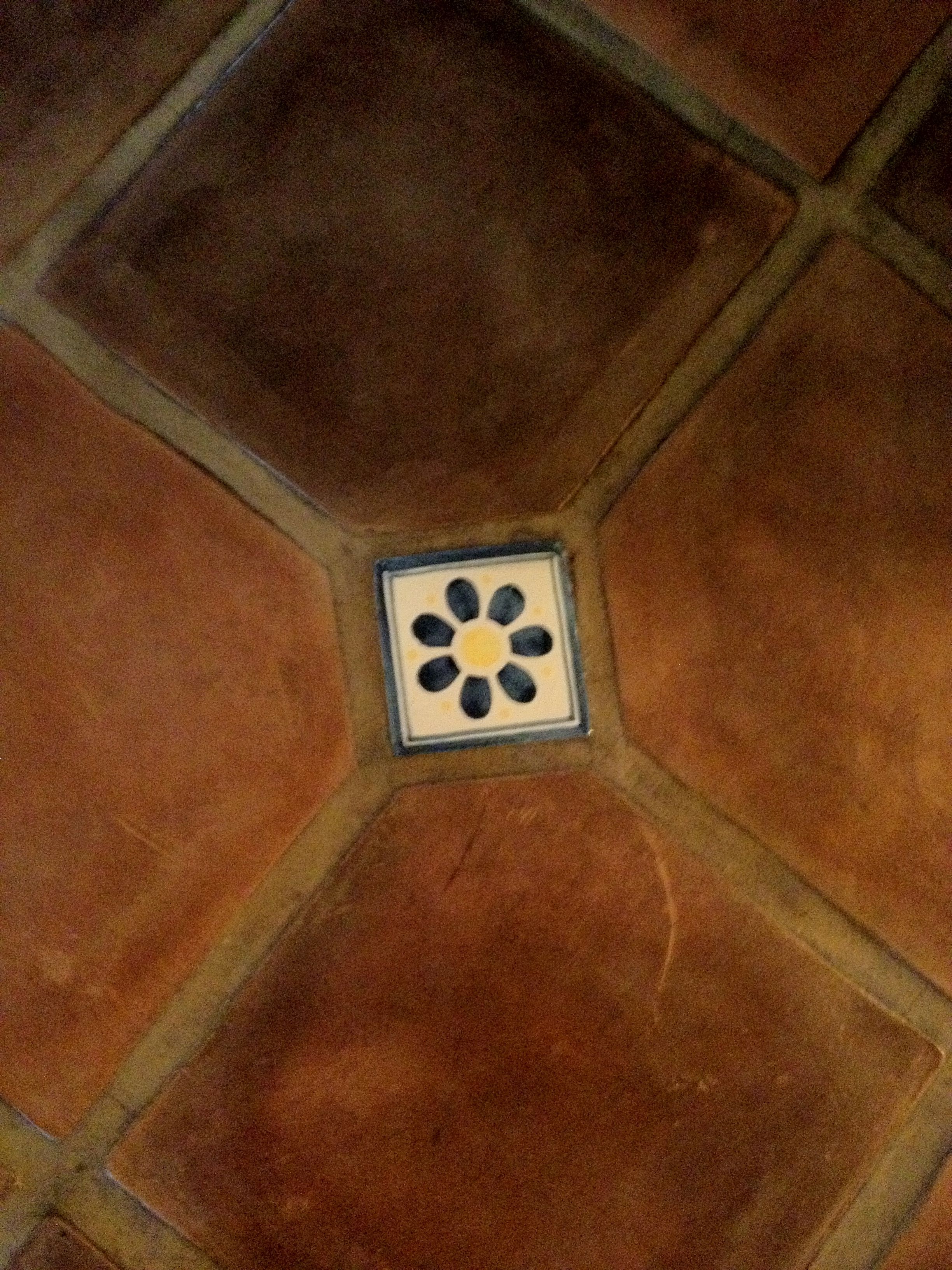
Saltillo tile runs through the entire home with cute, hand-painted Mexican tiles dotting the diamond pattern.
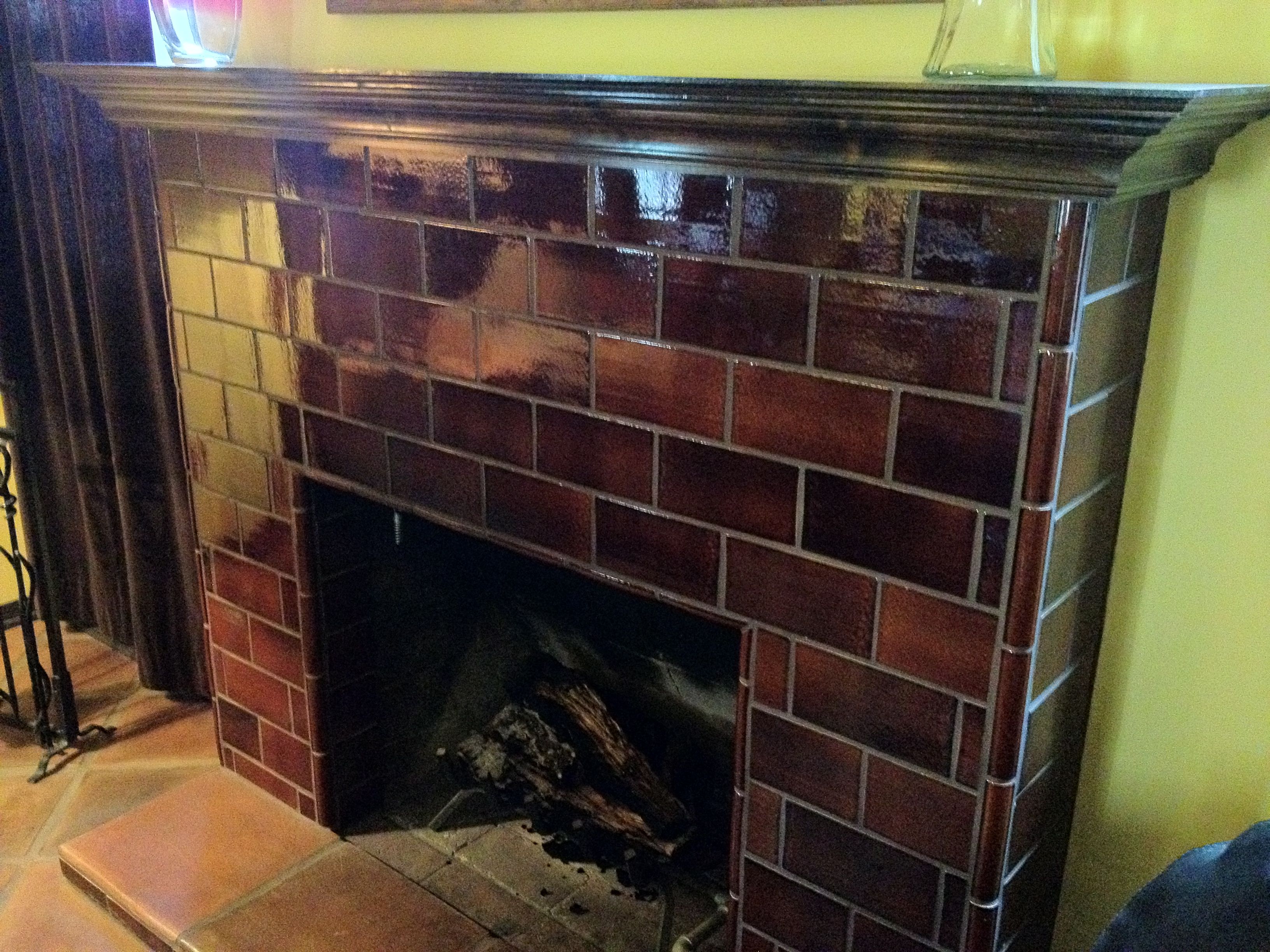
I loved this fireplace and wondered if the tile was original to the home or if they had added it during a renovation. It is a gas fireplace, so on chilly nights, it is easy to find to a warm spot in the living room.
The living room at La Casita. (Photo from the VRBO website.)
It is a small but perfectly outfitted kitchen. It's clean too! (Photo from the VRBO website.)
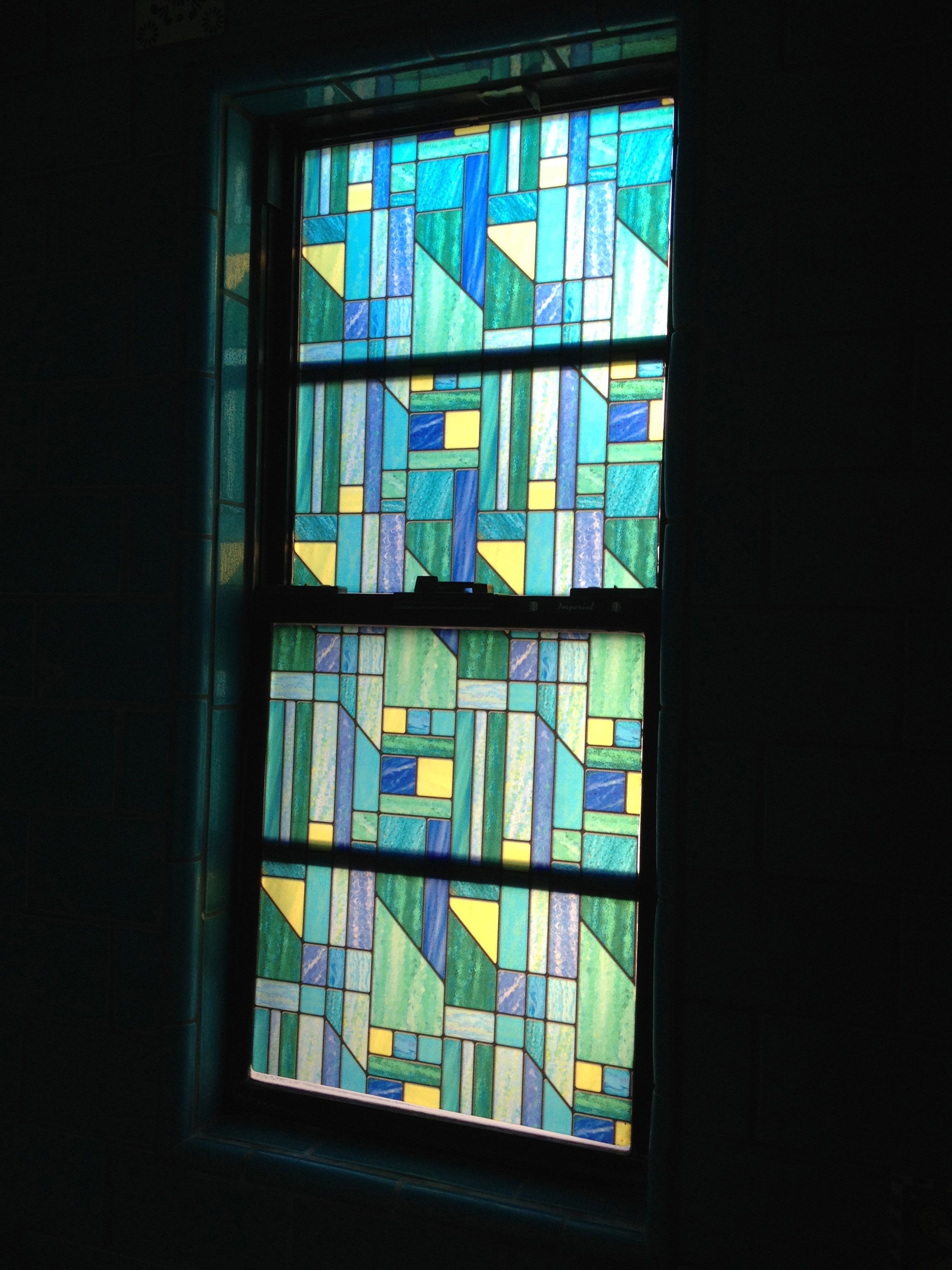
The first little bathroom off the hall has a window that looks like stained glass. Upon closer inspection, I saw that the "stain" was an adhesive film, but it's still unique.
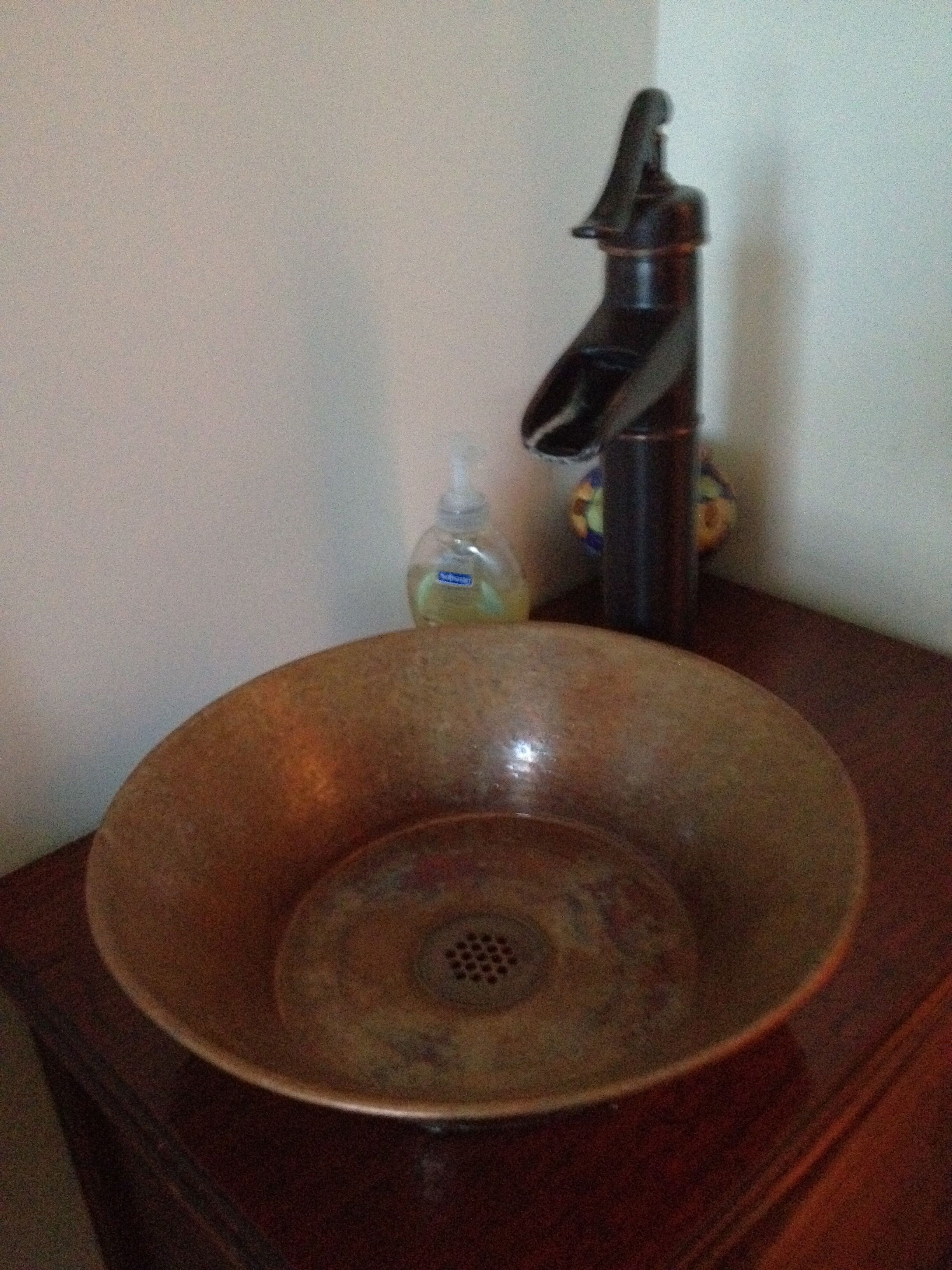
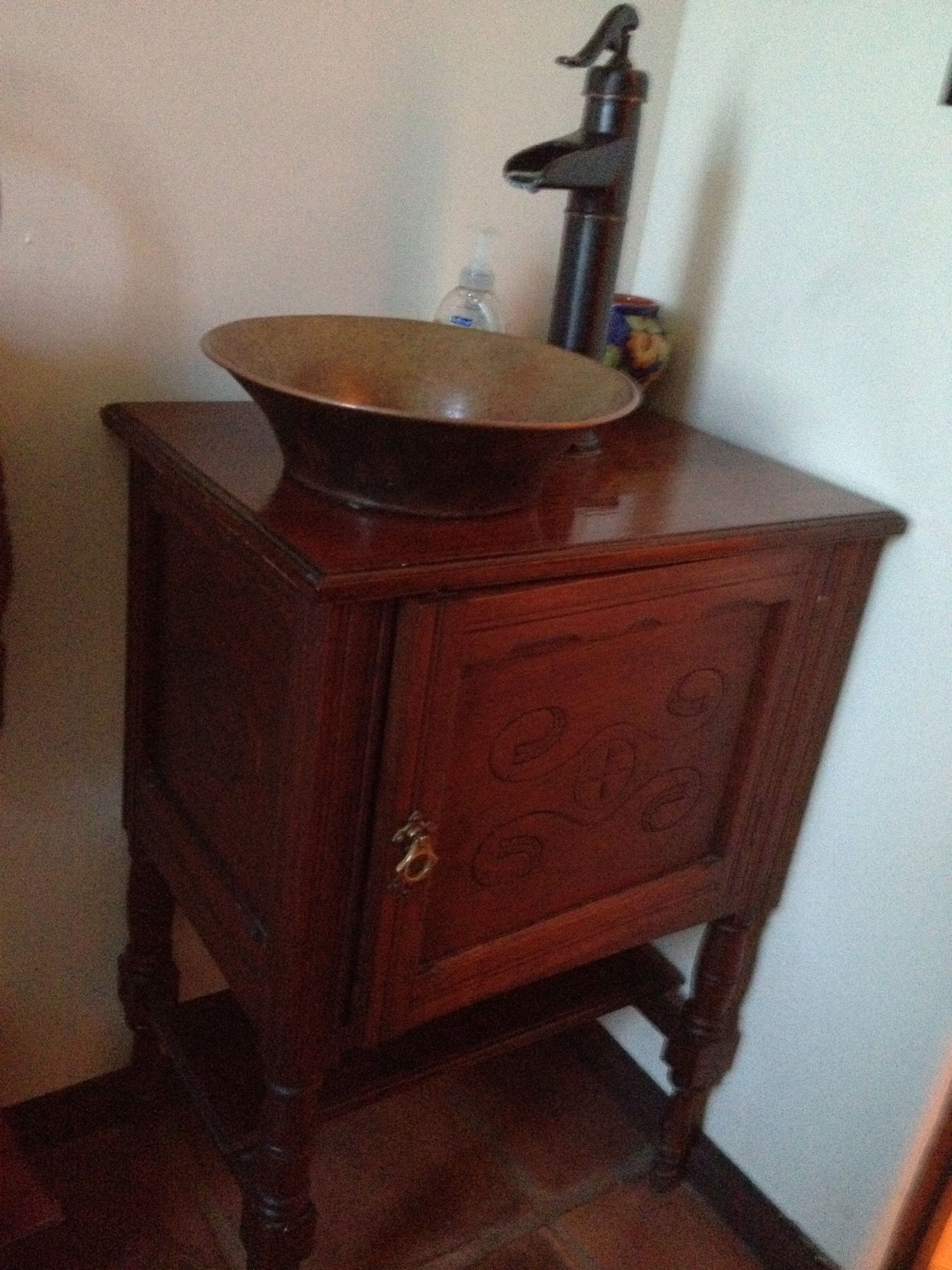
One of my favorite things in La Casita was this little copper sink in the bathroom.
It was set into this antique washstand!
First bathroom off the hallway. (Photo from the VRBO website.)
This is the main bedroom and it leads out to the pool. All the bedrooms have doors leading to the backyard. (Photo from VRBO website.)
This is the second bedroom. It shares a bathroom with the third bedroom. (Photo from the VRBO website.)
This is the second of two bathrooms. It is in between two bedrooms.
This is the third bedroom with twin beds. All bedrooms have a door leading to the backyard and all have TVs. (Photo from VRBO website.)

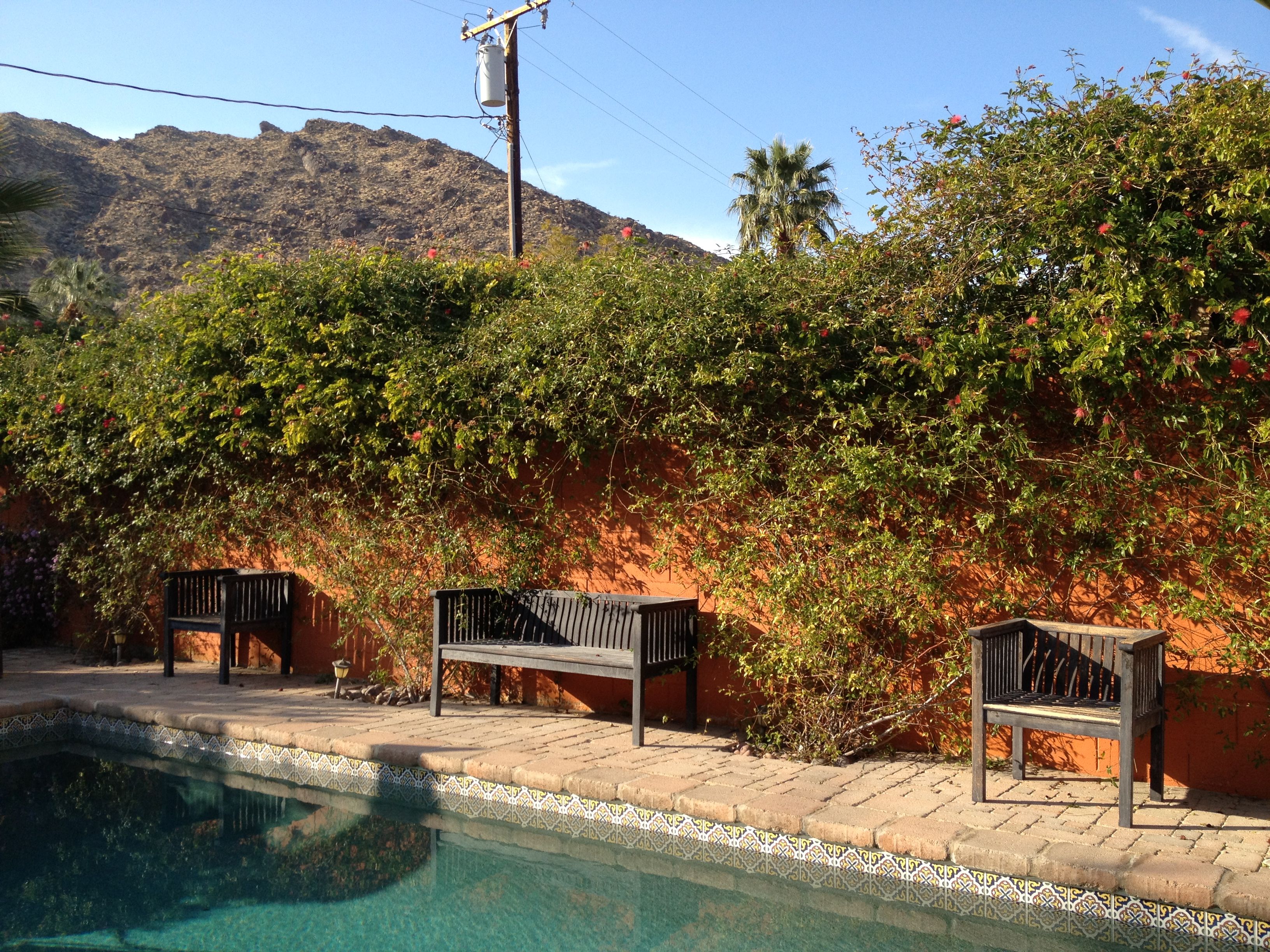
The backyard was quiet but for the occasional hummingbird that buzzed through or the wafting sounds of a jazz band playing somewhere off in the distance at night. It was a relaxing and somewhat spiritual experience to be surrounded by such peace and beauty, backed up by a serene mountain. The lighting in Palm Springs is particularly friendly because the sun softens as it goes behind those mountains and disperses a light that makes the world seem simpler, friendlier.

The serene mountains and the delightful pool. Photo by M Dryja.
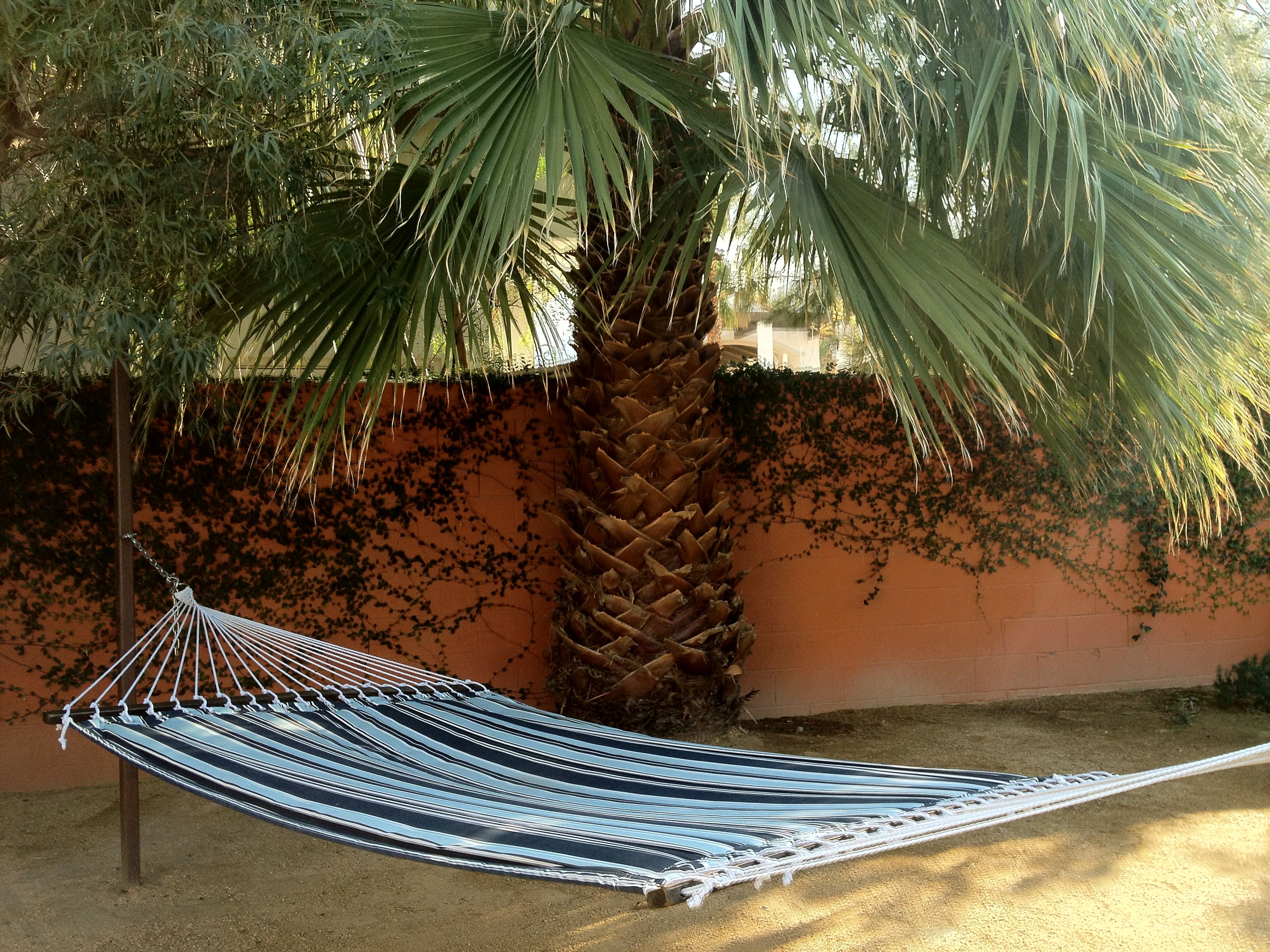
One of two hammocks. This one is closer to the mountain.
The other hammock, closer to the house.
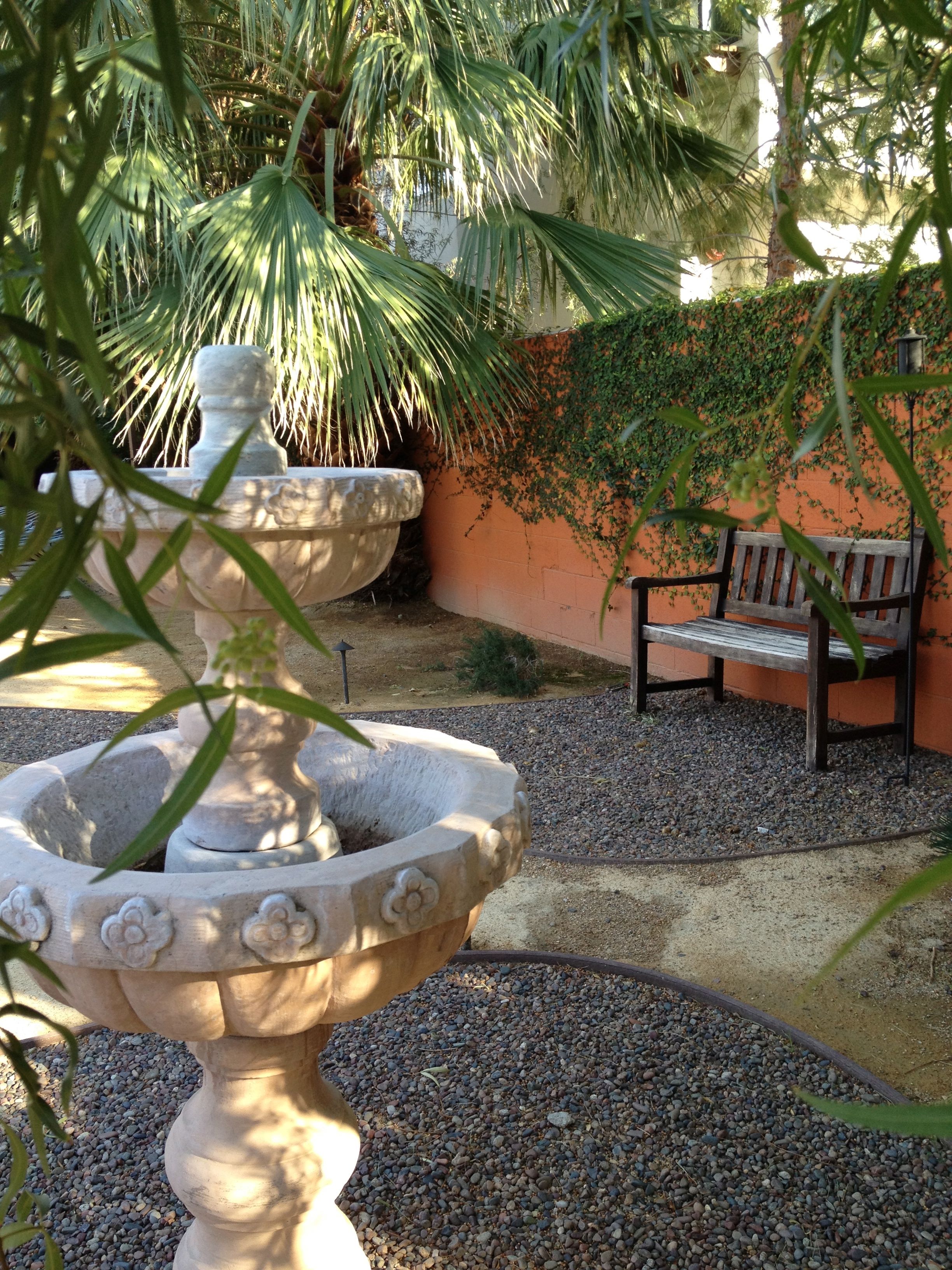
A pretty fountain and a solitary bench.
St. Francis watches over it all.
The hot tub.
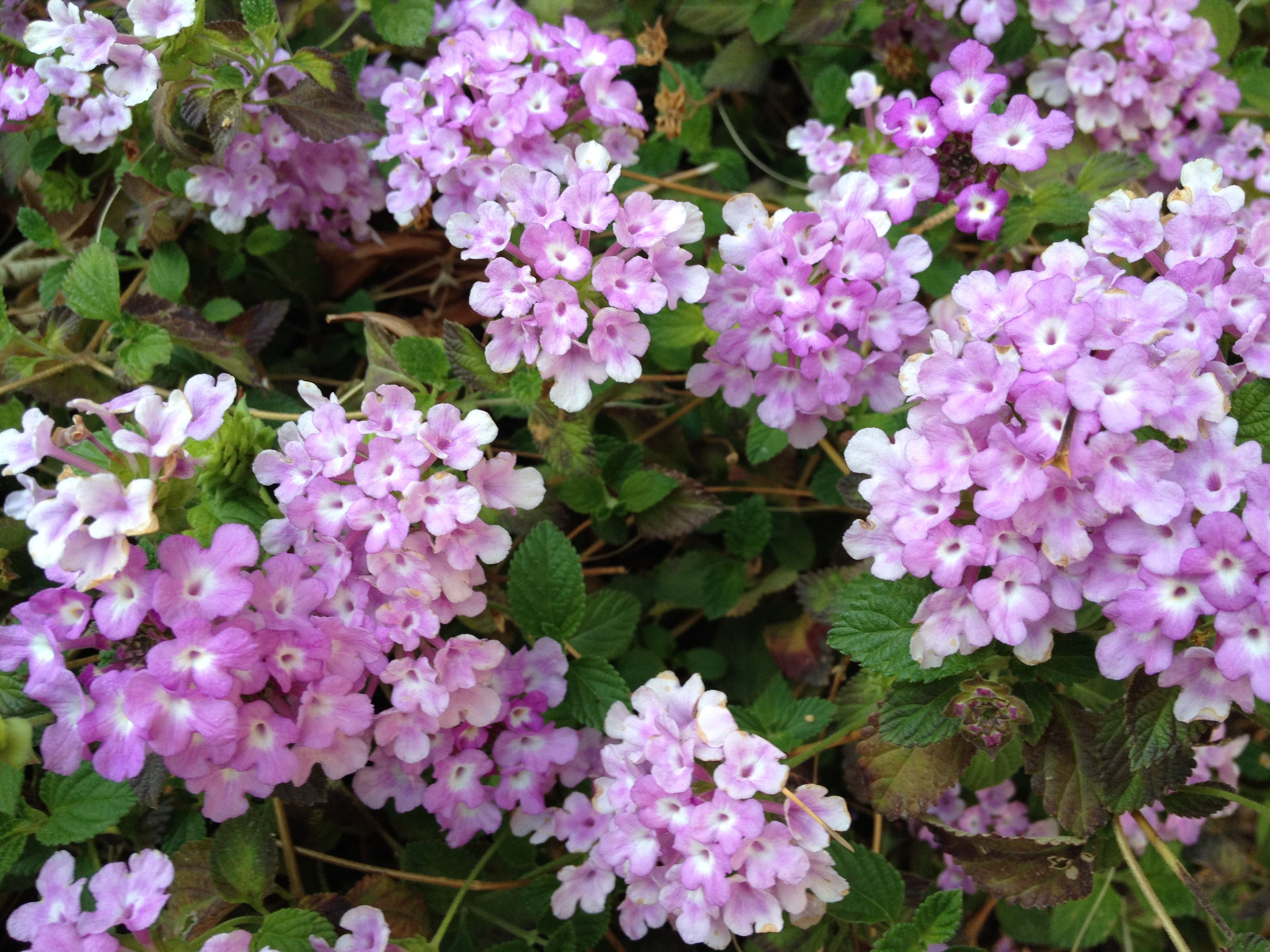
Flowers line the orange brick wall.

By the way, if you read my post about the Frey House II, you can see that house from La Casita’s backyard, if you know where to look. Kind of fun.

Benches line the pool on one side. Chaise lounges line the other side.

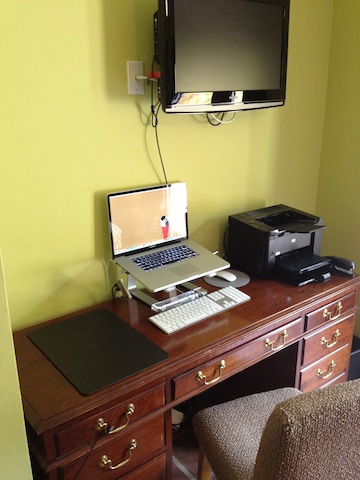
As you can see, it was easy to stay in La Casita, with all sorts of little nooks and crannies in which to relax and unwind. It was also easy to get work done since the house had a large desk on which to work and came with high-speed internet and wifi.

Work was made easier, thanks to the desk and high-speed internet provided. (Photo by M Dryja.)
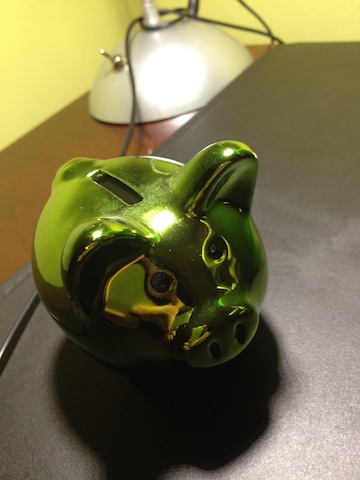
Of course, our time there wasn't all work. You know that already. This little green pig was part of the fun. We found him at one of the shops on Palm Canyon Drive. Hubby named him "Frey". (Photo by M Dryja.)

Our time at La Casita ended far too soon. Even now, several days after returning to our “headquarters” in Arizona, we miss the friendly light of Palm Springs and our little paradise at La Casita.

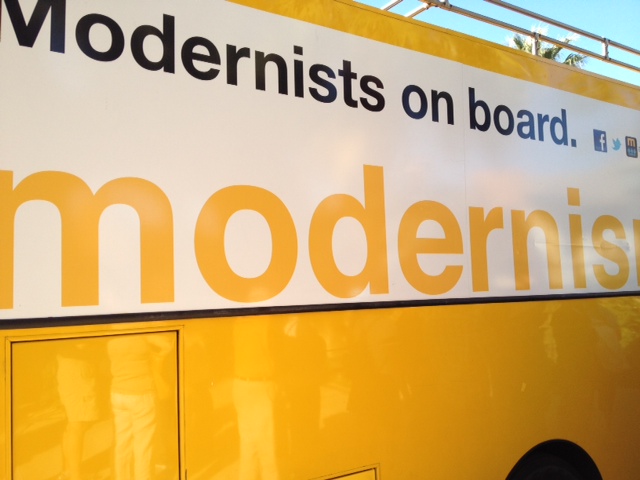
Waiting for the double-decker bus tour to start!

Last day of Modernism Week for me!

How Frank Sinatra helped Palm Springs become a goldmine of Modern Architecture

Before Frank Sinatra ever stepped foot into Palm Springs, the little town in the Coachella Valley had started its metamorphosis from a dusty spot in the desert to the polished star it would eventually become. But it was people like Mr. Sinatra who, with their interest and investment in this paradise, propelled the town into a place to see and be seen.

It is because of that interest that Palm Springs is now an icon of Mid-Century Modern design. Famous architects of that era were drawn here, both for the success they could achieve in designing homes, banks, and shops, and for the stunning weather the area is known for. Thanks to people like Sinatra, and other important but lesser known investors and visionaries, Palm Springs now has some of the best examples of preserved modern architecture to be found in the world.

Below are photos from my recent tour of Frank Sinatra’s Twin Palms estate, which has been lovingly refurbished after having escaped complete ruin, and a tour of the commercial district in Palm Springs, where all these swanky celebrities watched architects like E. Stewart Willaims turn this town into a goldmine of modernism.

The Twin Palms after which Sinatra's first Palm Springs estate was named. The house was designed by famous modernist architect E. Stewart Williams.
The pool, the pergola walkway, and the first house Frank Sinatra owned in Palm Springs. Originally, Sinatra wanted a traditional Georgian mansion, but when E. Stewart Williams presented him with this modern design, Old Blue Eyes chose the contemporary style: a house with a flat roof, lots of glass windows, and horizontal lines.
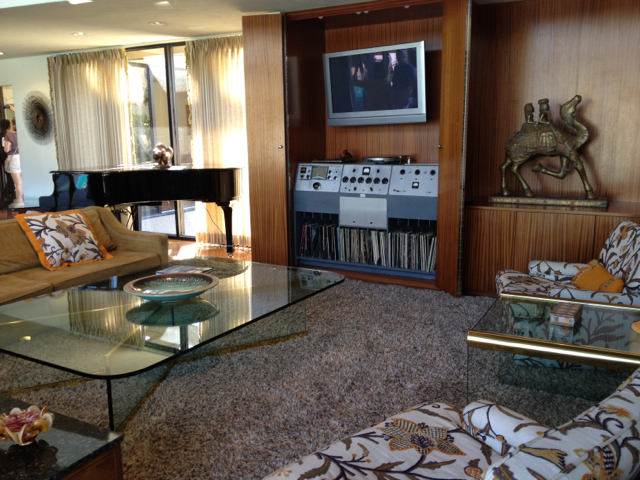
The living room with the original recording equipment still in tact. The house is rented out these days, which is why plasma screen TVs can be found in most of the rooms.
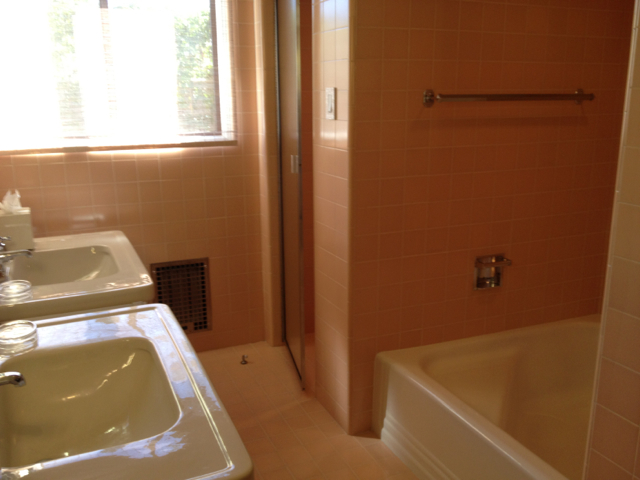
Much of the home has been completely renovated because it was otherwise falling apart in ruins. This bathroom, however, had all the original tile and fixtures from Frank's day, including a crack in one of the sinks said to be from Ava Gardner throwing a champagne bottle during one of the lovers' famous arguments.
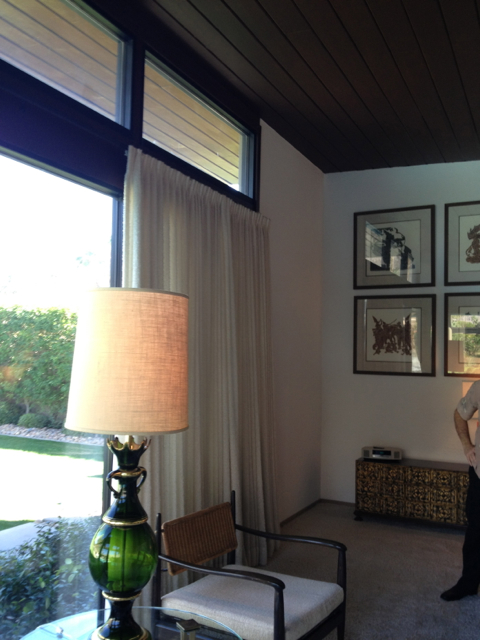
Wood-clad ceilings, clerestory windows, and large floor-to-ceiling windows are some of my personal favorite features of this house and its contemporary style.
Also a favorite design element used in this house: the stacked ledger-stone, found on the fireplace in the master bedroom and on chimney outside.
Love those crooked lines of stacked ledger stone.

Architects like E. Stewart Williams designed a lot of the homes in the area, but the commercial district–a short, few-block span bordered by Indian Canyon Drive and Palm Canyon Drive–is packed with exquisite examples of modern architecture designed by Williams and other famous names of that era. Nearly every building has the presence of a beauty queen.

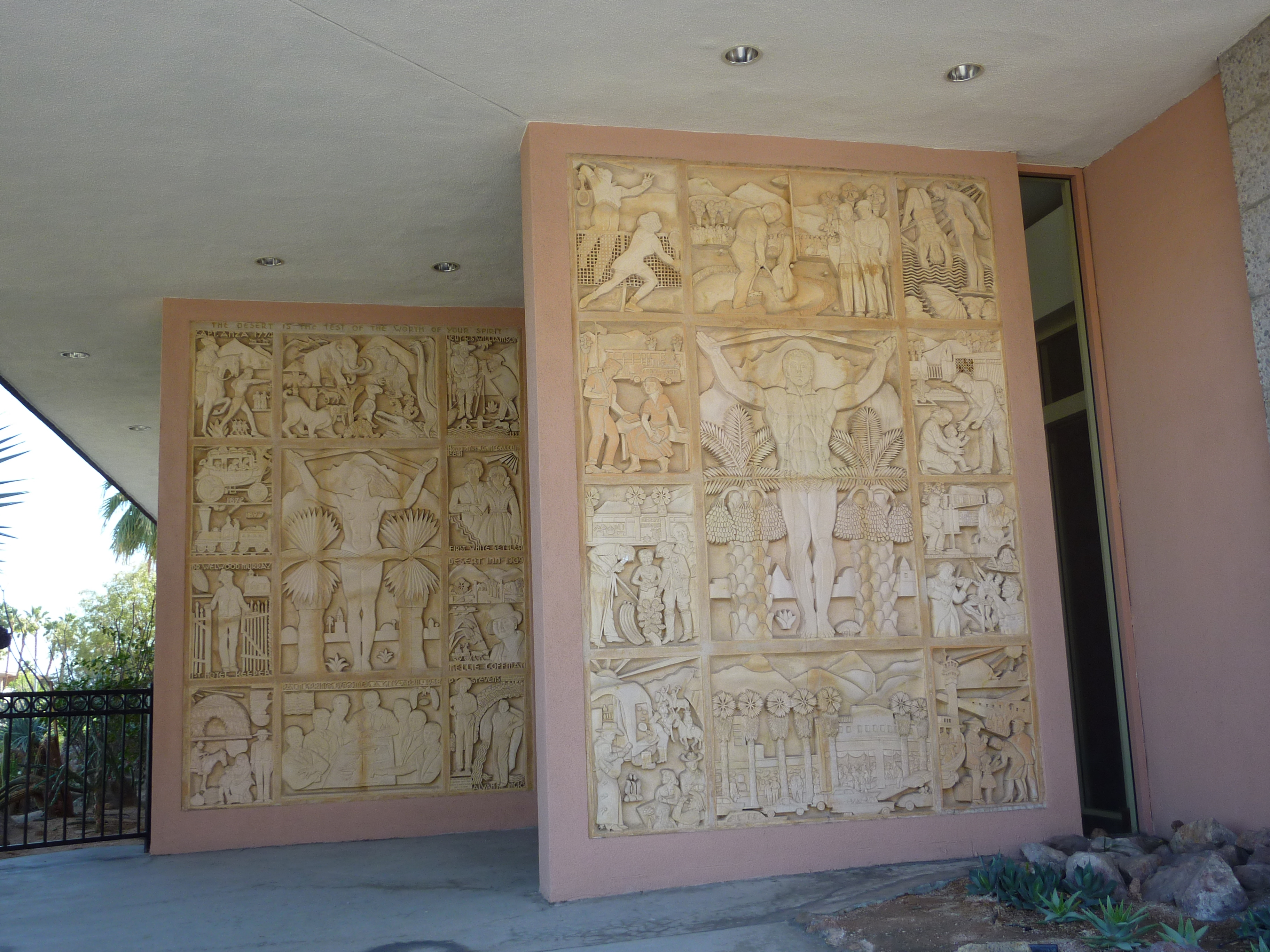
Union Bank has beautiful art deco tiles which tell the story of Palm Springs' history.
One of the easier modern icons to spot, thanks to its location on a triangular corner and the blue tiles along the front of it, was designed by Rudy Baumfeld of Gruen & Associates in 1959. Today it is a functioning Bank of America branch.
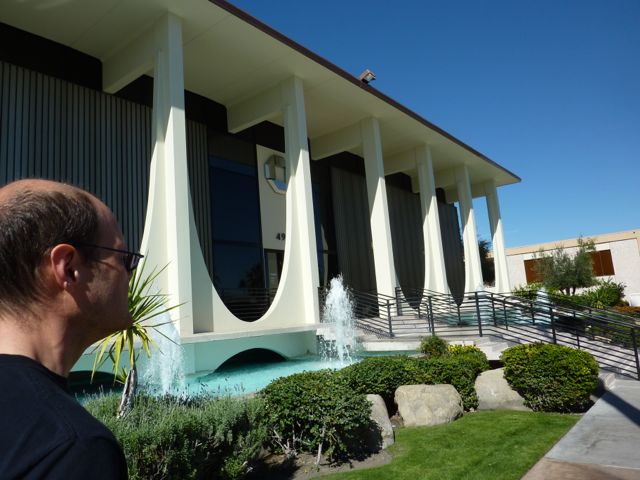
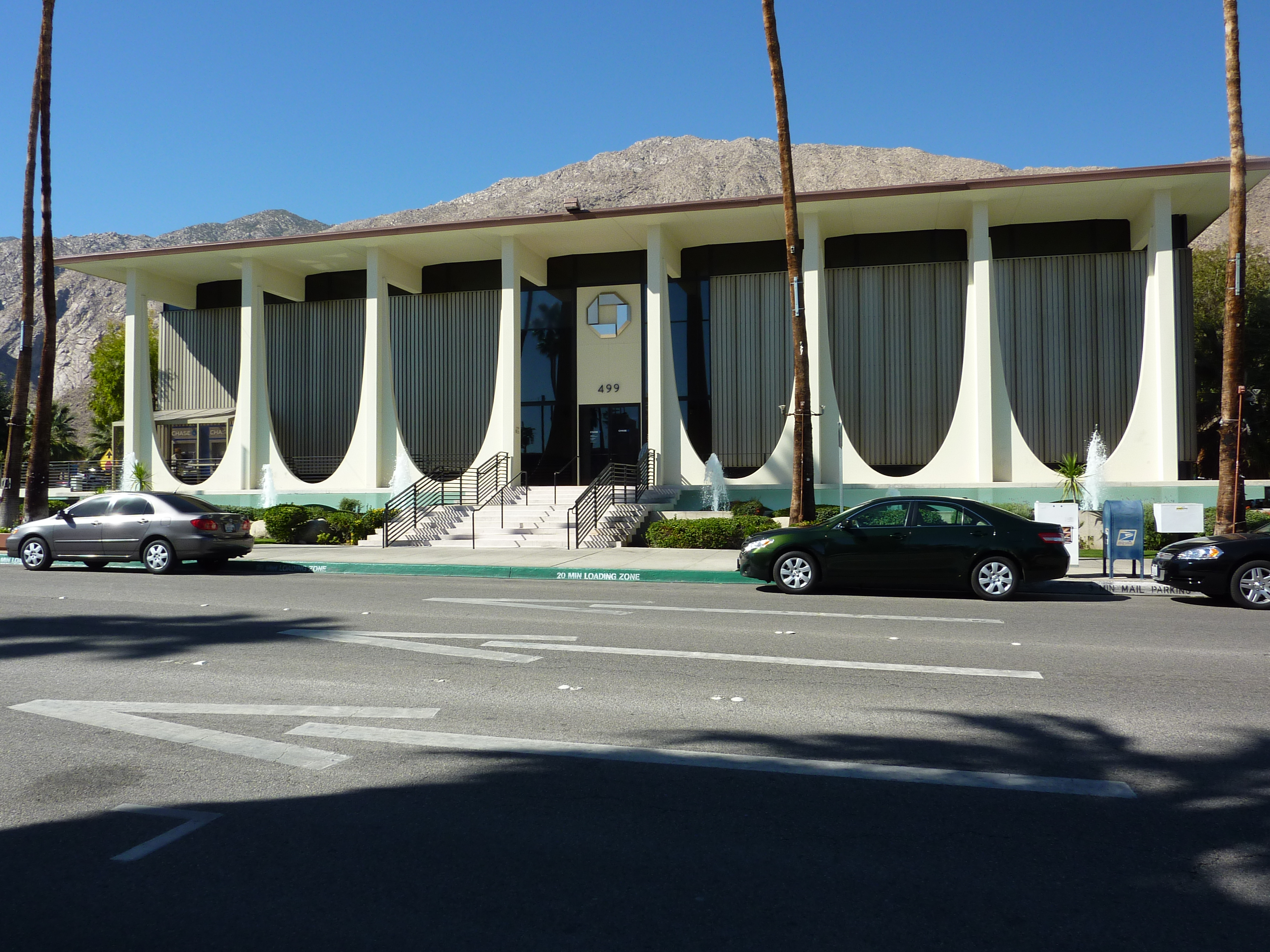
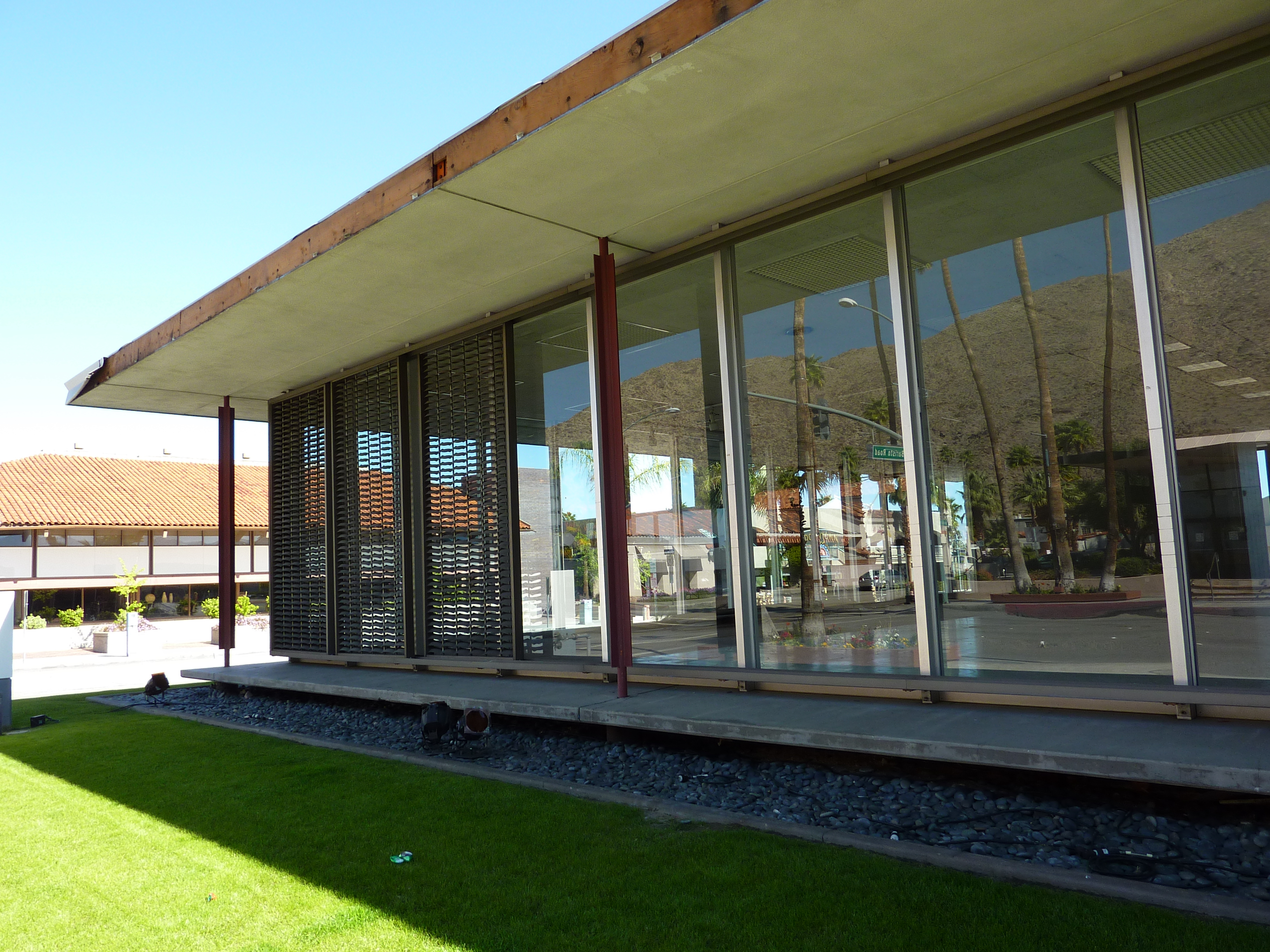
This is my favorite building in Palm Springs. It was designed by the same man who designed Sinatra's house, E. Stewart Williams. It is now a Chase bank.
Here you can see it from across the street. Notice how the mountain behind the building seems to sit on top like the pediment of an ancient Greek temple.
Another building designed by E. Stewart Williams, the Santa Fe Federal Savings and Loan was completed in 1960. This building is in the process of being restored to become the Palm Springs Art Museum’s Edwards Harris Center for Architecture and Design.

There are lots of other buildings along the route that have a wonderful connection to the modernist architects from the middle of last century. Palm Springs Art Museum and the Palm Springs Preservation Foundation have done a wonderful job of encouraging preservation of these buildings and homes. On the tours we have participated in, the names of the architects are spoken with deserved respect. On the sidewalks outside of the soon-to-be Palm Springs Art Museum’s Edwards Harris Center for Architecture and Design those same names so well-known and beloved in this beautiful city are preserved on a Walk of Fame.

Donald Wexler, known perhaps best for the Alexander Steel Houses built in the early 60s around Palm Springs, he is a rock star architect in these parts and still lives in the area.
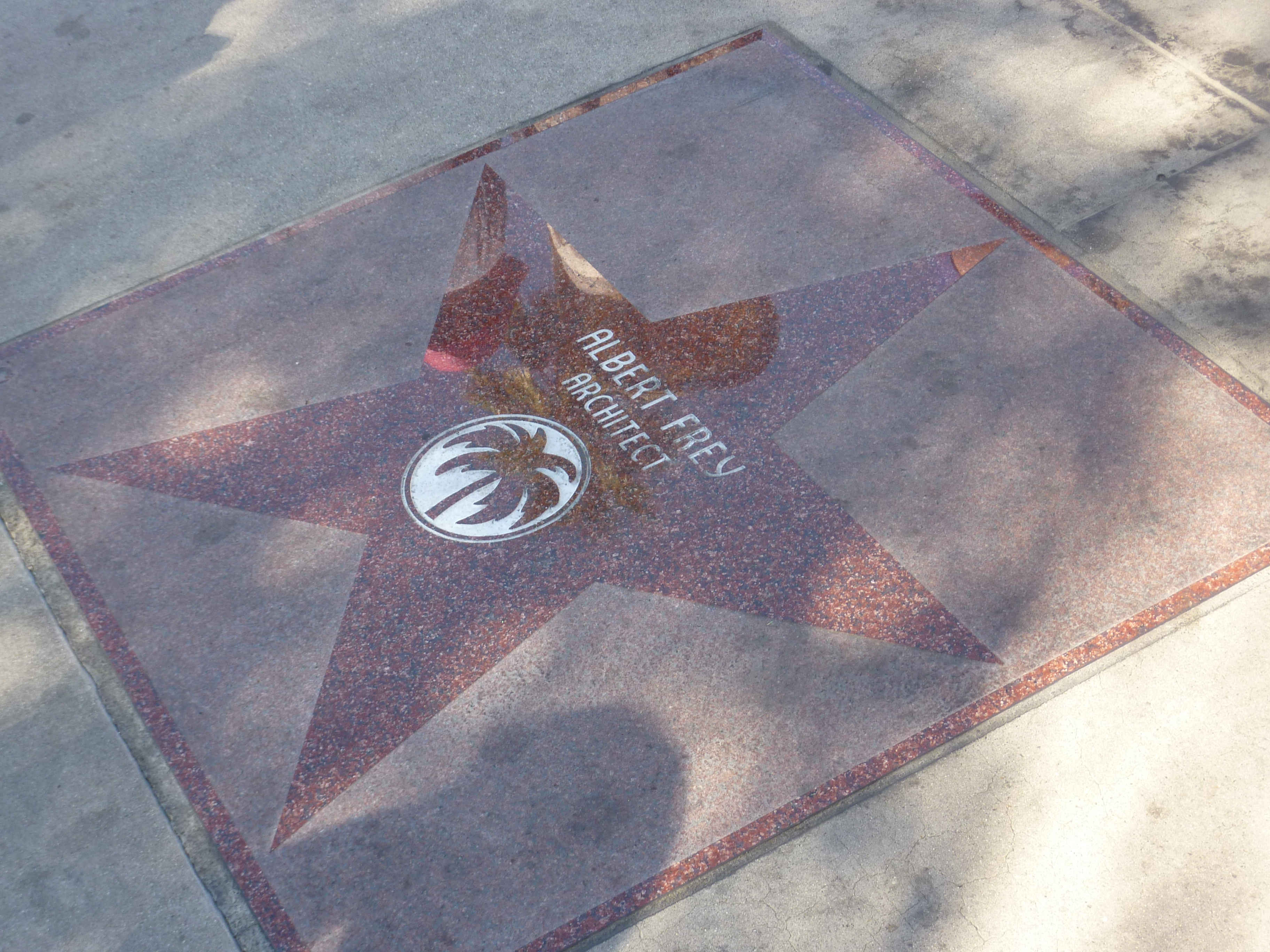
If you've been following my posts this week, you will recognize this man's name: Albert Frey. He has several structures in the area that are still in use, including the Palm Springs Aerial Tramway, the Tramway Gas Station (now the Palm Springs Visitor Center), and, of course, several homes, including his own. Outside the bounds of Palm Springs, Frey might best be known for designing the Museum of Modern Art in New York.
William Krisel designed some 30,000 homes in Southern California and left when the industry became "too uptight". He was interviewed by Dwell Magazine in June 2009.
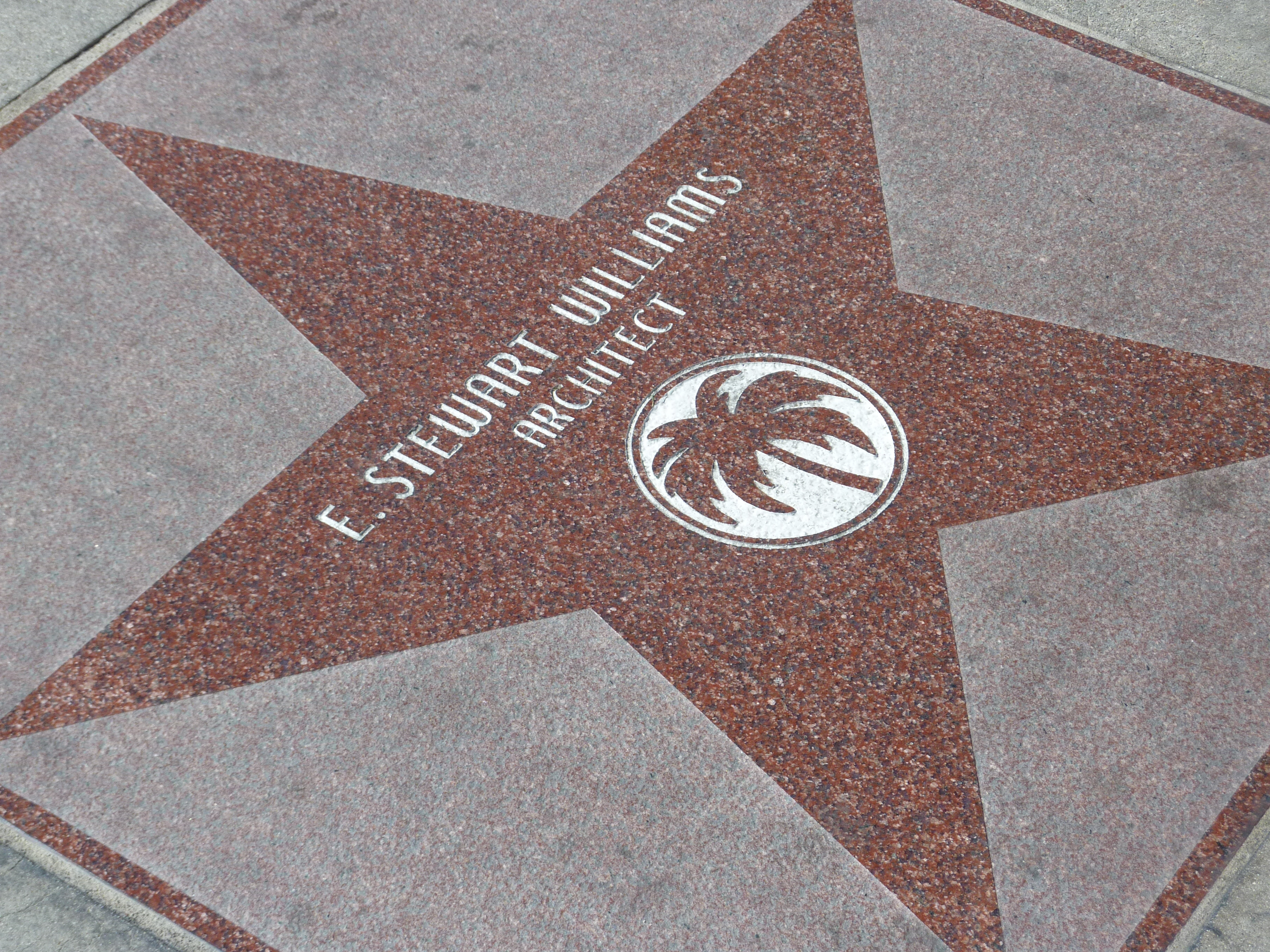
And, of course no Palm Springs Architect Walk of Fame would be complete without E. Stewart Williams. He contributed much to the style for which Palm Springs is so well known.

For more examples of Modern Architecture found throughout Palm Springs, take a look at this article which provides information about a lot of the greatest of the Old Dames and their architects.

Other resources about Modern Architecture can be found below:

Tomorrow is the last day of Modernism Week for me. It is my understanding that the Double-Decker Bus Tour I will be taking is the perfect way to wrap up such a fantastic week of travel back to the mid-century.

Embraced by the desert at Frey House II in Palm Springs

You are here.

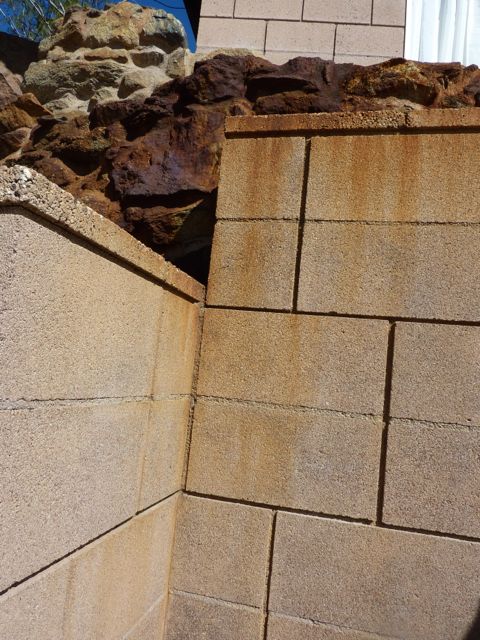
Frey House II leans into the San Jacinto Mountains on a pedestal of earth-colored brick, like a ship which has run aground. The home’s architect and inhabitant, Albert Frey, had been exact about the color of the brick, wanting it to blend perfectly into the side of the mountain. Even the iron from the surrounding rocks has bled into and discolored the brick, just as it would normally do the soil around it. That was something Frey wanted to happen, something he perhaps delighted in.

The home was built in 1963 as a place for Mr. Frey to live. The original square footage was no more than 800 square feet. We learned he later added on to the home, to make room for his girlfriend, but our focus on this day was the original footprint.

A porte-cochere or portico housed Frey's small car.

One oddity stood out at the bottom of the steps leading up to this very angular house: a chubby, rotund cowbell. It makes more sense, however, knowing that Frey was born and raised in Switzerland and he placed the bell there as a nod to that heritage. In some respects, this house was the ideal Swiss chalet in his adopted “California Alps”.

Earth-colored brick, a glass block (is one missing there in that hole in the wall?), and a cowbell led us up the steps to the home. I like the shadows of the bricks jutting in and out on that corner.
Discoloration of the earth-colored brick by the iron-rich rocks.

Seeing those bricks colored and discolored like the earth and noticing how the roof of the place seems to mimic the sky on one side and the mountain on the other, for the first time I can grasp what is meant by modern architects like Frey who worked to build structures which imitated and “disappeared” into their environments. This house, perched into the walls of this mountain, was embraced by the desert around it. It blended in and molded to the nature surrounding it. Even the pool, so sparkly and blue, seemed to imitate the expansive sky above.

Looking out over the pool.
I liked the little stones embedded into the concrete around the pool. Are those river rocks? Or stones found on the mountain?

Outside, the direct sun pressed hot and heavy with temperatures flirting past 80-degrees Fahrenheit. Inside, the difference in temperature was immediately felt. It had all been planned that way by Mr. Frey to be a home that was cool in the summer and warm in the winter, without the need for piped in heat and air.

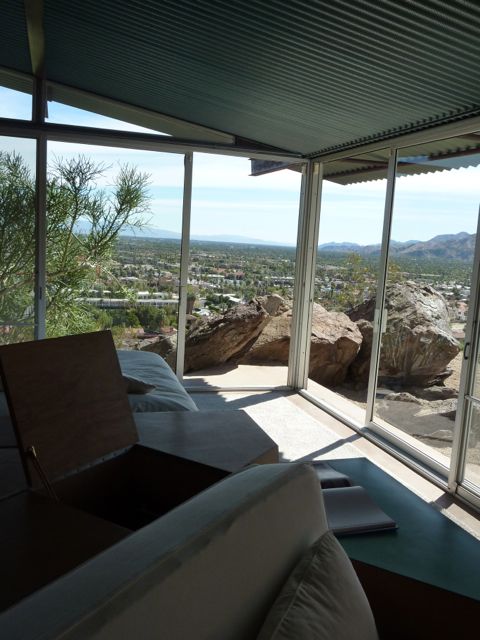
Our guide told us how Frey had spent an entire year studying the position of the sun as it hit the ground so he would know how to best place and situate the roof and its overhangs. In the summer months, the sun barely brushes the top step outside the home–never venturing further into the home with its steamy tendrils, thanks to the ribbed aluminium eave hanging over the steps by the pool. Today the winter sun (hot as it was outside) humbly crept along the floor and warmed the carpet inside. With the windows wide open, cool breezes drifted through and made the room quite pleasant and relaxing.

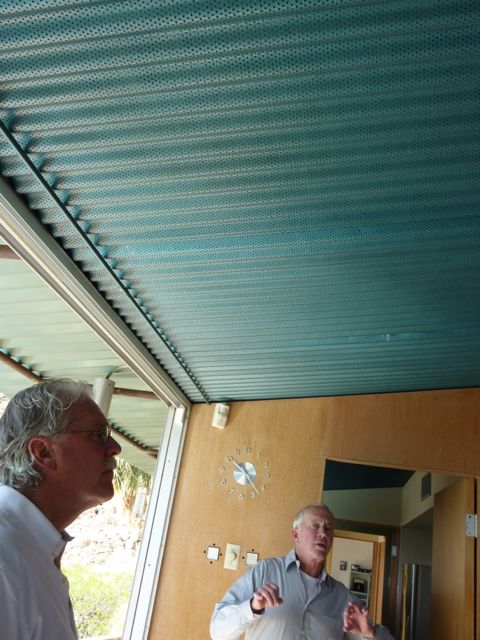
Perforated corrugated aluminum sheets were used on the roof/ceiling of the home. Reminds me of the sky and the cool blue of the pool.
Winter sun comes barely comes in. The rest of the house is shaded and cool.

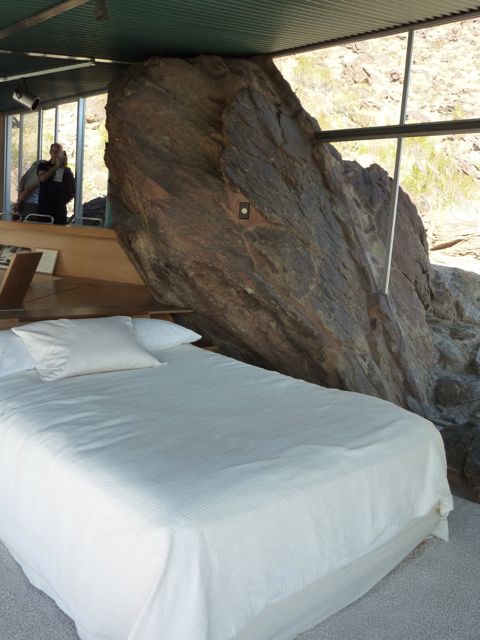
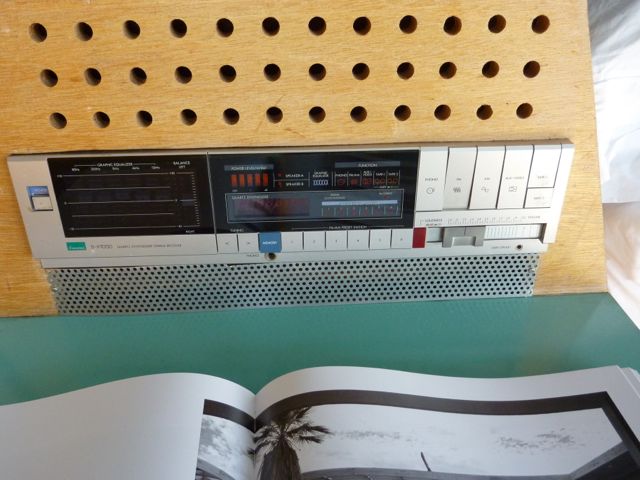
It was so comfortable in this tiny ship of a house. Everything was built in–the couch, the record player, the drafting table–that it felt as if everything had been thought of and was within arm’s reach. It truly was like living in a ship–one which had been cast up onto high ground and landed perfectly on its anchor, a gorgeous, massive rock.

The rock is at the heart of this small home.

Frey thought around every obstacle as he built this home around the boulder. He did not have access to the kinds of laser-accurate tools we have today which could cut glass to the exact wrinkles and undulations of this rock. So he chipped at it, positioned the glass around it and then filled it back in using the chips he had displaced.

Everything was built in, even the record player.
A stereo console and nightstand/end table connects the bedroom to the main room.
Looking east onto Palm Springs. This photo gives some idea of the length of the living room/bedroom/office space in which Frey lived.

Unlike the Stephens House, I found myself wishing I could be one of the lucky few to live there. It seemed so peaceful, as if inspiration could be born and nurtured inside, while all the little niggling worries of everything else were left outside to melt in the sun.

The large windows opened up and exposed the room from floor to ceiling to welcome, cool breezes. The yellow curtains on one side looked like the yellow flowers dotting the desert floor just outside. The blue drapes on the other side of the home reminded me of the sky visible from the lower level of the living area. It was a dream home–not pretentious, but nonetheless elegant in its simplicity and functionality.

Yellow curtains, the color of bright encilia flowers just outside.
The drafting table with Frey-crafted chairs and blue curtains, the color of the surrounding sky.

In spite of a concrete floor and an aluminum perforated ceiling, this house was richly inviting. Perhaps it is the color of the wood veneer so prominent in the space, used back then for its low-cost availability, and now prized because it is so rare. Woods do tend to soften even the harshest of spaces. Or maybe it was the colors he chose–the blues on the ceiling, curtains, and tabletops. Likely, it is the complete package, a combination of everything, a habitable expression of the desert mountains, which makes it so delightful and draws out feelings of contentment and joy.

The honey-colored wood veneer covered walls and built-in furniture alike. Love that clock.
A view from the open floor-to-ceiling window off the bedroom area.

The hospitality of the home could also simply be owed to its creator, a man who put in his will a special endowment for the house to be maintained and restored as needed. He lived there and loved that house from the time it was built until his death in 1998. It was something special to him and he was happy to share it. He specified that someone should always live in the home because empty houses fall into disrepair and he desired that the home remain “alive” by having someone live there. He also made sure that architecture students and other architects should always have access to the home “for study and inspiration in the future.”

For those of us considered amateur students of architecture, this home is deeply inspiring, a welcome embrace into the simplicity and philosophy of Modernism.

Thank you to the Palm Springs Art Museum and the Architecture and Design Council for making it available to we, your budding students, privileged to walk in the life and steps of people like Albert Frey. This tour has so far been the highlight of Modernism Week for me.

For more photos from our tour of this great house, see the slideshow below.

This slideshow requires JavaScript.

Next week: “Car Plays” in La Jolla

"Car Plays", a Moving Arts production presented by La Jolla Playhouse.

Modernism Week in Palm Springs is not even close to wrapping up, but thanks to updates on Facebook and Twitter, I can already start imagining next weekend when I go to La Jolla, California to see “Car Plays”, a Moving Arts play as presented by the La Jolla Playhouse. Being that the theater is actually 15 separate cars with 15 separate stories being told, I know this is going to be a ride I won’t soon forget.

For more information about the plays, take a look at the article written by James Herbert for U-T San Diego. For tickets, go directly to the La Jolla Playhouse website.

The plays run from February 23 through March 4, 2012. Tickets are $25 a piece and run time for the show is 60 minutes. This is part of La Jolla Playhouse’s Without Walls series.

Stay tuned for an update of the play coming at the end of next week.

The Stephens House: a model of modernist design in Palm Springs

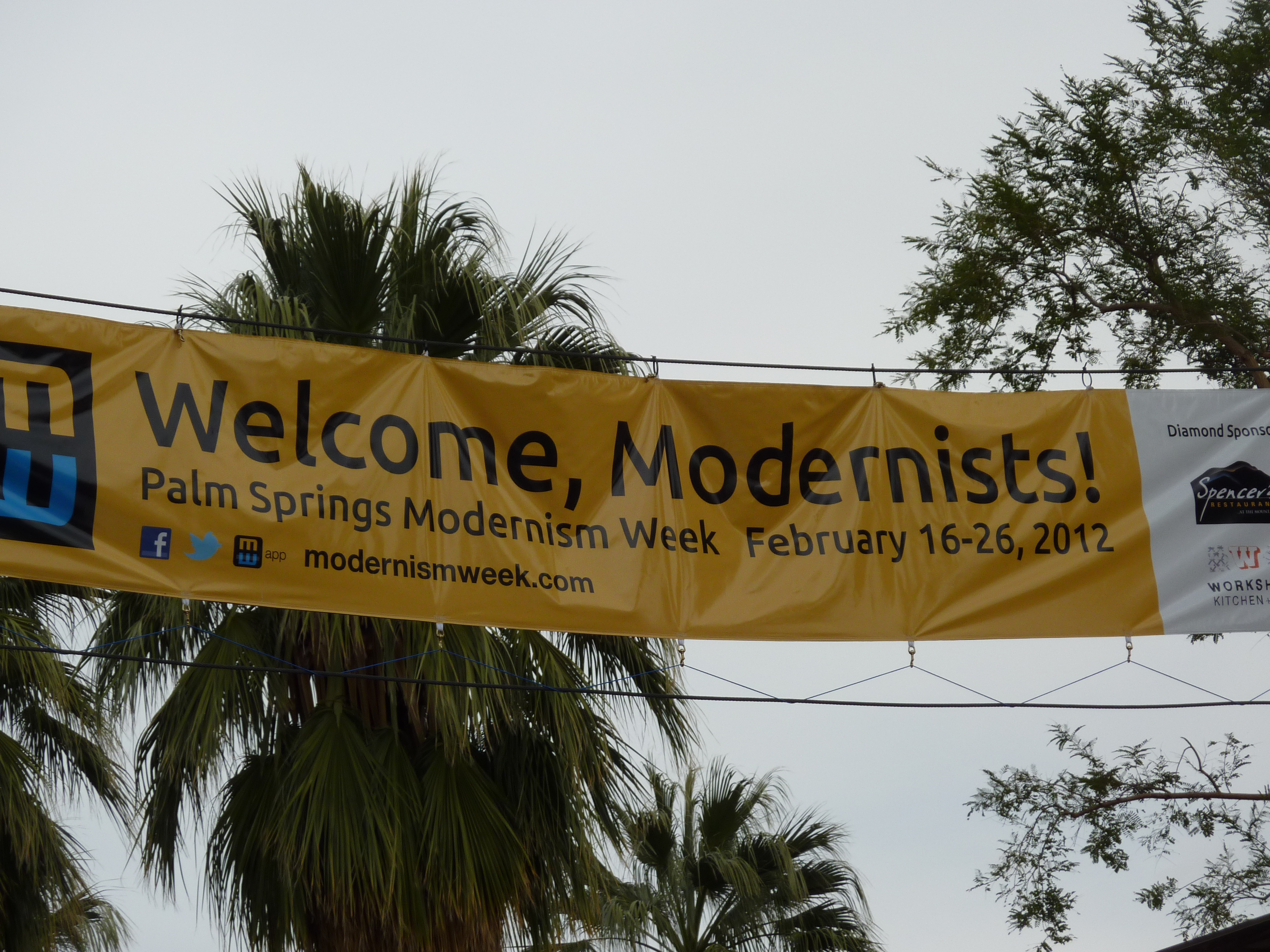
Palm Springs Modernism Week is all about mid-century design and no where is that better illustrated than in the architecture of homes and businesses found throughout the city. The Stephens House is just such a jewel but it is not readily seen by casual passersby. It is hidden on the front side of the house with massive landscaping and hidden from the back by a silent wall. The only telling features from the street that anything exists behind that small desert forest is a mailbox and a modest, winding sidewalk leading up to the home.

The backyard of the Stephens House opens up to an oasis.

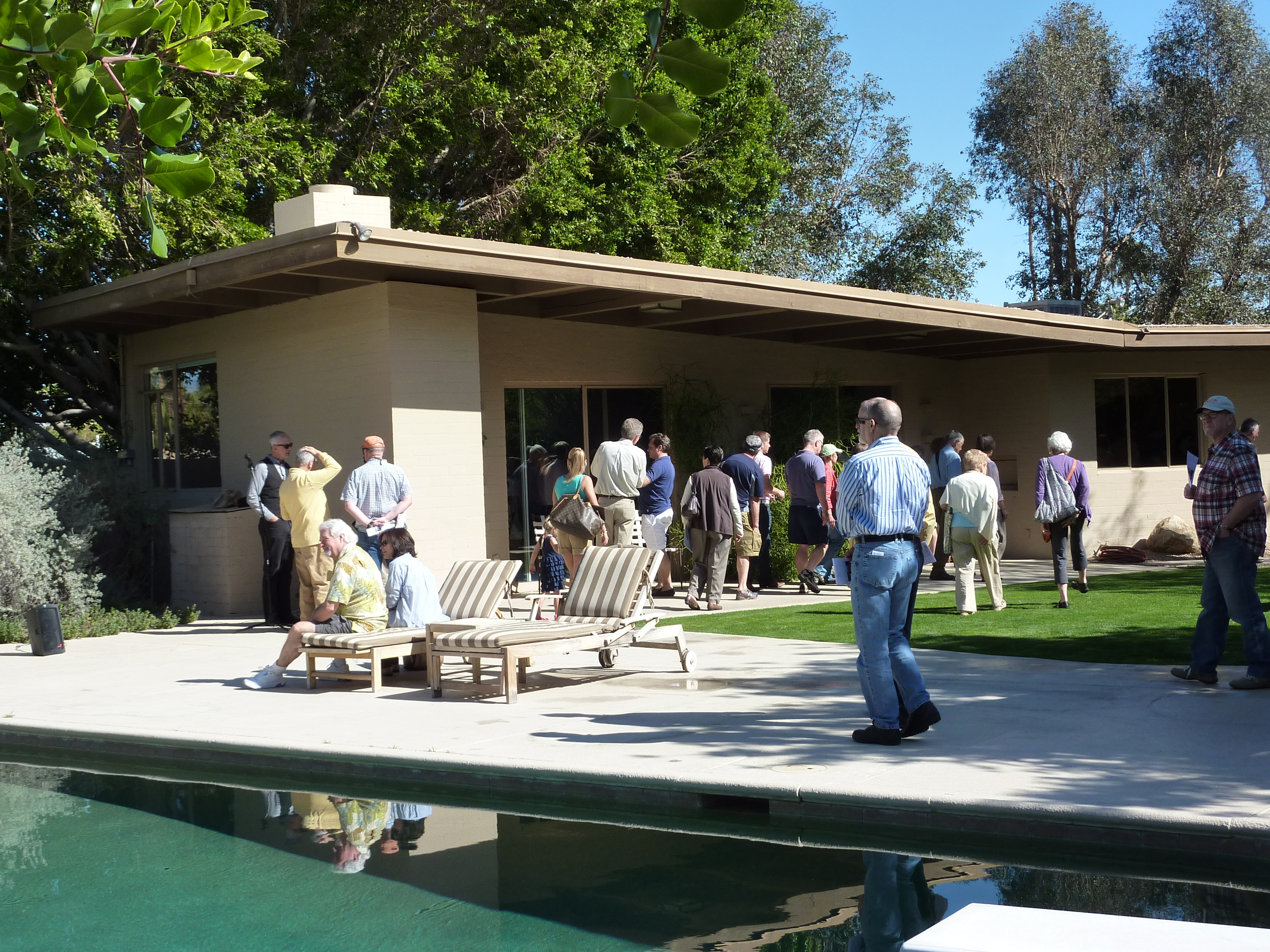
The backyard is where the sky opens up and reveals evidence of human inhabitants. A gorgeous pool and hot tub, a large, expansive patio, and manicured, green grass all point the way to the home at the property’s center. It is a home designed in 1949 by the famous Palm Springs modernist architects, John Clark and Albert Frey. The home was built in 1951 and is considered iconic modernist design because of its flat roof, large glass windows, and the mixture of glass and concrete block. It is situated and covered by eaves such that it is warmed by the winter sun and shaded from the summer sun. This particular home was featured in the September 1955 issue of House Beautiful as an introduction to the idea of a “family room” to post-war America.

The notion of a family room was introduced with this house.

As much as I appreciate the angles and form of such a home, I realized in walking through it that I could never live there. The exposed, painted masonry blocks within the home reminded me too much of military barracks–very stark and utilitarian. The paint around the frameless windows can’t help but chip as the weather seeps in through unseen cracks and works its destructive magic. And hanging anything on the wall is not only permanent, it becomes a job for a masonry expert since everything must go through the brick. Perhaps with the original carpet I might have warmed up to it, but I doubt it.

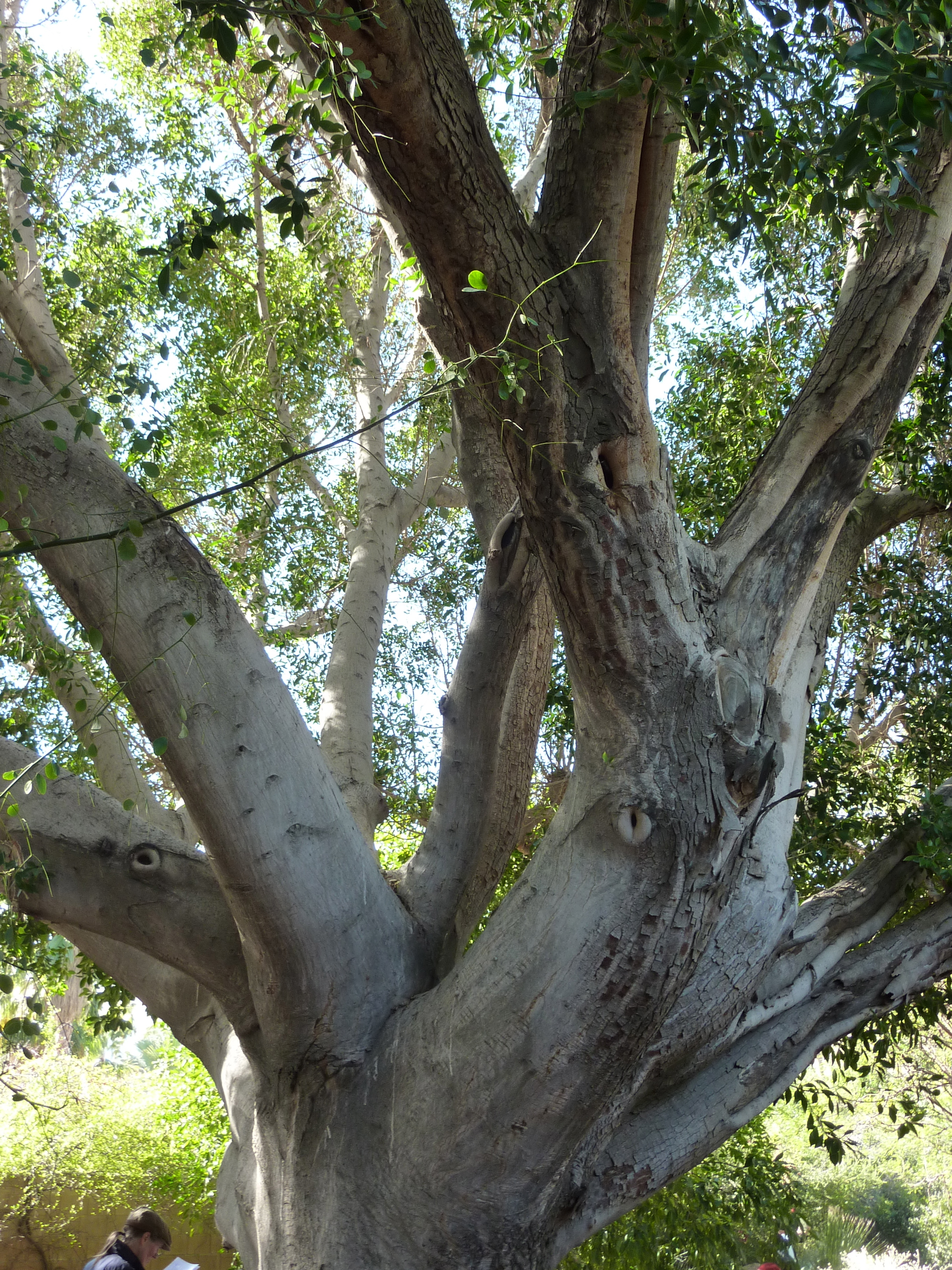
Large windows look out on a massive ficus tree.
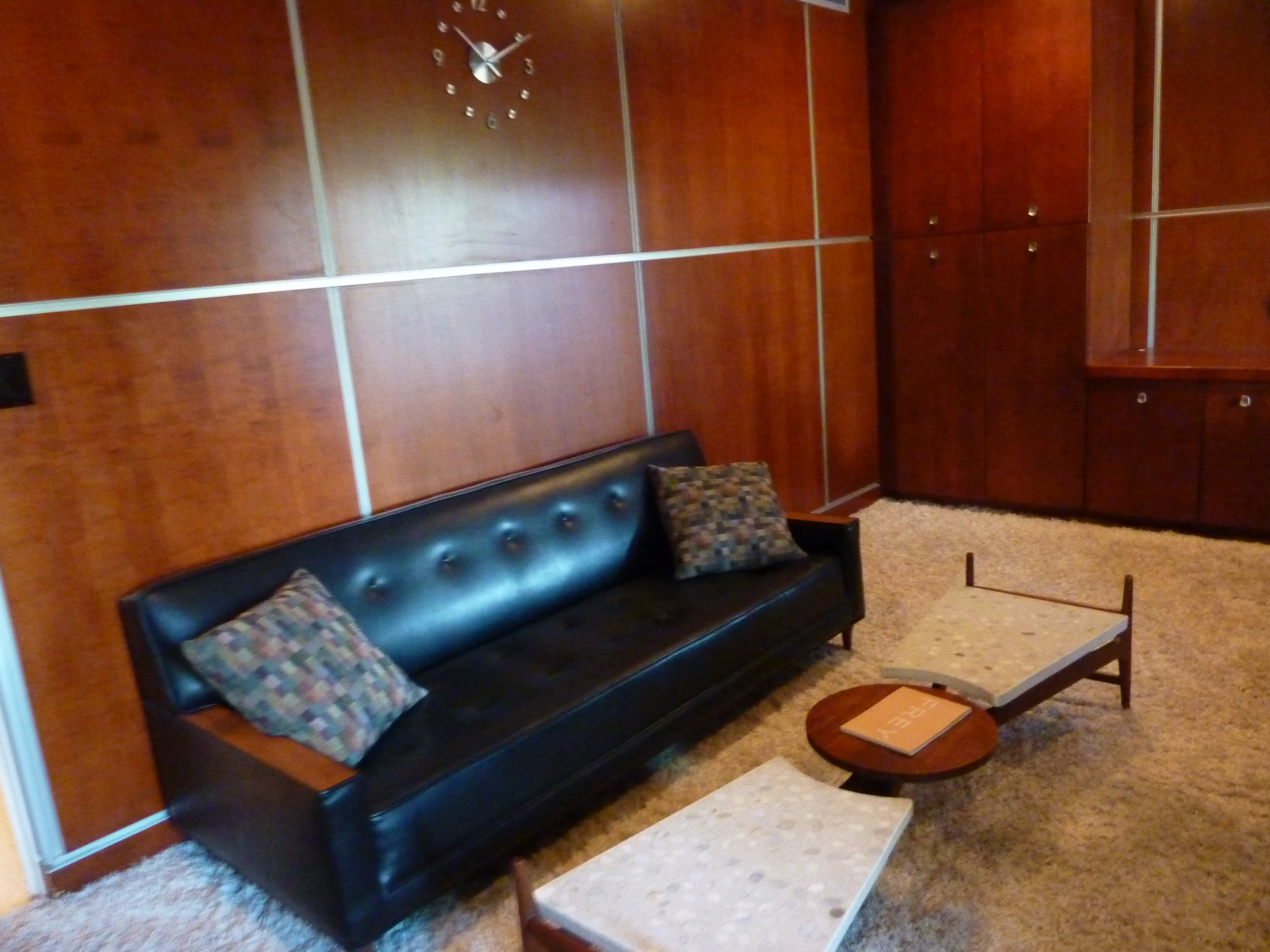
The wood-paneled walls and the built-in clock created a warmth that was harder to find in other rooms clad only by masonry bricks.
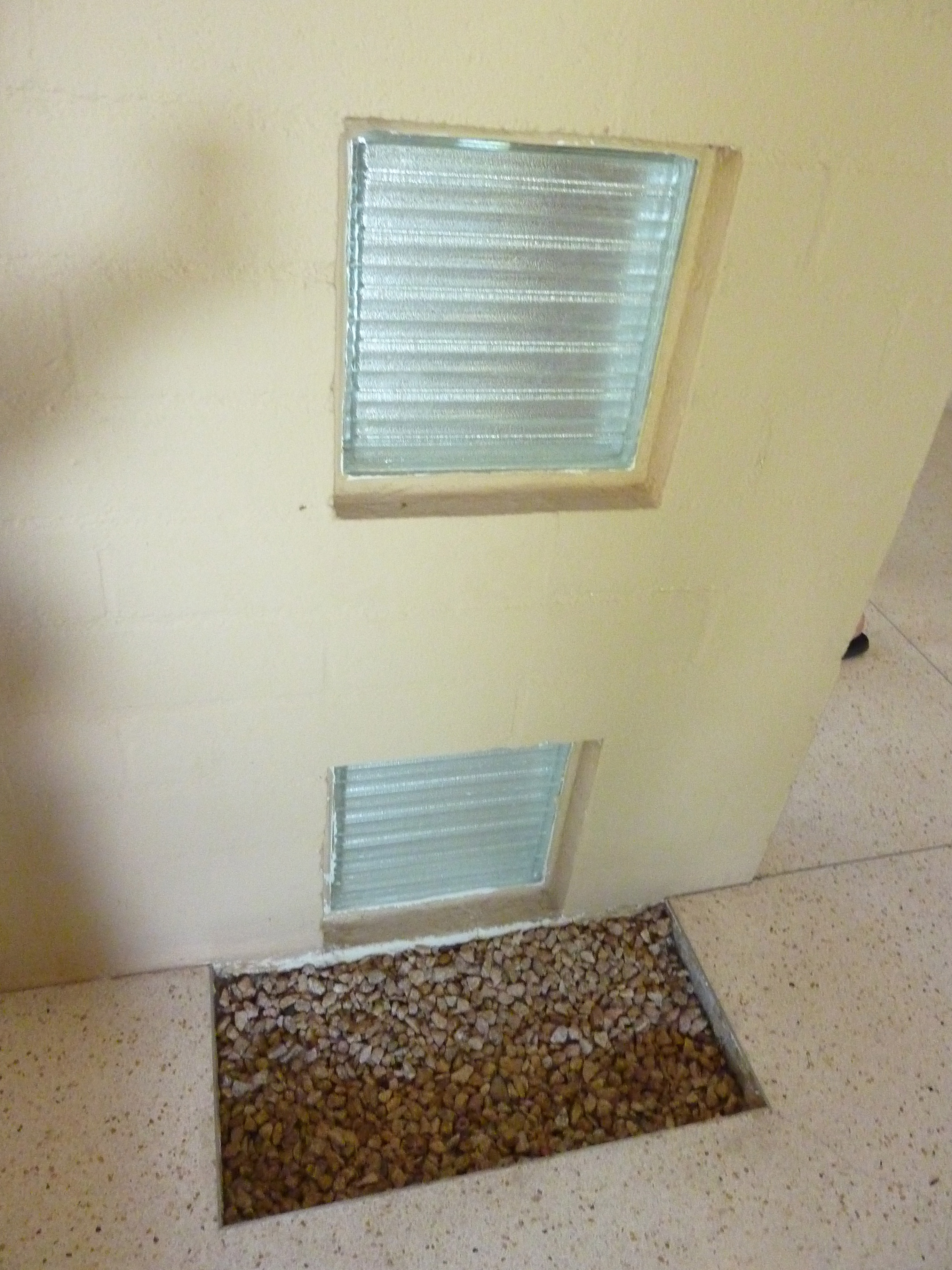
Small block windows dotted the walls inside and out, bringing in light, enough for a small plant to be grown indoors in the floor. I'm not sure if that is part of the original design to the home since all the original flooring has been replaced.
A picture of happy lady bugs danced merrily in a framed alcove along the hallway wall.

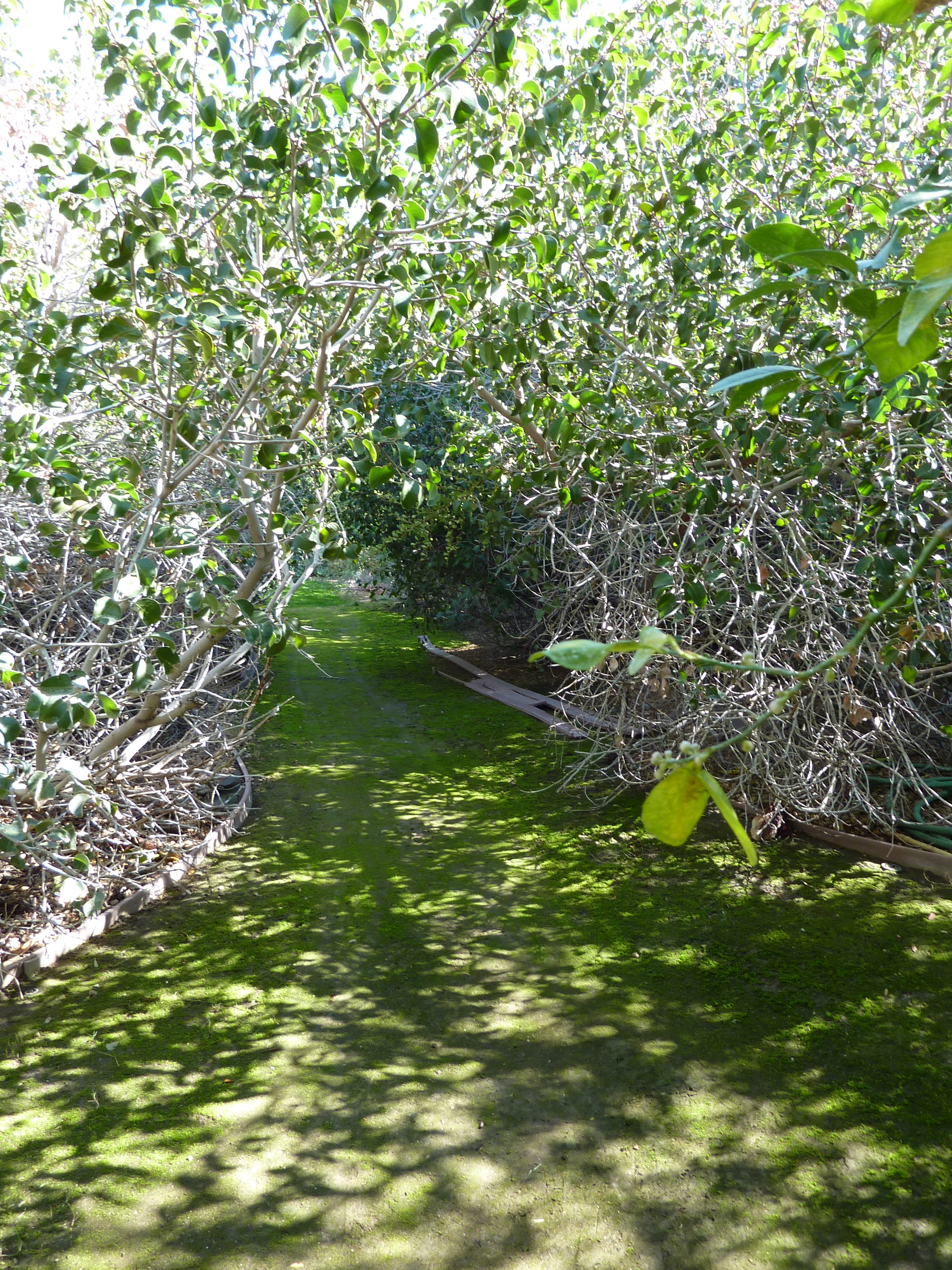
For me, the warmth of the home was best felt outdoors, wandering under the massive ficus tree, which the experts on site agreed must have been planted in 1951 when the home was first built. It is a wonder that the winter frosts, even in the desert, did not kill it off. Happily, however, it has grown so large that its canopy covers one half of the backyard. The other half meanders back over an expanse of inviting grass, past the pool and its made-for-cocktail-party patio. Tucked beyond the pool, trailing smaller and smaller through the foliage on a grassy (and sometimes mossy) path, is what seemed like a magical forest. A table and chairs sit behind a giant palm tree, under the countenance of citrus trees. A sitting buddha reminds all who enter this triangular nook to respect the space with quiet joy and appreciation.

A ficus with stories to tell.
Looking toward the pool and mountains from the ficus tree.
A small brook hops through the brush and trees. No one seemed to know where it started or where it drifted off to.
A secret nook hidden behind and under large palm and citrus trees.
A path that sparks the imagination and leads to another part of the backyard.

How thankful I am to the Palm Springs Preservation Society and to the current owners of this home for making it available to the participants of Modernism Week. Even though I could never live there myself, I can appreciate its place in Modernist history and feel the fond memories of the first family that lived there in the walls and under that ficus.

Below is a slideshow with all the images taken on today’s tour, including some of the buildings encountered along our walk to and from the Stephens House.

This slideshow requires JavaScript.

Vintage cars and mid-century furnishings rev things up at Palm Springs Modernism Week

Photos from the 50s and 60s might be in black and white, but judging from the colors seen during two of today’s Modernism Week events in Palm Springs, the mid-century was bursting with color and shine.

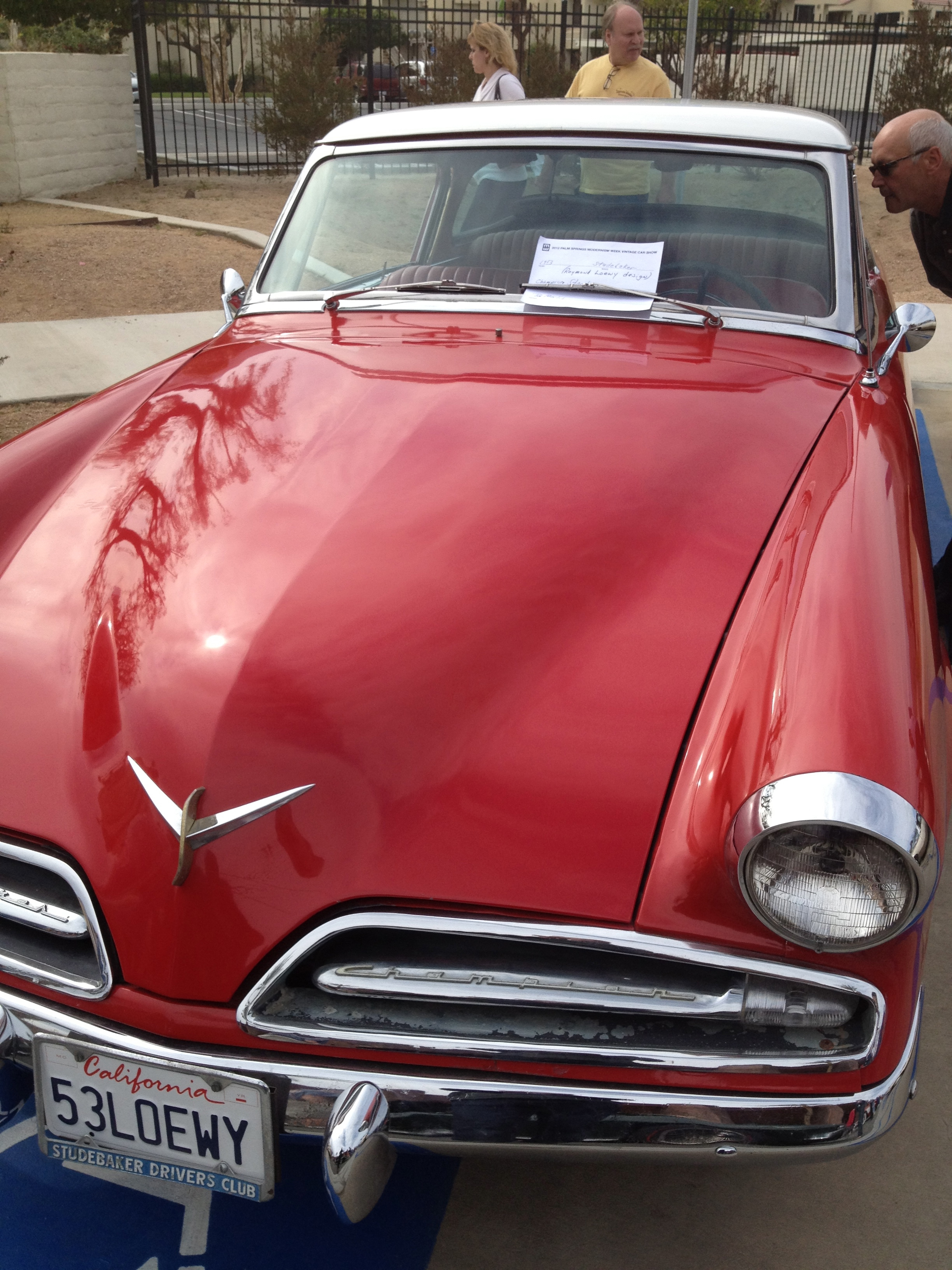
“They don’t make ’em like they used to.” No where was that more apparent than at the Vintage Car Show located outside the Palm Springs Convention Center. It was a sight of brilliant colors, shiny chrome, and decadent lines and curves. These are the cars of an era long gone, of free-wheeling creativity. They don’t make ’em like that anymore.

Lincoln Continental convertible.

Somewhere inside of me is a prolonged sigh–not for a past that wasn’t as good to some as it was to others–but for that kind of open-ended creativity and an “anything’s possible” attitude that created these kinds of cars.

Looooong daddy-oh. Looks like something Batman would drive.

When I look at cars today, I see only hints of the passion and flair of yesterday’s four-wheeled marvels. Where did it go? Maybe with all the rules and regulations about what a car must be today, there’s not room for that kind of passion in the car industry. Or maybe we’re just waiting for that next generation to come along and burst the seams of what we thought was possible.

All about the chrome, color, and massive hood ornaments.
Vintage Car Show at the Palm Springs Convention Center. Photo by Michael Dryja
Cherry red convertible Studebaker. Photo by Michael Dryja.
Chrysler New Yorker: Long, lean, and shark-like with its gills and fins. Gorgeous.
Inside the Chrysler New Yorker.
1959 Desoto.
Built in a time when kids were seen and not heard, ash trays dominated the back seats instead of video screens.

Outside the Convention Center the cars seduced with their chrome bumpers, curvaceous lines, and statuesque hood ornaments. Inside the Convention Center there was plenty to salivate over as well, thanks to the 12th Annual Palm Springs Modernism Show. All parts of a Modernist home were represented in warm shades of lacquered wood, blue vinyl, polished metals, and sparkly glass. Primary colors danced on metal orbs, rods, and squares. They saturated vinyl couches, were splashed across canvases, and were woven into fabrics.

Love this blue vinyl couch with built-in coffee and end tables. How about those fluffy, furry white pillows?
Large, colorful jacks decorated a glass fireplace surround.
Grouping of Transmission Tower Replicas at Christopher Anthony Ltd. in Palm Springs.
Not sure what material was used to house this radio. Stained wood? Melamine? It is marbled and unique.
Honeycomb bookshelves.
Colorful lamps that look like nuns bowed in prayer.
Simple, colorful, elegant clocks.

For more photos, check out the slideshow from both events:

This slideshow requires JavaScript.