Walking suburbia like it’s an urban jungle

"Me and my shadow" and Hubby's too! Taking the road less travelled--walking a sidewalk along a major street in our suburban town.

“Above all, do not lose your desire to walk. Everyday, I walk myself into a state of well-being and walk away from every illness. I have walked myself into my best thoughts, and I know of no thought so burdensome that one cannot walk away from it. But by sitting still, and the more one sits still, the closer one comes to feeling ill. Thus if one just keeps on walking, everything will be all right.” ― Søren Kierkegaard

Kierkegaard was right, you know. Since incorporating walking into our daily routine a year and a half ago, Hubby and I have walked ourselves to health. Not only are we free from medicines related to high cholesterol and diabetes, walking changed the way we see our sprawling suburb and the way we plan our trips.

I don’t know about you, but the idea of walking five miles on a treadmill or hiking around a track over and over again has absolutely zero appeal. Combine those walks, though, with stuff I have to do anyway and, not only do we get our exercise, we get that other stuff done at the same time. Plus–and this is a bigger deal than I would ever have imagined before–we connect to the bigger world, experience the seasons, discover local art and artists, and meet new people because of it. Much to our surprise, incorporating walking into our regular routine really makes us happy.
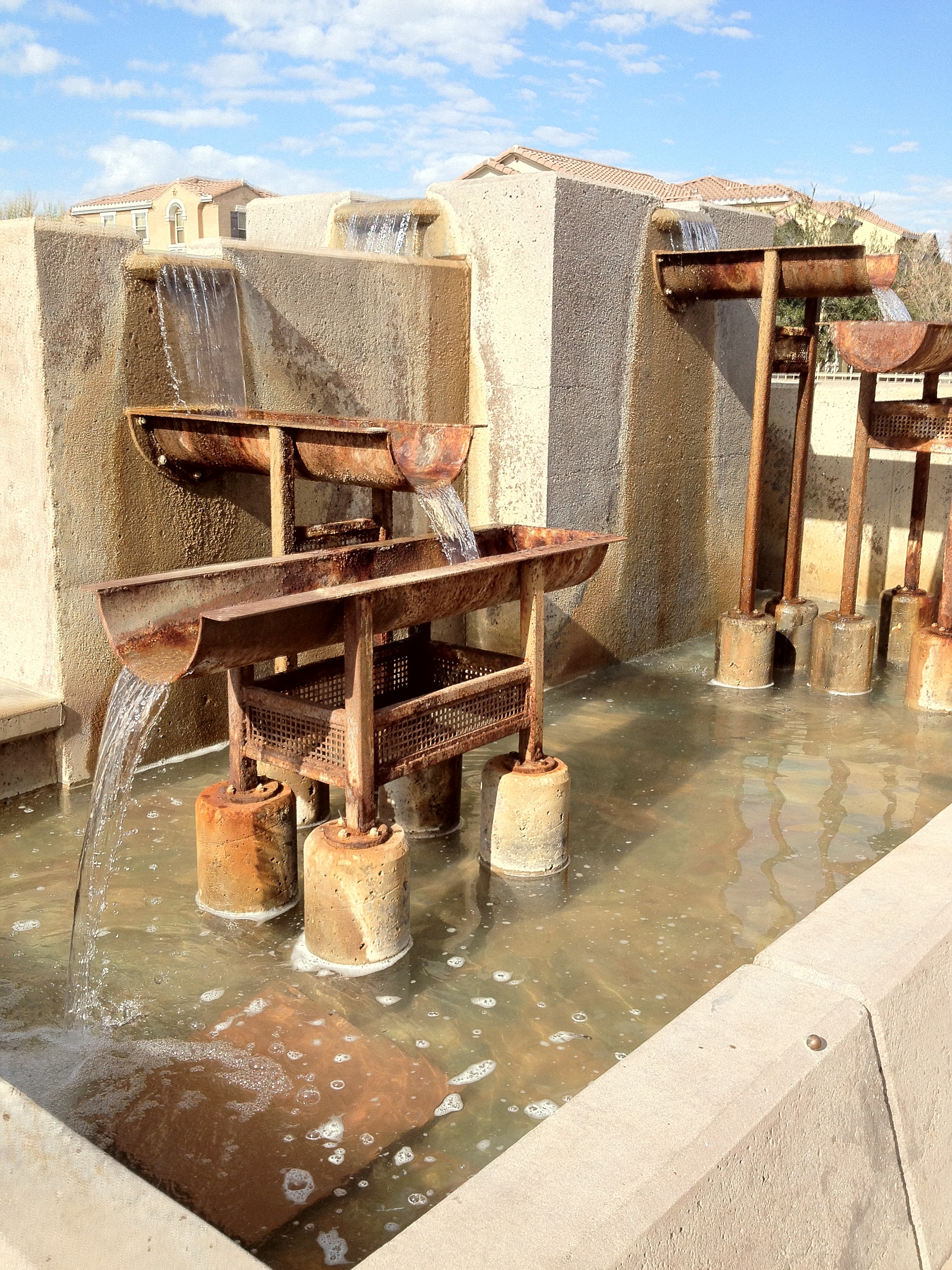
Cool fountain we discovered on a walk to the farmers market.

Each day Hubby and I strive to walk at least 10,000 steps. This is the equivalent of five miles. Hubby tends to walk more than that each day, achieving around 13,000 steps or more on average. My average tends to hover right around 10,000 steps a day, with a few days of 12,000 and a few 9,000. In general, if we did not strive to hit this goal, each of us would average about 2,000 steps a day.

My FitBit showing I have only 627 steps this morning. Only 9,373 to go!

Our FitBits are a big part of keeping us focused. They track our steps and automatically update that information into a private and personalized “dashboard” on their website. We can also track what we eat and how long we sleep. All the information on our dashboard is kept private, for our use only, or to share with friends and family with whom we choose to give this information.

My Dashboard on FitBit.com from earlier yesterday. It shows how many steps I've taken daily and allows me to set goals to strive for each week.

When we first started walking, our minds were just focused on achieving a step goal. It was a chore, something that had to be done, like taking out the garbage or cleaning the bathroom. This was something we had to do in addition to everything else we do in a day.

According to WalkScore.com, our town has a walking score of 48, which is considered car dependent. That’s exactly how we saw our town, unwalkable. We needed a car to get around and we accepted what we perceived were the limitations of suburban America. Each night, after we finished work, we drove to dinner and returned to walk on the exact same path around the exact same park over and over and over again, for an hour at a time. This is how you get healthy, I thought? It’s no wonder so many start a walking program only to get bored and drop out before they get very far.
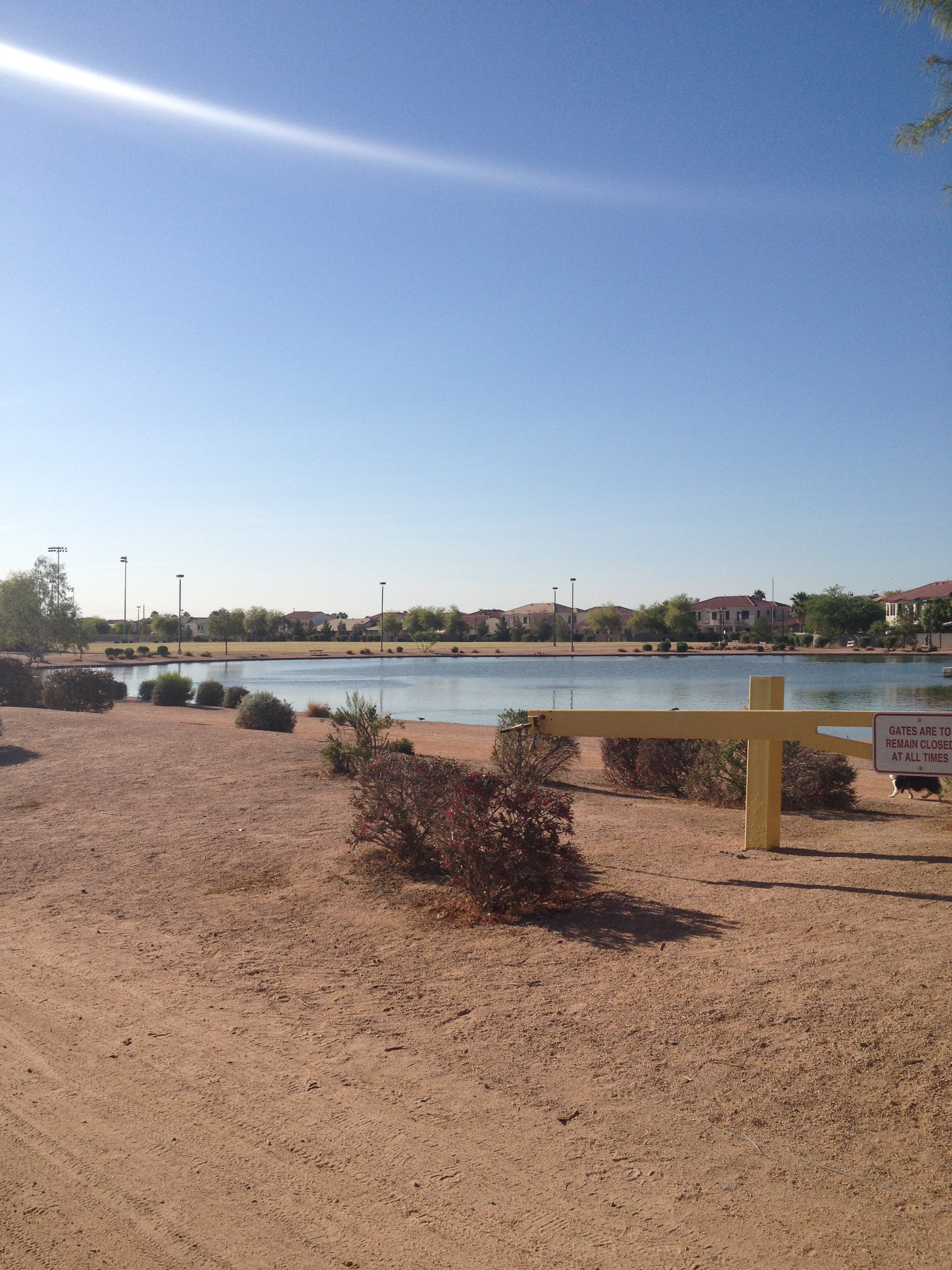
We used to walk around this little pond over and over and over again. The first couple of times are interesting, but it gets dull very fast.

Then we visited St. Paul, Minnesota where we stayed in a very walkable part of town, and that’s when everything changed. We started walking to a coffee shop about a quarter of a mile from where we were staying. Each night we walked to dinner and we took near-daily jaunts to a neighborhood market for groceries. Returning to Arizona, we figured, if we could walk St. Paul, why couldn’t we walk suburbia too?

Using Google Maps and the Maps App on our iPhones, we started to check out what was nearby and how to get there on foot. At first, a mile seemed too far to walk anywhere, so we started slow. We walked to the bank, about a half a mile away, or 10 minutes one-way. Little by little, we became a more adventurous. We added a daily coffee break at Dutch Bros., about a mile away (or 15 minutes). Not only were we getting a total of 4,000 steps with that trip, we were getting one of my favorite rewards: coffee! (And if you know me at all, you know I love coffee.)

Our closest Dutch Bros. coffee shack. It is walk-up or drive-thru. Walking up is so much more fun.
Walking to Dutch Bros. means we get to have conversations with other world travelers like Mitzu, who has walked the roads and paths of South and Central America. Next on her list? Honduras! She also introduced me to an amazing new taste sensation: an Iced Chai Soy Latte with a shot of sugar-free raspberry Torani flavoring!

Everything went along great for a while, until one day we had to work a little later than usual and neither of us could take a break for coffee. By 6pm, we had 2,000 steps and we still had to eat dinner  before we could get those other steps needed. It looked like we were going to have to walk circles around the park again.

I need to pause here to explain something. We eat out every night. At some point during Hubby’s first days dieting, he discovered that a lot of the chain restaurants not only have low-fat options on their menus, they have that information posted on their websites, so there are no surprises when we get there. Chains tend to have nutrition info located on their websites as well, or it can be found on-the-go through various iPhone apps like Dottie’s Food Score, My Fitness Pal, and WikiWeight. While we learned how to eat better, we created a routine of going to Chipotle, Chile’s, and places like those because, believe it or not, we knew we could get things there that would fit with our new, healthier eating habits.

On that particular night we still needed to eat, we needed lots more steps, and neither of us were looking forward to walking around the park a hundred times at 10pm. That’s when one of us looked up the distance from our house to Chile’s. It was 2.3 miles–the farthest we had ever walked for one of our “integration” walks.

We were hesitant at first. As strange as it sounds, it seemed impossible, really. The walk was far and it would take us down busy streets, along routes we had only ever driven before. There was even a light feeling of adolescent embarrassment–we were the only ones walking those particular sidewalks along those particular streets. We were so uncool. The reward, though, was too tempting. That walk would give us nearly 10,000 steps round trip and we would break it up with dinner!

Ever since then, we have been walking to dinner three and four times a week. We still go to Chile’s regularly, but we also visit local places I’ve written about before, like Flancer’s and the farmers market. Two-and-a-half miles one-way is pretty much our outer limit at this point because of the time it takes to get there (about half an hour to forty minutes).
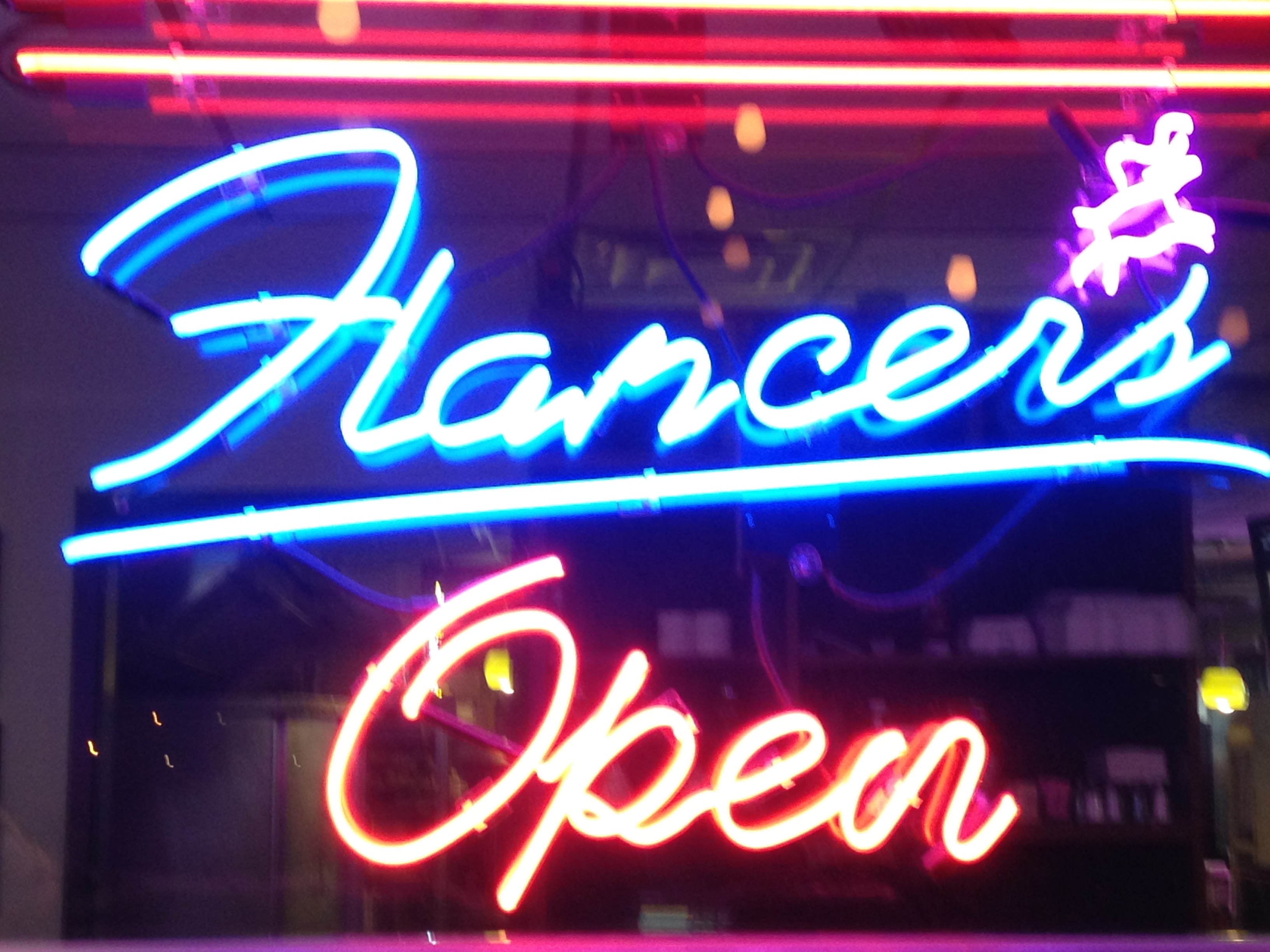
Flancer's is a weekly walk for us.
The farmers market is a little more than two miles from where we live.

Not every American suburb has access to as many sidewalks and safe paths. Rural areas like where my grandmother lives in Oklahoma are tough because of the distances it takes to get anywhere you’d want to go. Still, I can’t help wondering if some of this isn’t perception. If you had asked me a year ago if our suburb was walkable, I would have told you no and sincerely believed it.

What we have learned this last year is that almost anything is walkable, especially when there is some reward involved, even if that reward is simply checking off one more thing on the list of things to do. Admittedly, some places require more planning and street smarts than other places. When we walk the canal path near our house, for example, we clamber over the rock-laden moat of a railroad track so we can get to Flancer’s.

Sometimes we have to wait for the train to pass first.

What I recommend to anyone interested in trying this way of integrated walking is to start out with smaller trips and add on as you feel comfortable. If possible, pick things that are actually rewarding. In my case, it was coffee. Plan ahead and take what you need to be safe and comfortable in various weather and road conditions. Backpacks and cross-body bags are best for carrying things you might need. When we go to the farmers market, for example, I pack an insulated bag with a couple of bottles of water. As we drink the water on the trip there, we make room for our purchases at the market. Of course, no matter where you go, always pay attention to the traffic around you and navigate accordingly. Never assume a driver sees you.

Waiting for the light to change.

Even with a certain amount of danger, this adventure of ours makes us happy. I have discovered, as Kierkegaard did, that I am happiest when I do not have to rely on a car to get places. I hate having to scope out and pay for parking. And we all know gas prices aren’t getting any lower. There are ways to walk and be safe, even in suburban America. Just be sure to remember your pedometer and wear comfy shoes.

For more inspiration on incorporating walking into your daily life, visit these websites:
Every Body Walk! is an “online educational campaign aimed at getting Americans up and moving. Through the help of our partners, we are working to spread the message that walking 30 minutes a day, five days a week really can improve your overall health and prevent disease. We provide news and resources on walking, health information, walking maps, how to find walking groups, a personal pledge form to start walking, as well as a place to share stories about individual experiences with walking.”

America’s Walking is a show on PBS which “highlights great walking destinations across the country, provides advice on food and nutrition, presents tips on the best fitness apparel, and features the inspirational stories of individuals who have seen their lives transformed by simply walking.”
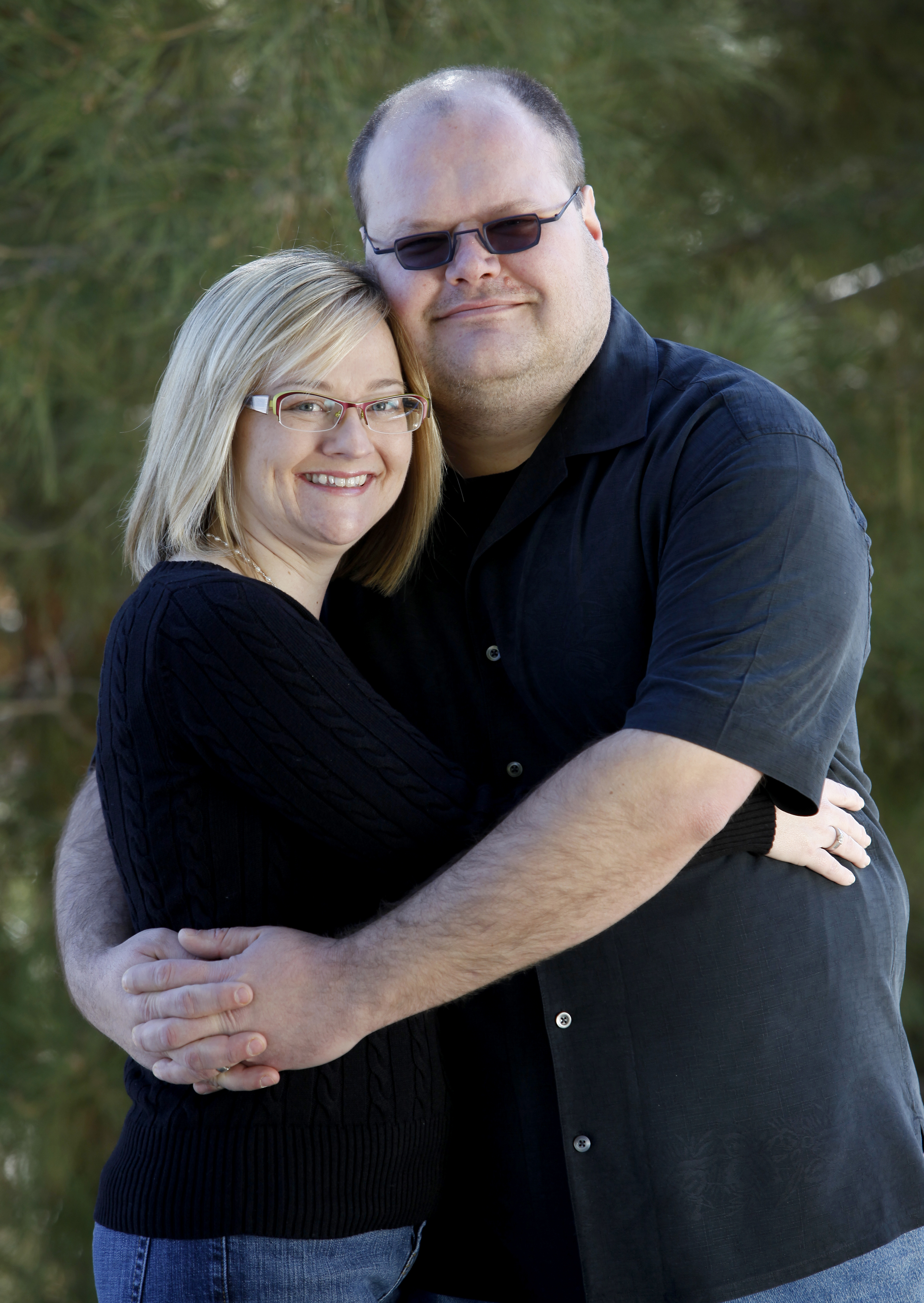
Walking North America: How Weight Watchers and a pedometer changed our health and our travel

Nearly two years ago, my husband decided to lose weight. He was bordering 300 pounds at the time and his doctor was warning him of the oncoming signs of diabetes. He was already taking medication for high cholesterol and high blood pressure. So, when the conversation turned to preventative medication for diabetes, Hubby set his mind to make some major changes. And when my husband decides to do something, he jumps in with both feet and doesn’t look back. So, in October of 2010, we both went on Weight Watchers and started tracking how many steps we were taking each day with a FitBit pedometer.

Hubby and me in 2009.

Hubby lost nearly 120 pounds from October of 2010 to June of 2011. I lost 20 pounds total. Since then, he has been freed from all the medication he had been taking before for high cholesterol and high blood pressure, and he never had to take the diabetes preventative. There are no signs of diabetes anywhere.

Hubby wearing a pair of his old jeans in January of 2012.

As you can imagine, a great part of the change is owed to his weight loss and his food choices, but it also can’t be denied that walking has made a huge difference as well. It helps keep the weight off, it gives the heart a good workout, and it makes it so he can enjoy extras like beer and chocolate on a daily basis.

These days we walk at least 5 miles a day. Hubby usually walks more than that. He’s far more disciplined than I am. I peter out once I hit my step goal of 10,000 steps and some days I don’t even make it to that. Still, for both of us, walking has changed our lives and the way we travel.

Hubby and me in March of 2012.

Travel is now planned with walking in mind. We choose hotels and vacation rentals that are located in the heart of a walkable city or, as is the case with our home in suburban Phoenix, we figure out ways to incorporate walks into our lives without living life on a treadmill or circular track. Over the next few weeks, I will be sharing where these walks have taken us, and how they’ve changed our lives, as we explore North America on foot.

Coming up: “Walking in suburban America”.

My day as a dolphin trainer

Over the last couple of weeks my local PBS station has aired new episodes of the series Nature, featuring the giants of the ocean, whales and dolphins. The episodes are packed with gorgeous images of these amazing creatures and incredible facts about their lives in the ocean. Watching the underwater photographers get up close and personal with the whales leaves me breathless.

The idea of the ocean’s vastness, its unknowable depths, the unlivable environment, and the dangerous wildlife combine to create a reverent fear in me. Standing before it, I am humbled by its greatness, moved by its mystery.

Mysteries, though, call out to be explored. Once curiosity is awakened, it demands to be heard. Although I will never be found diving deep into the water to film giant humpback whales fighting over a mate, this past November, I heeded my curiosity and took the plunge at the the Dolphin Habitat at the Mirage Resort in Las Vegas as a Dolphin Trainer for a Day.

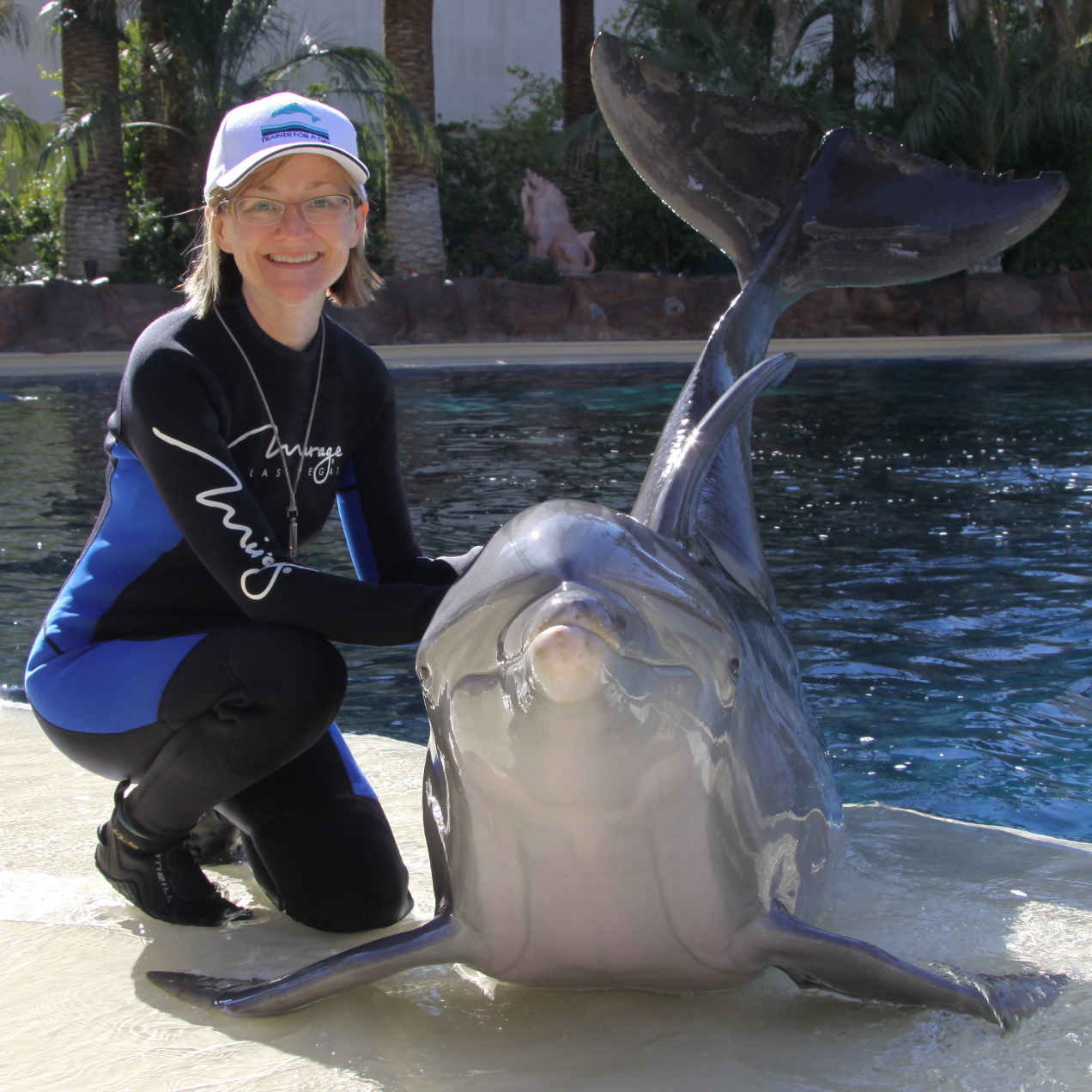
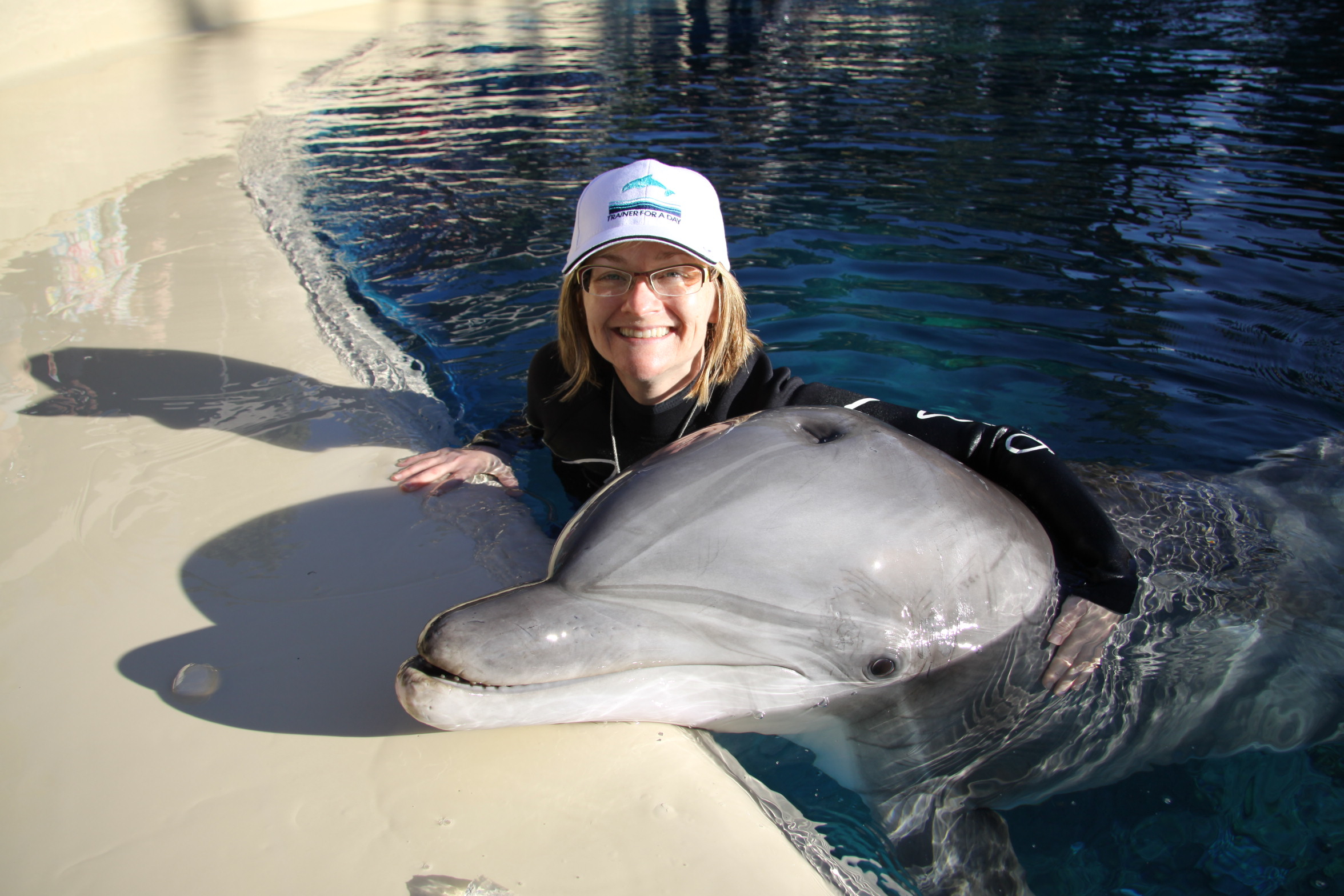
In spite of his name, Lightning was incredibly patient. He was the oldest of the males and did a nice job of keeping the other adolescent males in check. I was thankful he allowed me to get my photo taken with him.

The Dolphin Habitat has four connected pools, made up of 2.5 million gallons of water, a coral reef, and sandy bottom, creating a nurturing environment for the family of Atlantic bottlenose dolphins which live there. Even though this is Las Vegas, the purpose of the habitat is not entertainment. It is education. There are no shows put on. The dolphins are there to introduce us to our oceanic neighbors so that maybe, in getting to know them better, we’ll grasp our responsibility for keeping their world safe. The professional caregivers use positive reinforcement to train the dolphins solely so they can be kept safe and healthy while they teach us about their world and how it connects to ours.

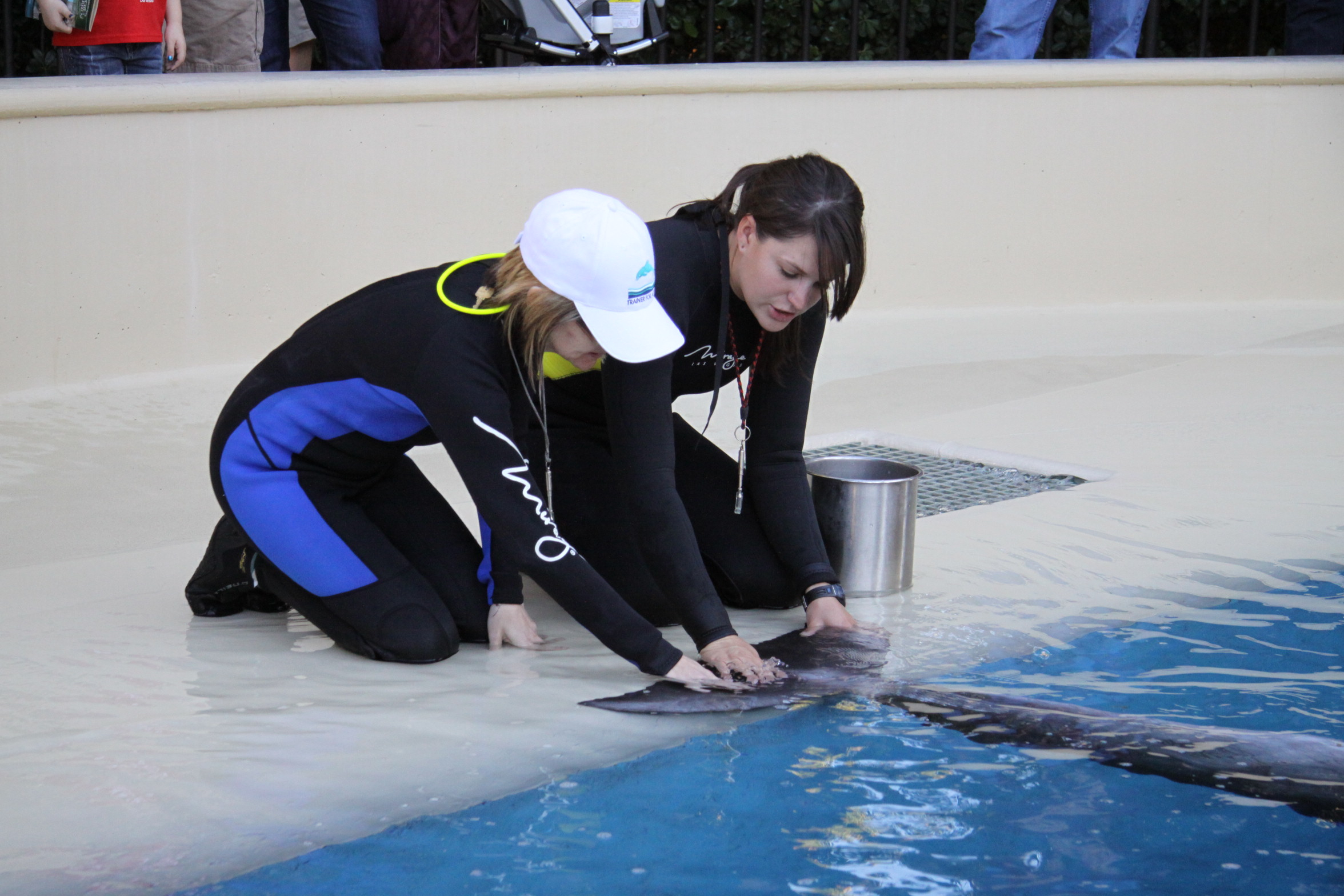
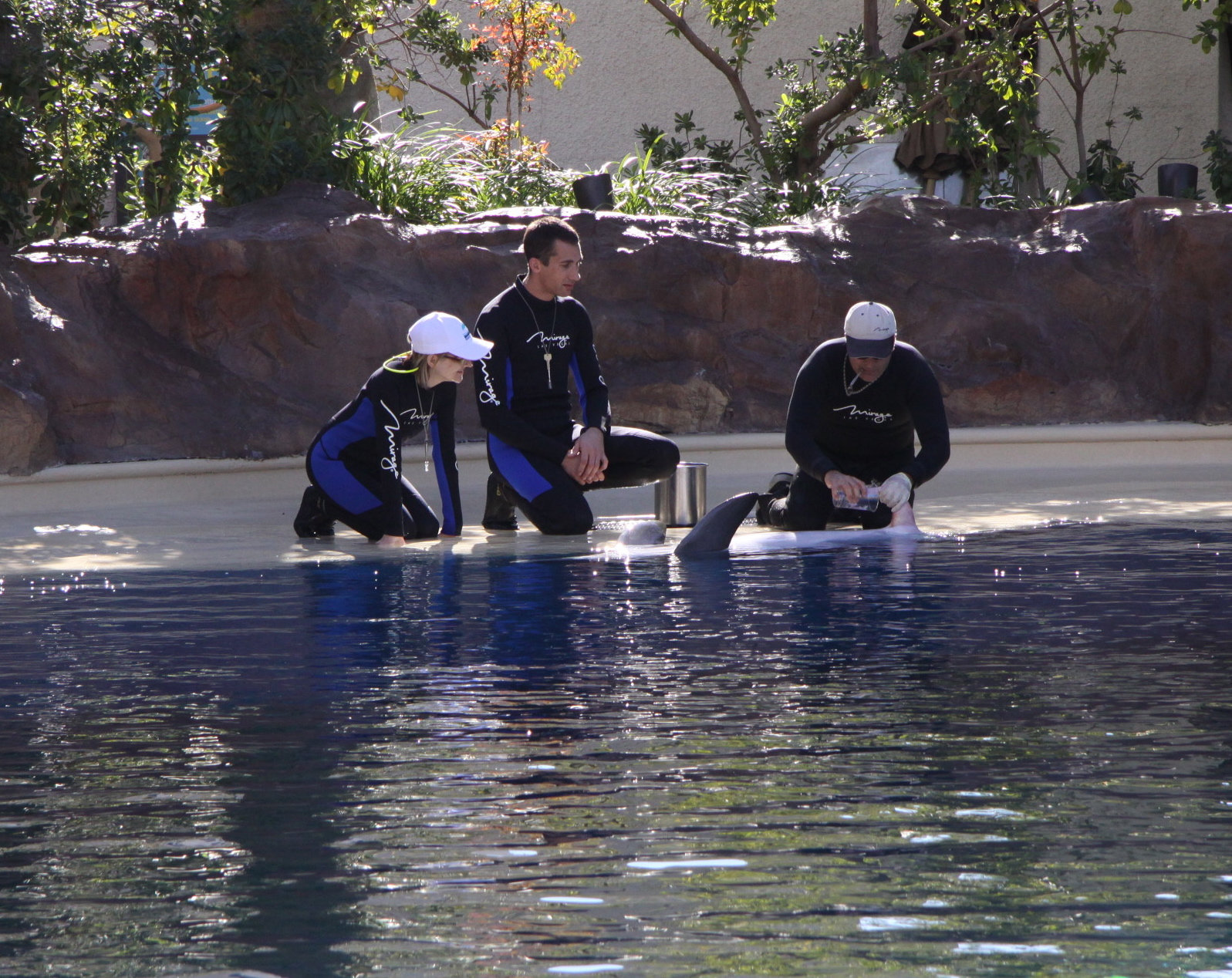
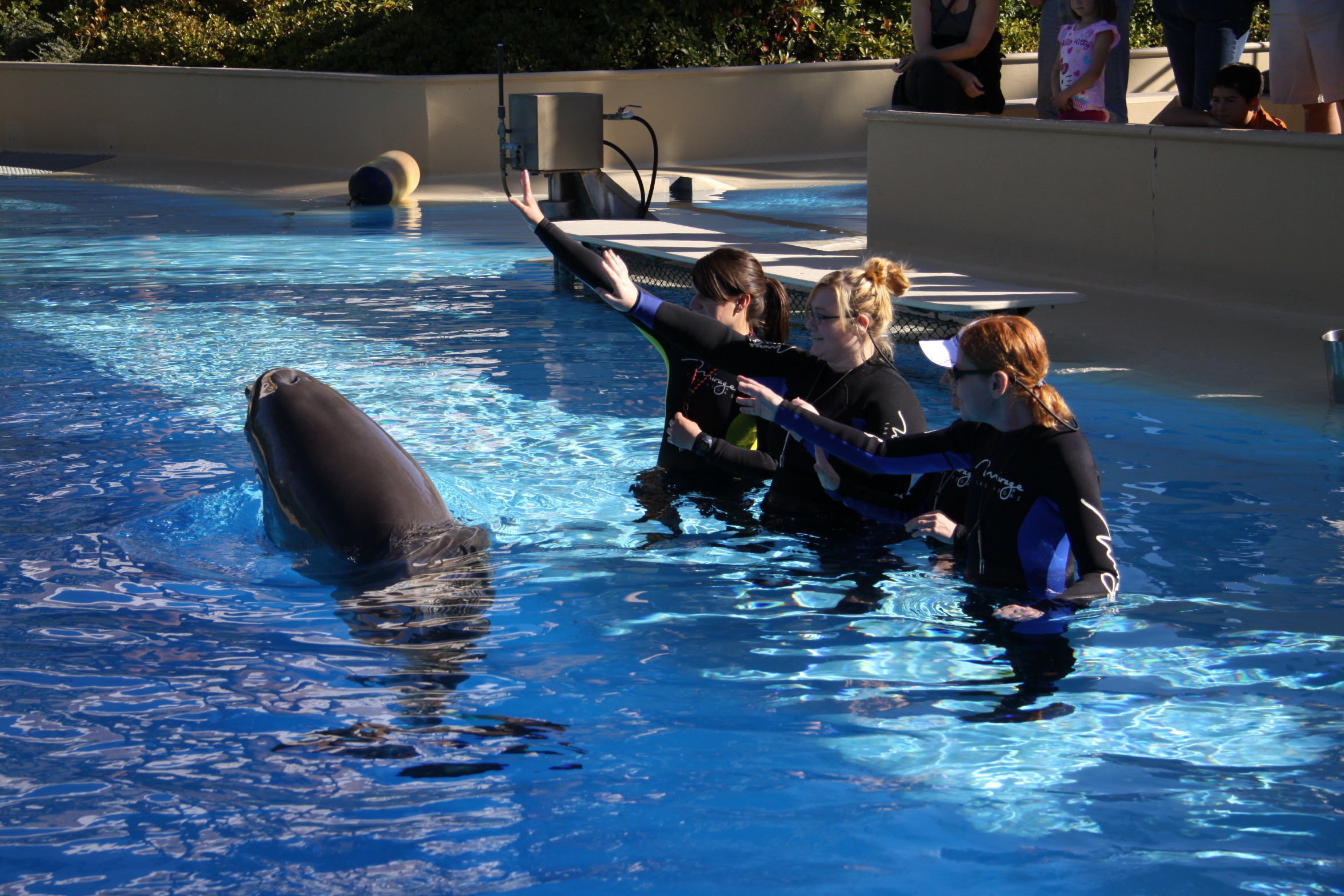
One of the professional caregivers shows me where they take blood from the tail fin to monitor this dolphin’s health. If the dolphin in this picture had shown any sign of distress, we would not have continued.

The Dolphin Trainer for a Day program allows a small group of dreamers (for we were all there with big dreams) to get up close and personal with these 500-pound mammals. We were provided wet suits and thorough lessons on how to approach and work with the dolphins for their safety and our own. Respect was the name of the game. The professional caregivers do not force the dolphins to do anything. The dolphins are never punished for not doing what is wished of them. Instead, they are rewarded when they do something right. As a result, it is important for trainers to have a deep well of patience.

Don, one of the head trainers, teaches us more about how to care for a dolphin.

Throughout our day, we were in and out of the water a number of times engaging with the dolphins. Duchess, the matriarch of the group, allowed us to look at and touch her belly. We learned about how the mothers give birth and feed their babies while swimming. It was fascinating to learn that the babies have little fringes on their tongues which lock in on the mother’s teat like a zipper so they can keep moving and eat at the same time.

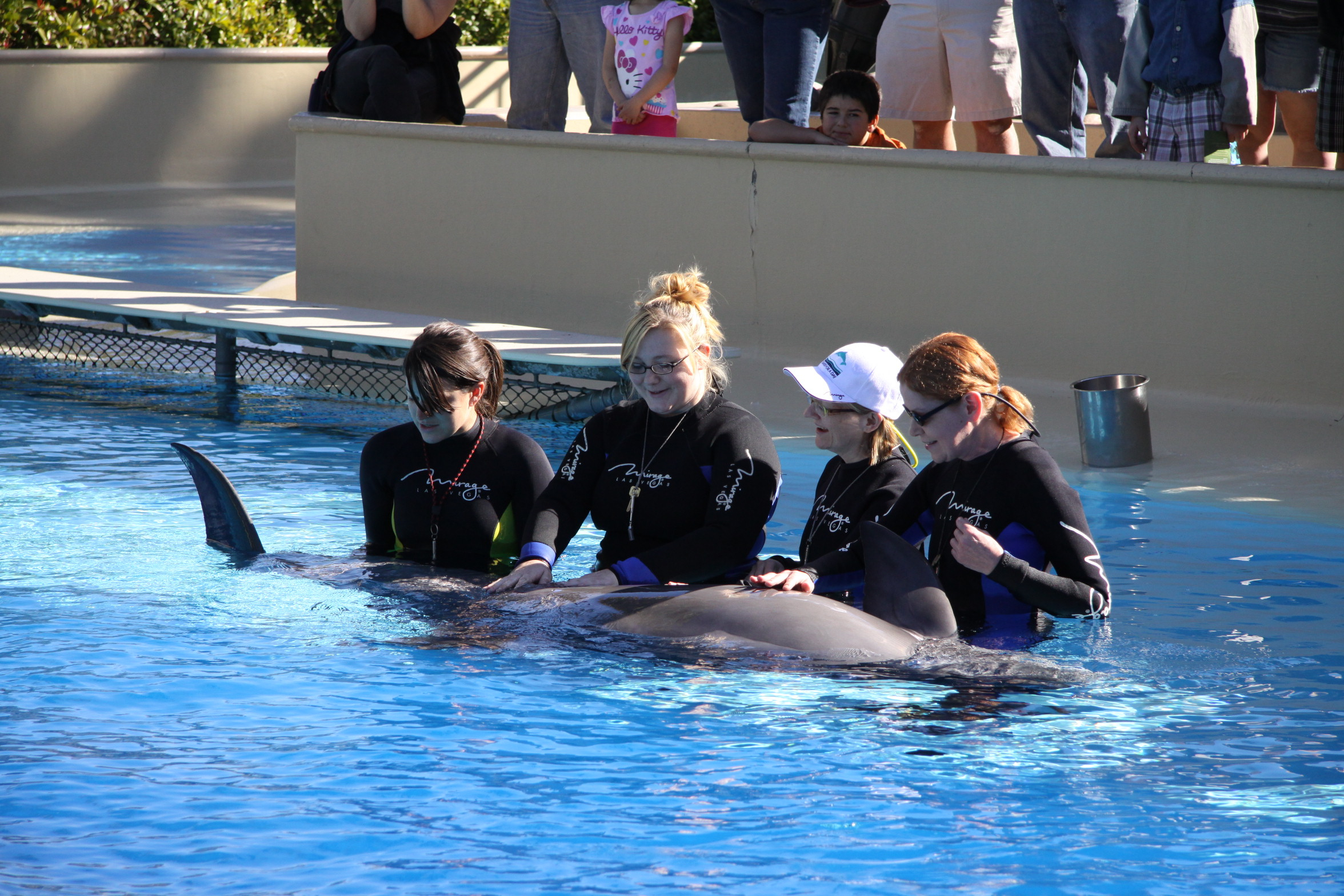
Here we are being taught about how dolphins mate and have their babies. Duchess, the matriarch, allows us to touch her belly and learn about how she cares for her baby.
Giving Duchess a little kiss.

It was a lot of fun to get in the water with Duchess, to touch and even kiss her, but we learned quickly that most of a professional trainers’ day is filled with chores involving basic attention and care for the animals. After our introduction to Duchess, we were led into the room where the food is prepared. This room is kept cold, like a refrigerator, to keep bacteria from growing. This is the room where fish and other food staples are processed, so if the room was warmer, bacteria could grow and cause the dolphins to get sick.

Trainers assigned the task of processing the food must arrive well before the sun rises to clean food buckets and prepare them with the appropriate kind and amount of food for each dolphin. For this particular task, it helps if you have a penchant for perfection. The buckets must be scrubbed completely free of all fish parts, including their very sticky and translucent scales, which often hide out in the damp, stainless steel bucket. Our leader was adept at both seeing and feeling those little fish scales and she made sure the buckets we scrubbed were thoroughly prepared for the next round of food.

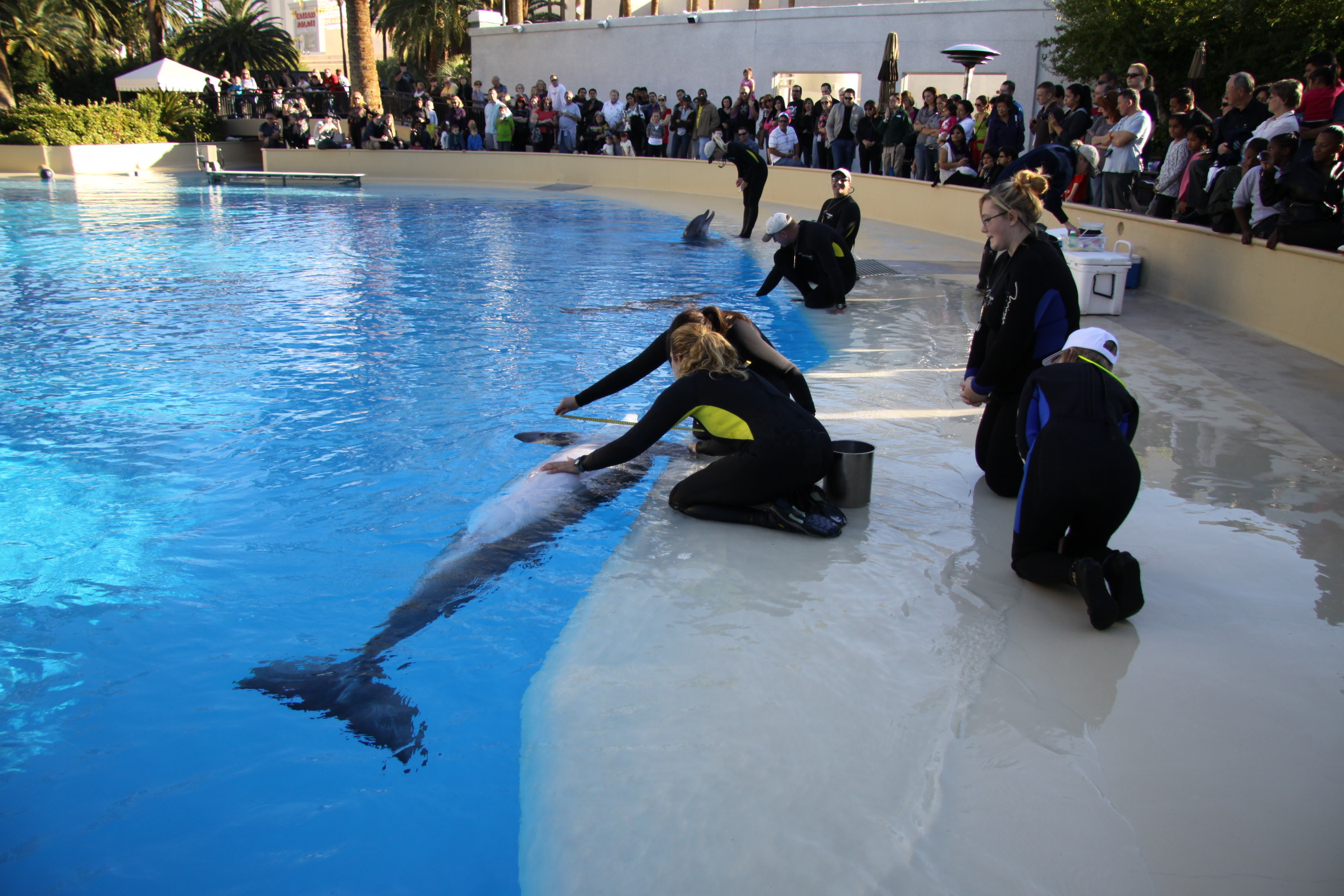
There is a scale on site which allows the caregivers to weigh each dolphin, but if that scale is out of commission for some reason, they can use measurements of the animal to figure the weight. Here, Duchess is being trained to be around a measuring tape.

Caregivers track everything about the dolphins. There are charts in the main office detailing what is tracked each day: what each dolphin ate, how much they weigh, and notes on behavior and training. Other things, like blood samples, are tracked on a less regular basis, to look at the same kinds of things we track on ourselves in order to prevent and diagnose disease.

For example, they guesstimated that one of the male dolphins, Lightning, was in his mid-30s. Apparently, that is pretty old for a dolphin. They wanted to see how he is doing at this stage in his life, reproductively speaking. So, I went with Don, one of the head caregivers, and another Trainer for a Day, to assist in taking a sperm sample from Lightning. What I learned was incredible.

The dolphin brain is one of the most complex brains in the world, in some ways even more complex than humans. In this instance, I discovered that when male dolphins ejaculate, they can decide whether they will provide sperm or not. On this day, Lightning decided not to. Instead, he gave us a sample of some other liquid, which I will not detail here. Rather than get upset that Lightning had not provided what was expected, Don gently sent Lightning on his way–without a rewarding treat–with the understanding that they would try again another day. Lightning was not punished for not doing what they wanted, but he wasn’t rewarded either.

We attempt, without success, to retrieve a sample.

This is all part of a professional trainer’s day. But, like with the sperm sample, I found myself fighting a juvenile embarrassment at first. My next task was just as personal and, therefore, started out with no fewer skittish nerves. My job was to assist in taking a fecal sample.

In both cases I was there mostly as an observer and to hold the sample cup for the professional. I never actually got up close enough to touch body parts or bodily fluids. Still, at first I felt somehow intrusive, both to the dolphin and to the caregivers who do this everyday. Yet, in each situation, my embarrassment was quickly replaced with deep respect for both the professionals working and the dolphins waiting.  All of the professional caregivers I met are the epitome of respectful, to the dolphins and to one another. Their focus and sense of responsibility helped me to focus as well. Because of this, I learned so much about the biology and psychology of dolphins. What started out as childish intimidation turned into fascination and eagerness to help. I remember wishing desperately that I knew more so that I could have been more helpful.

Getting a fecal sample. I kept a respectful distance so as to keep the dolphin from being nervous about my presence. Prior to this photo, he had flinched ever so slightly. The professionals backed off, let him rest, and then tried again with success.

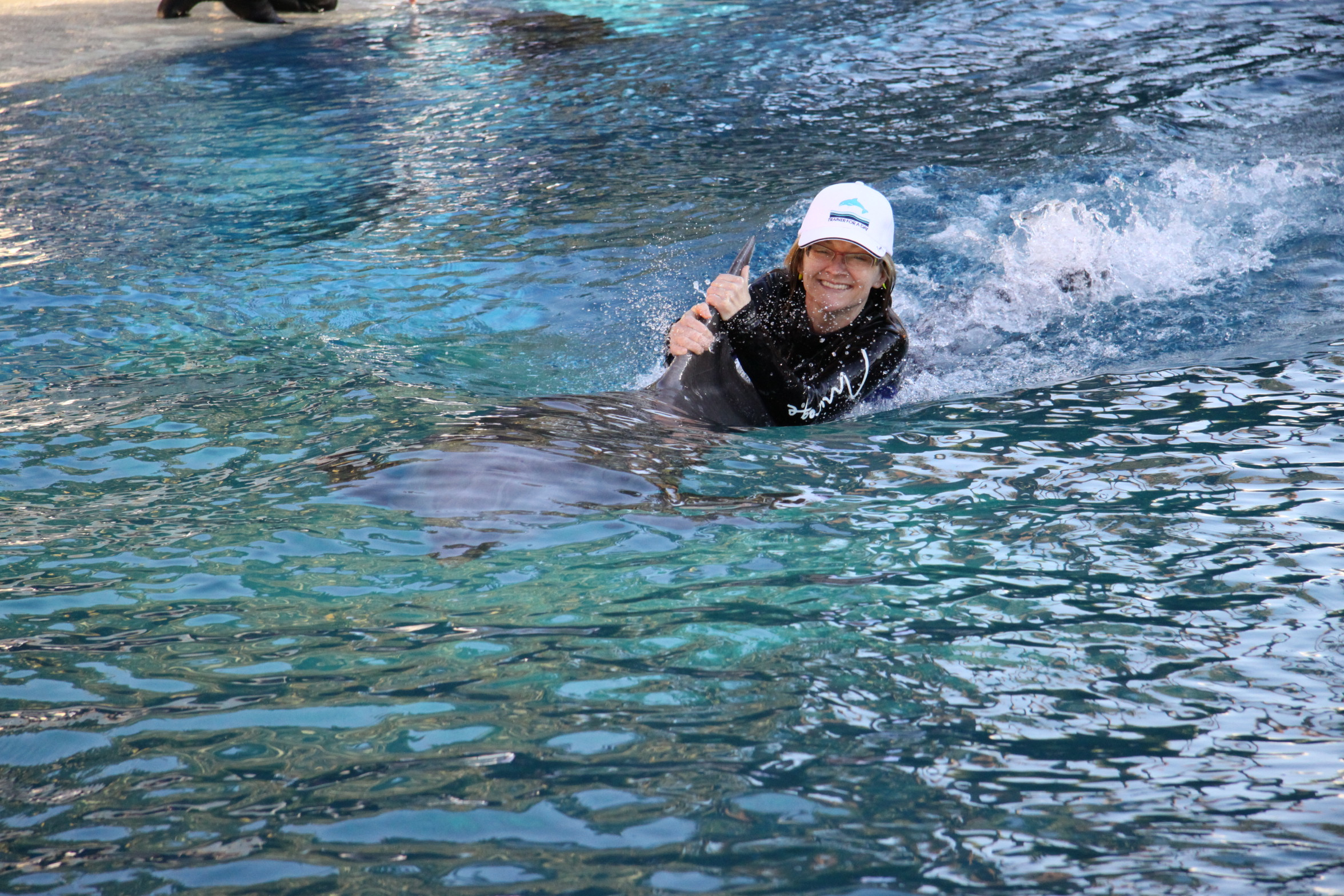
Our day as trainers was not limited, however, to scrubbing buckets and taking samples. We were able to participate in lots of fun things as well. We were given opportunities to touch the dolphins’ fins and bellies. We had our pictures taken with them. We also got to feed them, learning specific methods for getting the fish into the dolphin’s mouth such that it was easy for them to swallow it. My favorite part of the day was swimming out to the middle of one of the pools and being pulled back to shore by one of the dolphins.

Riding to shore being pulled by a dolphin.
All smiles with my buddy, Cosmo.

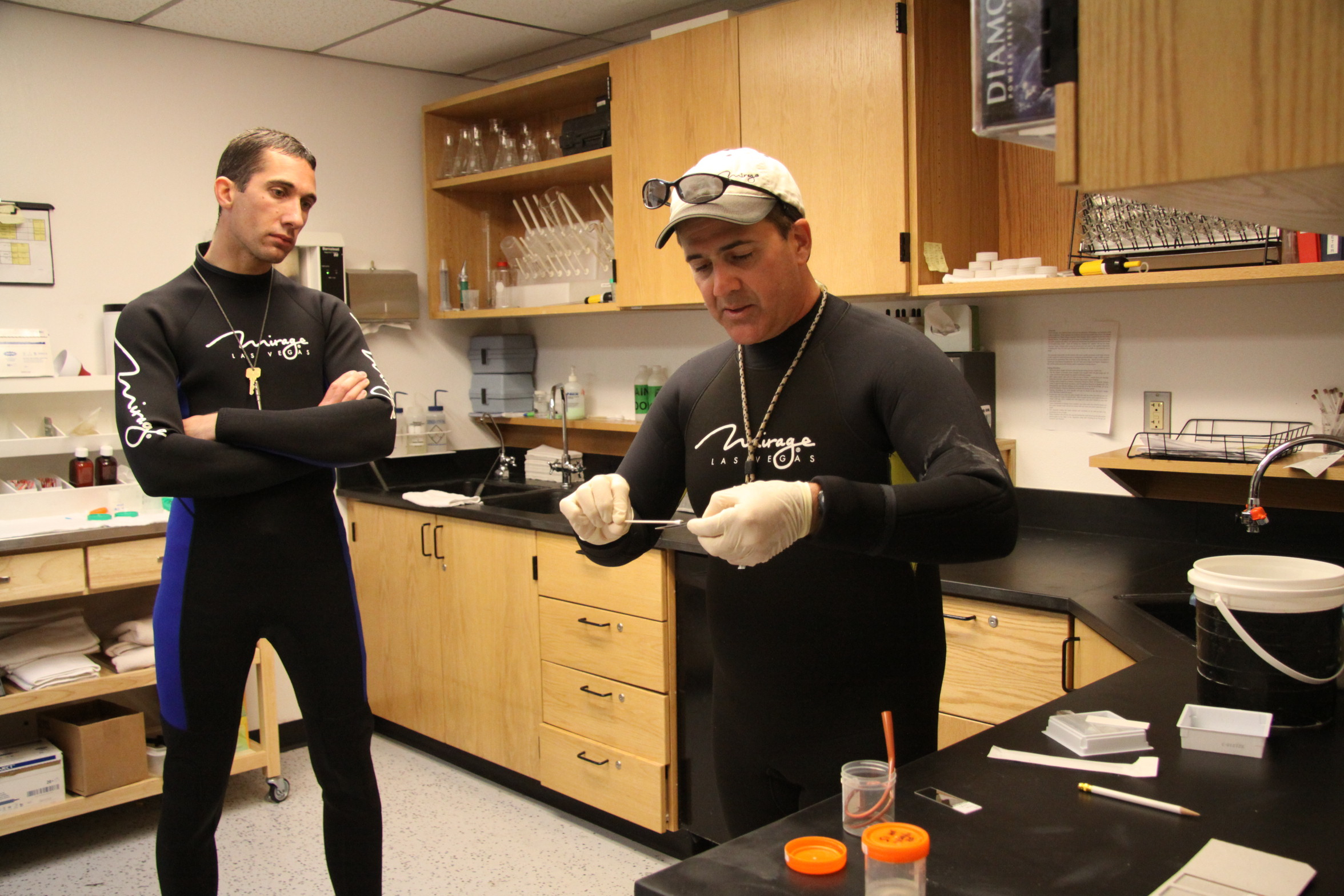
As for all those samples collected throughout the day, we were taken into the lab where the caregivers prepare the samples for doctors to look at and diagnose any issues that may come up.

Don, one of the lead caregivers, shows us how they prepare the samples taken each day to monitor each dolphin’s health.
Waving goodbye to Duchess.

As you can see, the life of a dolphin trainer is not always glamorous. Yet, there is something immeasurably rewarding about it at the same time. When I left at the end of the day, I walked away wishing I could do it every single day of my life. It was a day I will never forget.

To participate in this program, call 702.792.7889, or visit the website for more information. Participants must be over 13 years old. Reservations are highly recommended as only four trainers are allowed each day.

The cost is $550 per person. According to their website, the fee varies seasonally. Each trainer is allowed up to two observers, who are able to go behind the scenes, participate in breakfast and lunch, and get their picture taken with a dolphin as well. Observers are $150 per person.

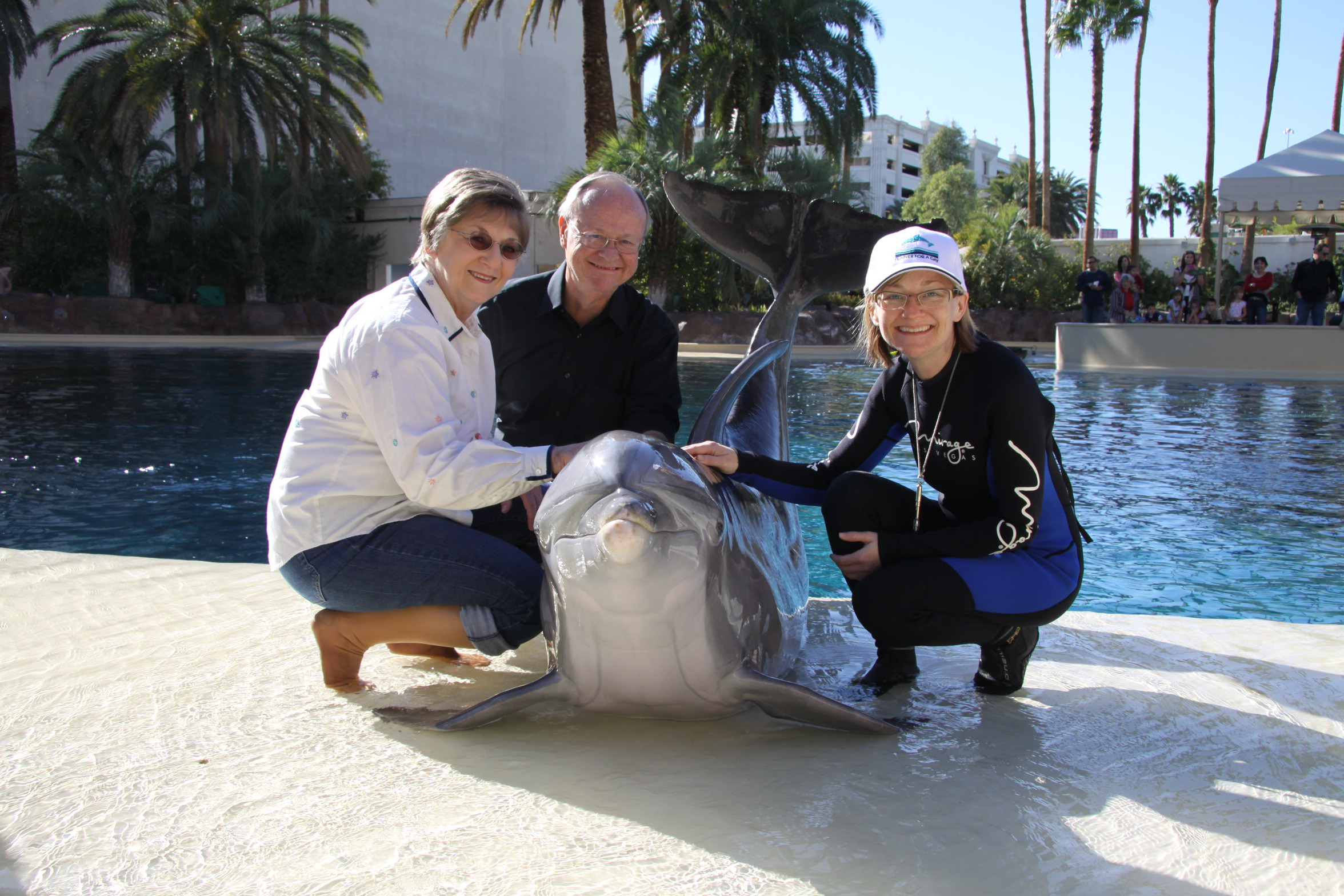
My parents came along to be my observers. Seen here, they got their photo taken with Lightning. They also were able to go behind the scenes, having breakfast and lunch with us and going into the lab to learn more about these amazing new friends.

Upon completion of the program, each Trainer for a Day receives a souvenir polo shirt, souvenir ball cap, an 8×10 photo with a dolphin, a photo CD with hundreds of photos taken throughout the day, and a certificate of completion. Also included in the price is everything you will need, including a wetsuit, a continental breakfast, and a three-course lunch on a private patio.

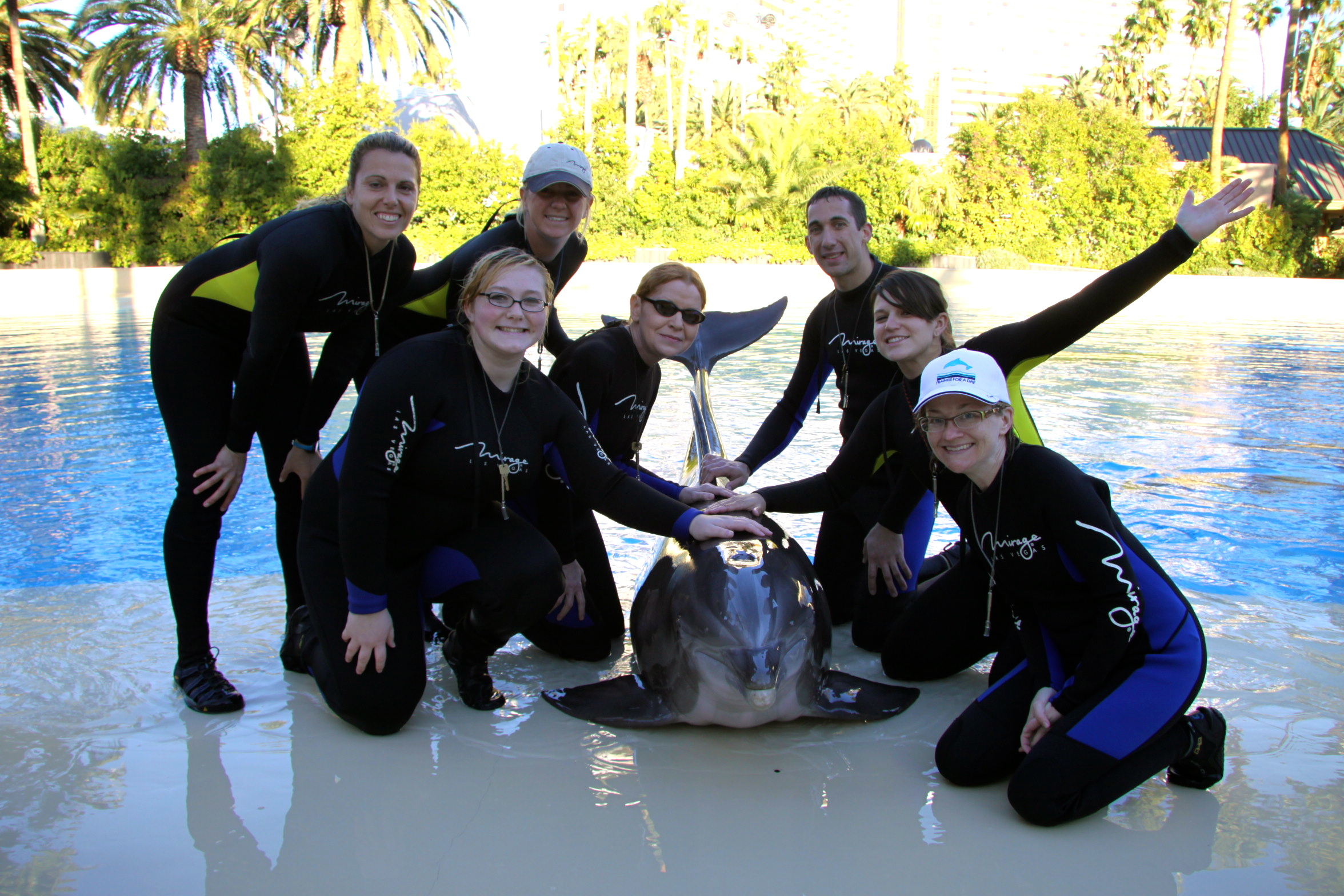
The four Trainers for a Day and the professionals who taught us all we now know about our oceanic cousins.

More photos from my day day as a dolphin trainer can be seen in the slideshow below. All the photos shared here were provided by the Mirage Dolphin Habitat Trainer for a Day program.

This slideshow requires JavaScript.

Traveling where the wind blows

Travelers tend to be restless creatures. A few manage to snip the roots at their feet and blow around the globe like a tumbleweed. Most of us, though, have roots in a place we call home and get itchy when it’s been too long since our last adventure.

No matter what kind of traveler you are, though, our dreams are built on the wind. We scatter to the far reaches of the earth, going where the wind blows.

So, when I came across an article by NPR’s Robert Krulwich which talks about how wind works and shows a work of art made up of wind patterns across the United States, I couldn’t help but be drawn to it, and want to share it with other travelers who might get lost in the patterns as I did.

A snapshot of the Wind Map from March 21, 2012. Photo from NPR.org and hint.fm.

The Wind Map by Fernanda Viegas and Martin Wattenberg looks like something dreams are made of while actually being made up of cold, hard data from the National Digital Forecast Database. The animated map shows wind patterns in near real-time, composed of that data collected throughout the day.

Below is a video of the wind as it blew on March 28, 2012.

To see the patterns of the wind as they blew through the US today, visit Viegas and Wattenberg’s website here. On their website, they mention that they are working toward providing Wind Maps for other parts of the world.

Now that you’ve seen the wind in action, where will it take you next?

Hotel Valley Ho stays fresh while paying homage to the hippest parts of its history

In the scurry that is Sunday morning at the Hotel Valley Ho in Scottsdale, Arizona, Hubby and I, along with a group of eight or so other people, met with Ace Bailey of Ultimate Art & Cultural Tours to learn all there is to know about this Mid-Century Modern hotel with a Southwest twist.

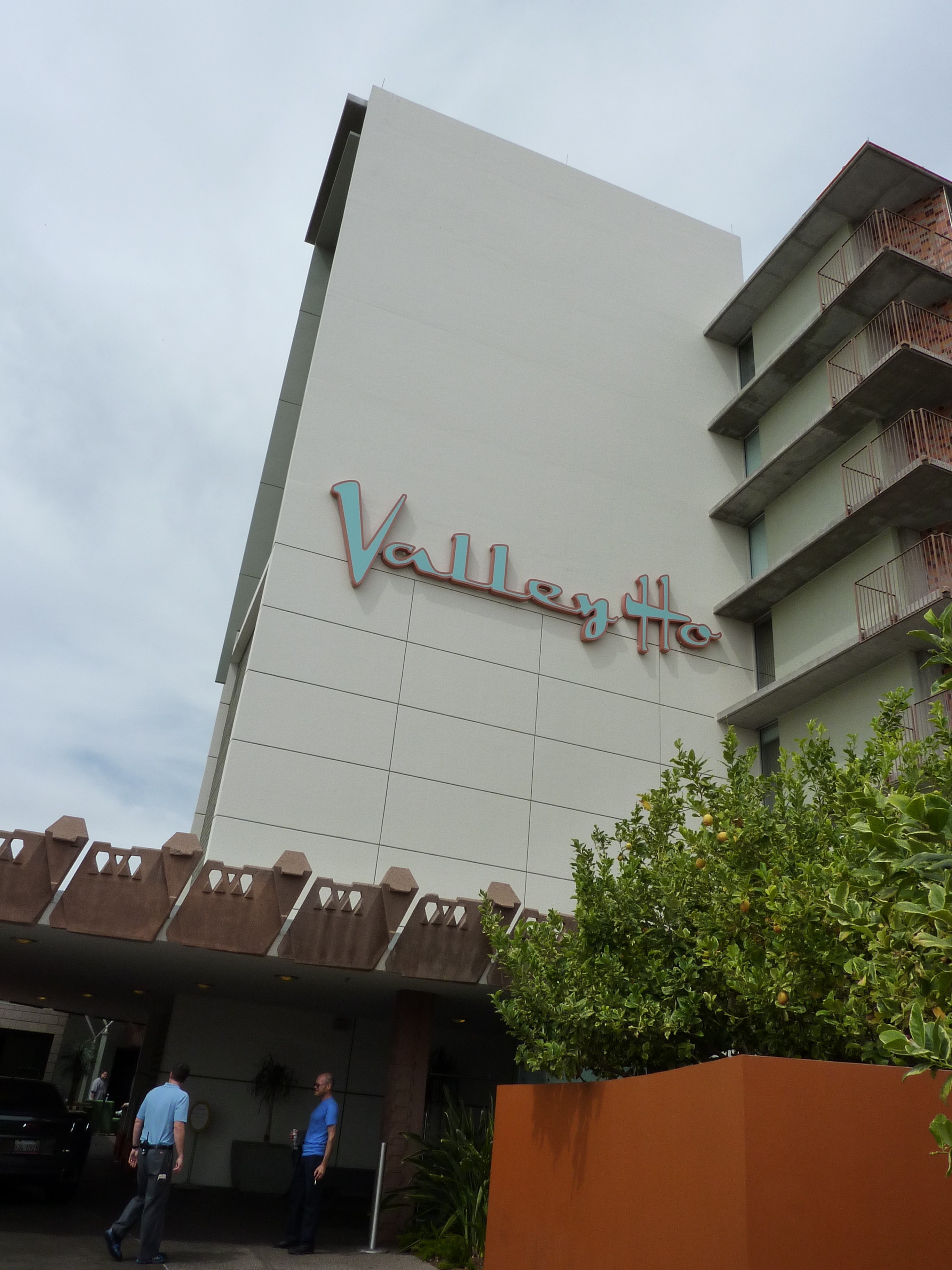
The Hotel Valley Ho in Scottsdale, Arizona. The concrete panels mentioned below can be seen lining the roofline of the porte-cochere along the entrance.

Built in 1956, the hotel was the first year-round resort in Scottsdale. It was lined all around with 350-pound concrete panels that have an “arrowhead” design set in them. The design marked the hotel as “Southwest” while keeping to the slick minimalism of Modern design. The hotel drew Hollywood’s elite to the Arizona desert with the lure of luxury and anonymity. Robert Wagner and Natalie Wood celebrated their wedding reception there. Jimmy Durante was a favorite guest who could often be found tickling the ivories at the purple piano in the lounge.

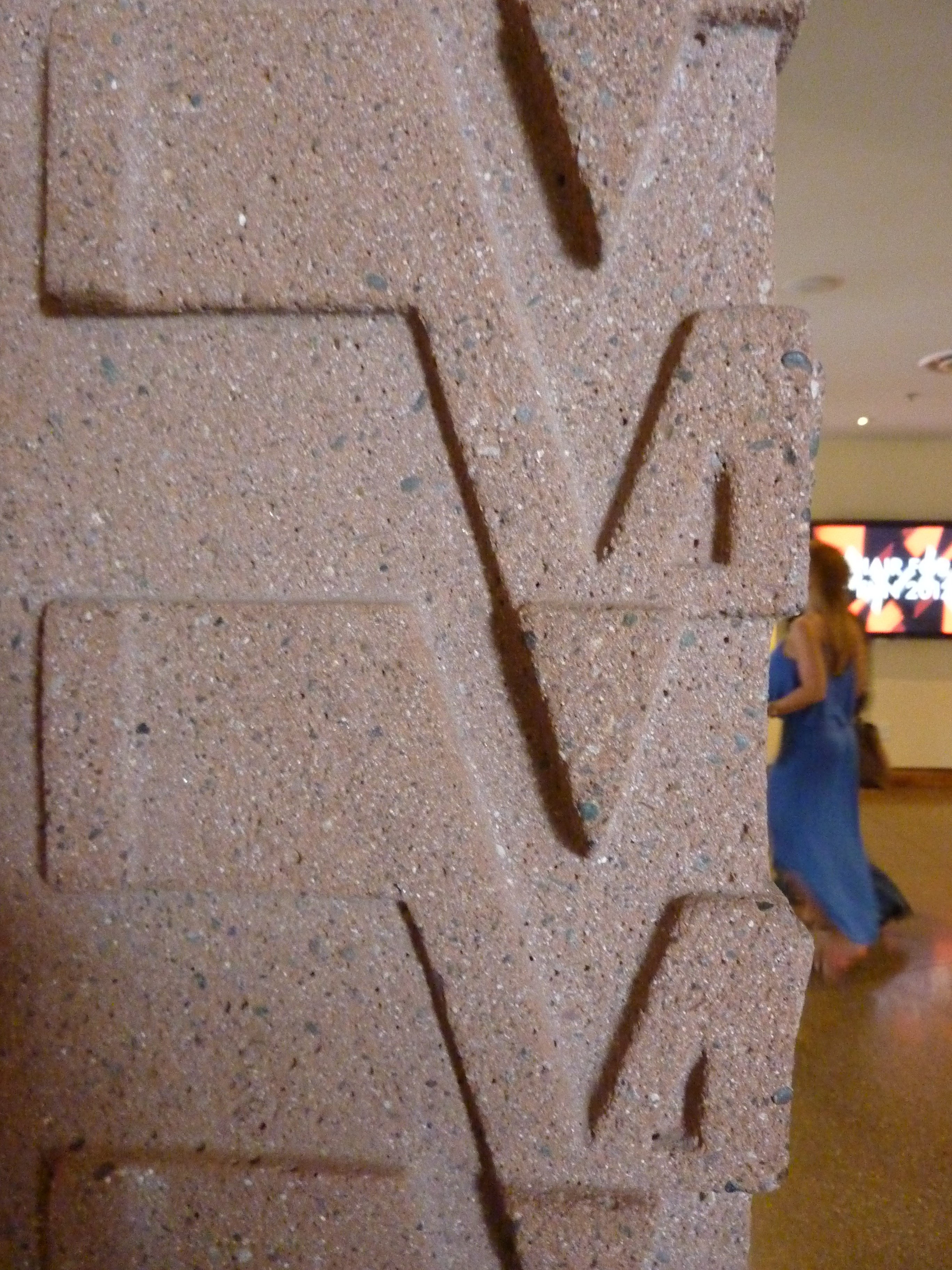
A column in the lobby has the arrowhead design in it. I don't know about you, but I see "V's" in it, for "Valley Ho," maybe?

Through the years, the hotel went through different phases of facelifts. Ramada acquired the hotel in the 1970s and tinkered with cosmetic changes. By the early 2000s, though, the hotel had seen better years and was up for demolition. In 2004, though, Westroc Hotels & Resorts took on the task of bringing the hotel back to life with a full restoration and update, inspired by the building’s cool history. It now embraces its hip past while setting trends for today. It boasts that it is “posh but never stuffy. Relaxed but far from dull.”
Below are pictures from our tour. I think you’ll agree that the hotel definitely clicks along to a familiar, fun-loving groove, inspired by its mid-century roots.

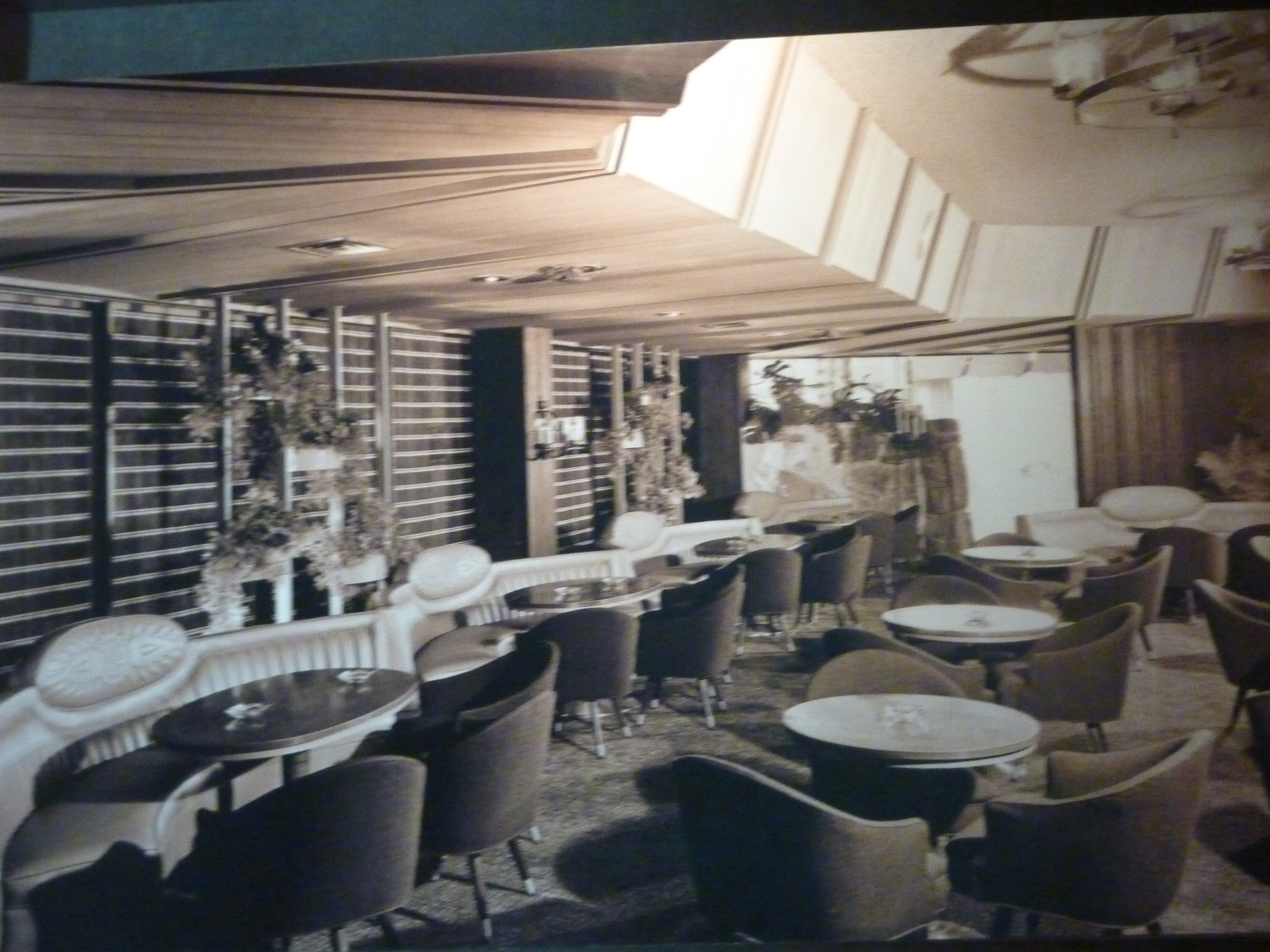
Old pictures of the original design can be found beside the concierge stand. Here is one of the original restaurant.

The lobby has a great expansiveness to it with the stone-clad wall extending outside, beyond the floor-to-ceiling windows. The fireplace is fantastic.

When the hotel underwent its most recent facelift, the developers went out of their way to reuse and recycle as much as they could. In fact, they managed to save 20,000 tons of waste from ever reaching the landfill by restoring the hotel instead of tearing it down. The fireplace in the lobby is one example as to how they did that. Instead of throwing out glass doors that had broken, they used them as a decorative feature in the fireplace. Today, the hotel has been classified as a “Green Hotel“, thanks to its environmentally friendly policies.

The environmentally friendly fireplace.

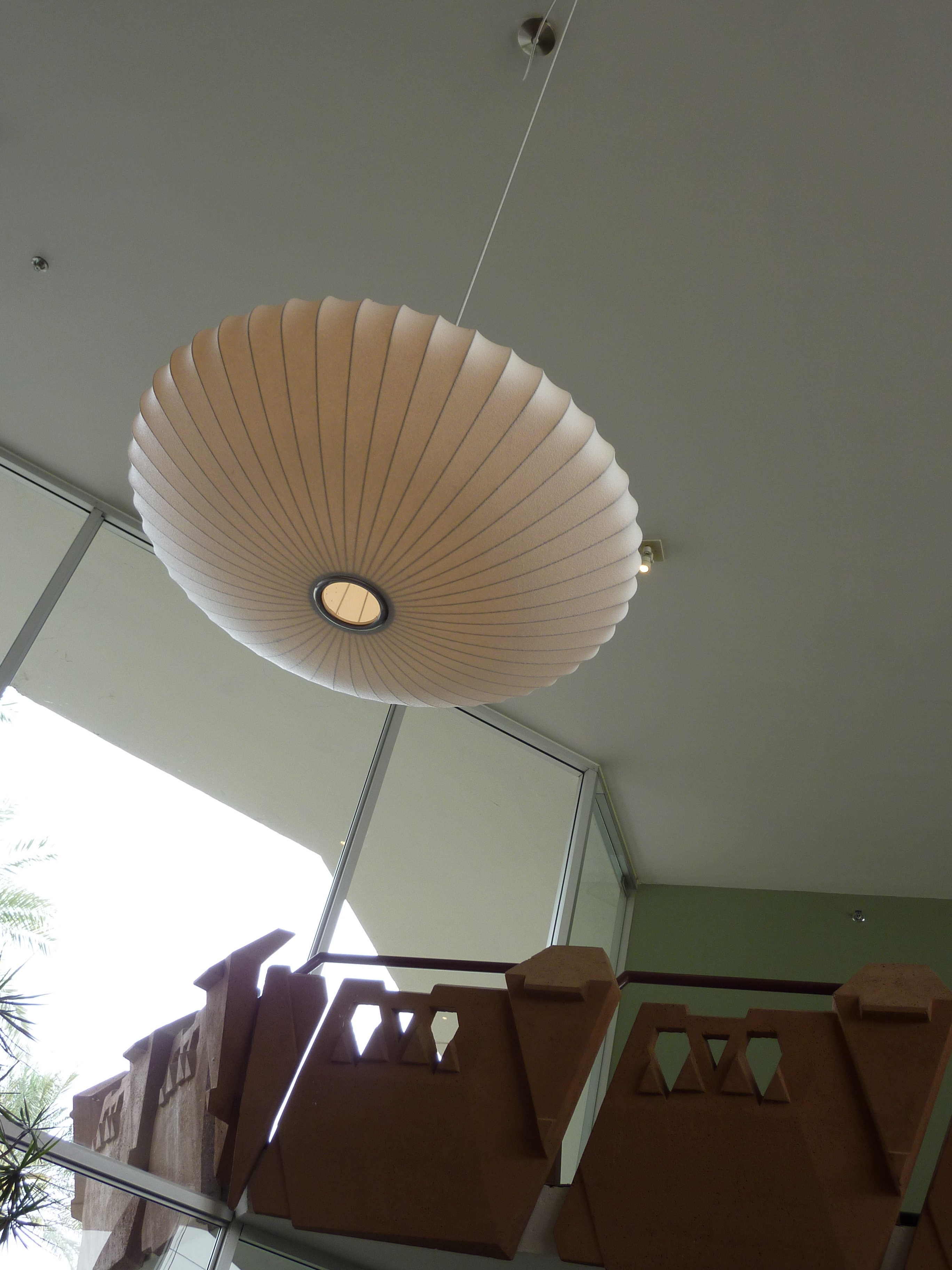
Seen here, the massive concrete "arrowhead" panels lining the hotel, and a Saucer Pendant Light first designed in 1952 by George Nelson, which is translucent plastic spray-coated onto a steel skeleton.

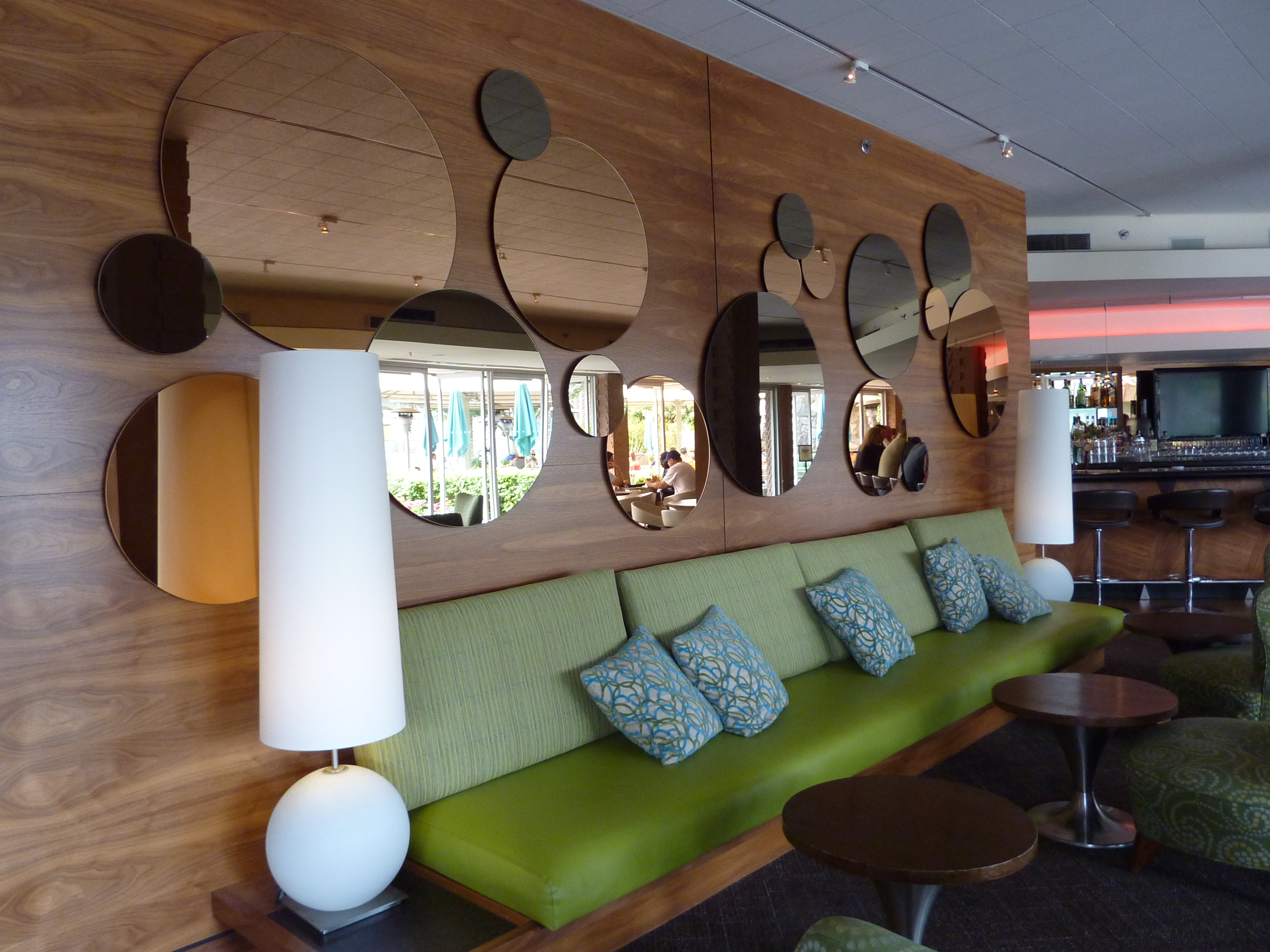
This is the bar/lounge area as it is today. I think they've done a great job of mixing the best of yesterday with what's cool today. I particularly love those "bubble" mirrors and those white lamps.

This curved wall leads from the lobby of the hotel to the lounge area. It is clad in shiny glass tiles. Layered on top of those is a hard-to-miss, funky design made of felt or some other soft fabric in blues and chartreuse.

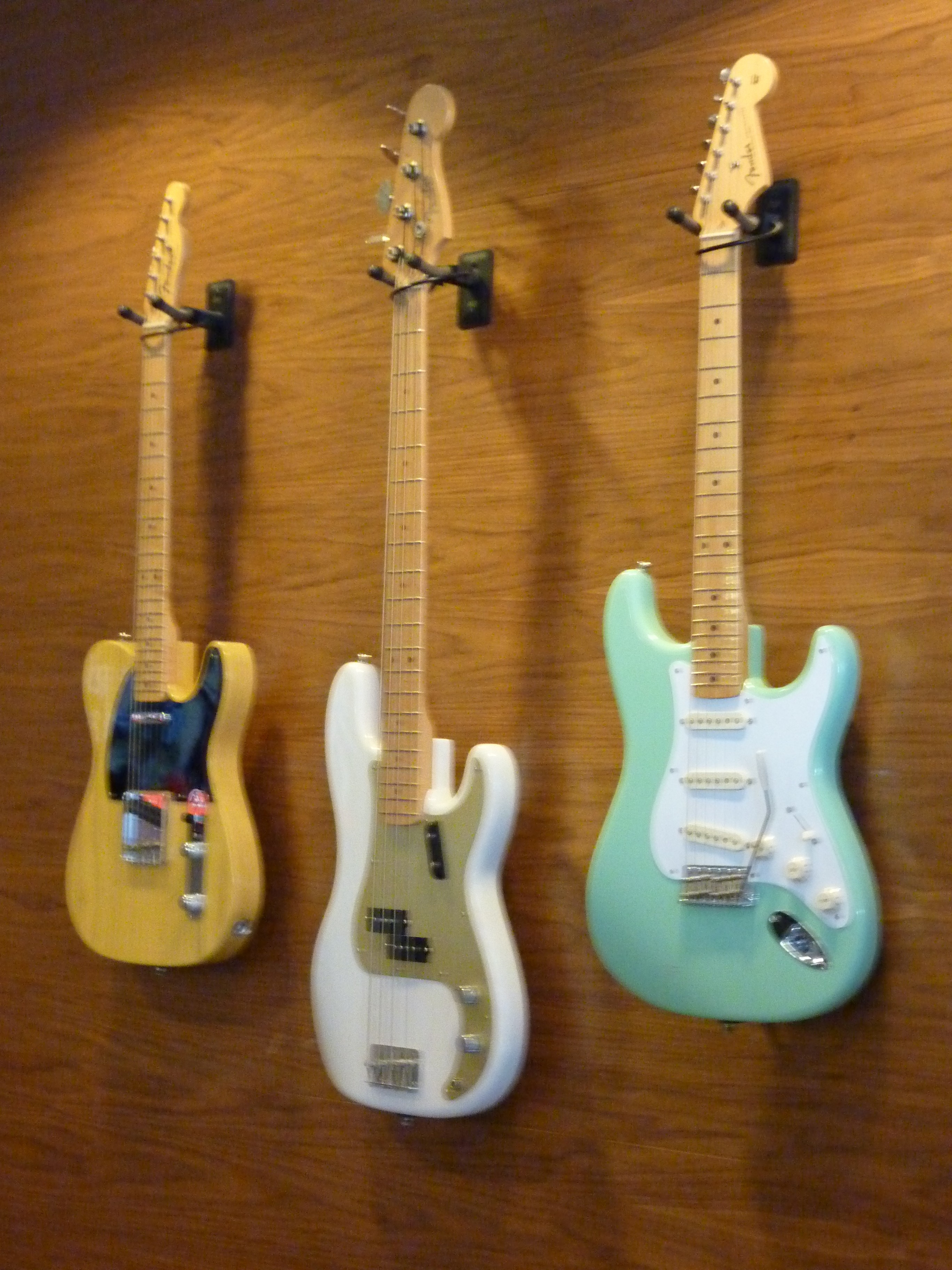
A toast to cool: 1950s Fenders hang in the lobby area, behind the concierge desk.

Back in the day, connecting rooms didn’t exist, so the architect came up with the idea of using rotating screens on the patios and balconies so friends and families could visit one another in their PJs. The screens are still in use today, but perhaps as more of a novelty since there seems to be less concern about being seen in one’s pajamas these days.

Look closely to see the bars which hang from the ceiling and allow the screens to rotate.

From the roof of the hotel, circles of tables perfectly aligned for, what looks like a celebratory dinner.

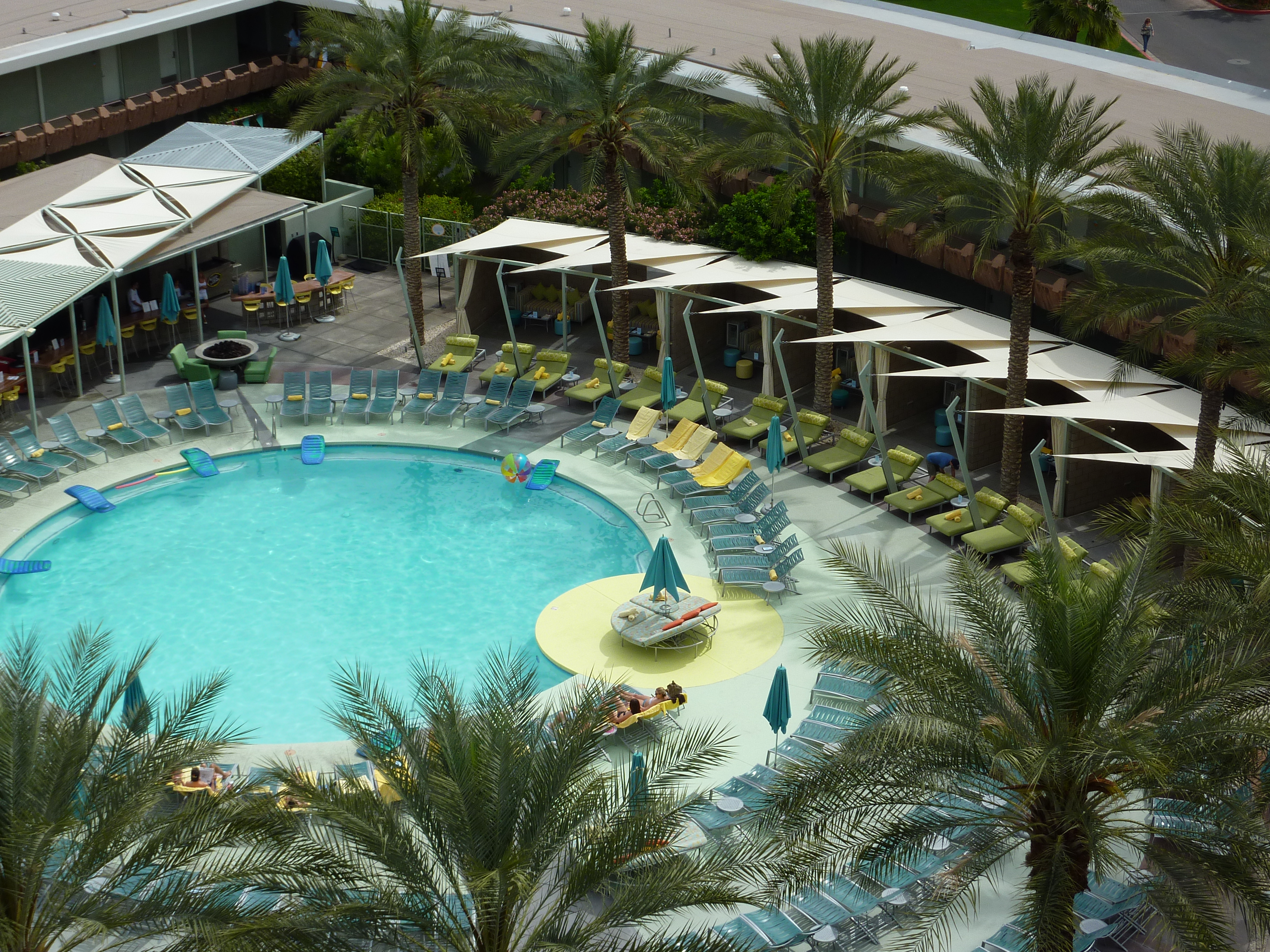
A view of the pool from the rooftop. Notice the shape--a circle within another circle. It is meant to be the view one might see when looking down upon a martini glass with an olive sticking out of the side. The pool shape is not original to the hotel. It had to be completely redone when Westroc took it over because it was in disrepair.

The view of a pleasant balcony for one of the rooms which, I believe, is an executive suite.

Rates for a signature king started at $229 a night when I did a search on their website for a weekend stay. The hotel also has several packages available.

The hotel also offers several rooms to those traveling with pets, providing some special amenities for your furry loved one.

If the price of a night’s stay is too rich for your blood, perhaps visiting Cafe Zuzu for dinner would be more to your liking. While the service can sometimes be a little off, I can personally vouch for Chef Wiley’s American cuisine. They offer new twists on old favorites.

There is a spa on site, as well as a fitness centerMyTown365, another blogger based in the area, recently posted a picture and information of one of the yoga classes provided on the rooftop of the hotel. From the looks of it, it is a very popular class among guests and the community at large.

Finally, if you do nothing else at the hotel, I highly recommend taking the tour with Ace Bailey. The price is $19.56 (in honor of the year the hotel first opened) and the 90-minute tour not only provides access to places within the hotel not usually available to the general public, you also receive discounts to the VH Spa and Cafe Zuzu. For more information about how to sign up for the tour, click here.

Hotel Valley Ho is located within walking distance to Old Town Scottsdale at 6850 E. Main Street, Scottsdale, AZ 85251. To make reservations or for more information, go to their website or call 480-248-2000.

Zipping around La Jolla on a Segway

On a partly cloudy afternoon last October, I took the “Another Side of San Diego” Segway Tour in La Jolla, California. My guide was a very knowledgeable, very friendly guy named Steven. We zipped all over town, taking in sea life, beach scenes, art, and architecture–all while smelling the fresh sea air and feeling somehow more connected to the town, its people, and the sealife because of the openness and accessibility of the Segway.
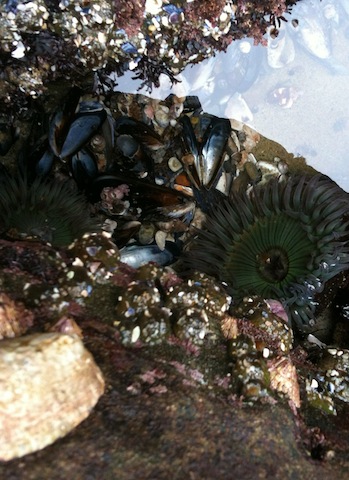
A sea anemone seen in one of the pools left behind at low tide. I think I even tickled this one with my finger.

One of my favorite parts of the tour was actually when we got off our personal transporters to go check out some of the life along the intertidal zone. It was accessible because the tide was out. Happily for me, Steven was a student of zoology and was able to tell me about the starfish, anemones, crabs, and other creatures living in the little pools of water left after the tide went out. It made me want to take their Tidal Pool Tour.

More sea anemones (look closely).

I also loved going into the two art galleries we visited: Legends Art Gallery, where they sell beautiful Mackenzie Thorpe prints and Dr. Seuss reproductions, and Lik Gallery, which showcases the photography of Peter Lik, known for his TV show, “From the Edge” on The Weather Channel. It was so neat to explore these galleries. On our tour, I learned that Theodore Seuss Geisel (Dr. Seuss) lived in La Jolla and was inspired by some of the trees, buildings, and landscapes of the area. Peter Lik’s photography has also been inspired by the shores of La Jolla.

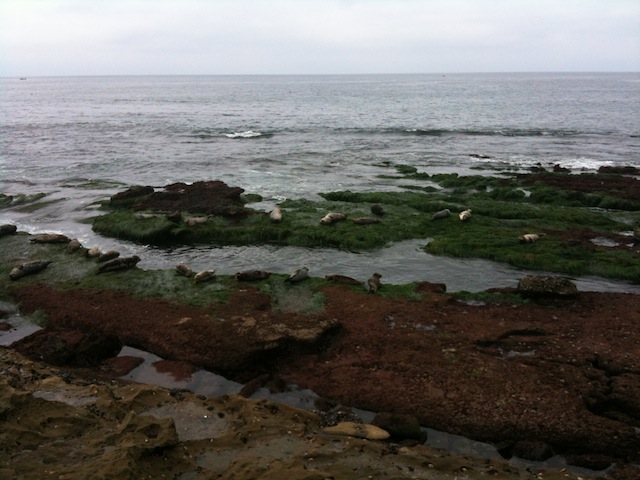
Seals lazing about near the Children's Pool in La Jolla.

There wasn’t anything I didn’t like about my tour. It provided a perfect balance of general sightseeing while focusing in on certain special details about the area. I would do it again in a heartbeat and, next time I’m in San Diego, I would love to take another Segway tour with “Another Side of San Diego”.

The price for this tour was $149. It was two hours in length and started and ended at Scripps Park in La Jolla. I highly recommend it.

Tips

  • Layer: I went in October. The clouds were overhead and made things a little chilly at first. As we went along, though, the sun popped out and warmed everything up. Steven brought along water bottles for the trip and there was a handy pouch on the front of the Segway to store my jacket when I took it off.
  • Wear comfortable shoes: If you heed nothing else I say, heed this advice. The Segway is all about standing and I learned from a previous experience that feet grow very weary standing on a Segway for two hours. I wore tennis shoes on this tour, and was very content the whole time.
  • Don’t forget your camera! I only took my iPhone camera but wished I could have zoomed in on some of the seals sunning themselves out on the rocks.

Flancer’s rocks tastebuds every night of the week

One of the restaurants at the top of our list in the Phoenix metro area is Flancer’s in Gilbert. Their motto is “rockin’ tastebuds since 2000” and they’ve been rockin’ our tastebuds on a near weekly basis since about 2007 when we first discovered them. This is the place we meet up with family and friends. This is the place we take out-of-town visitors when we want to provide a local experience with delicious food. We have also catered our Christmas and Thanksgiving meals several times from Flancer’s. The food is always delicious and it takes all the pressure off.

It’s not a fancy, hoity-toity kind of place, but that’s one of the reasons we like it. We can go there, knowing the food and service is going to be excellent and we don’t have to dress to the nines to experience that. All we have to do is come as we are, relax, and unwind with all the other folks who have discovered how great Flancer’s is.

If the sign is lighted, tastebuds are ignited!

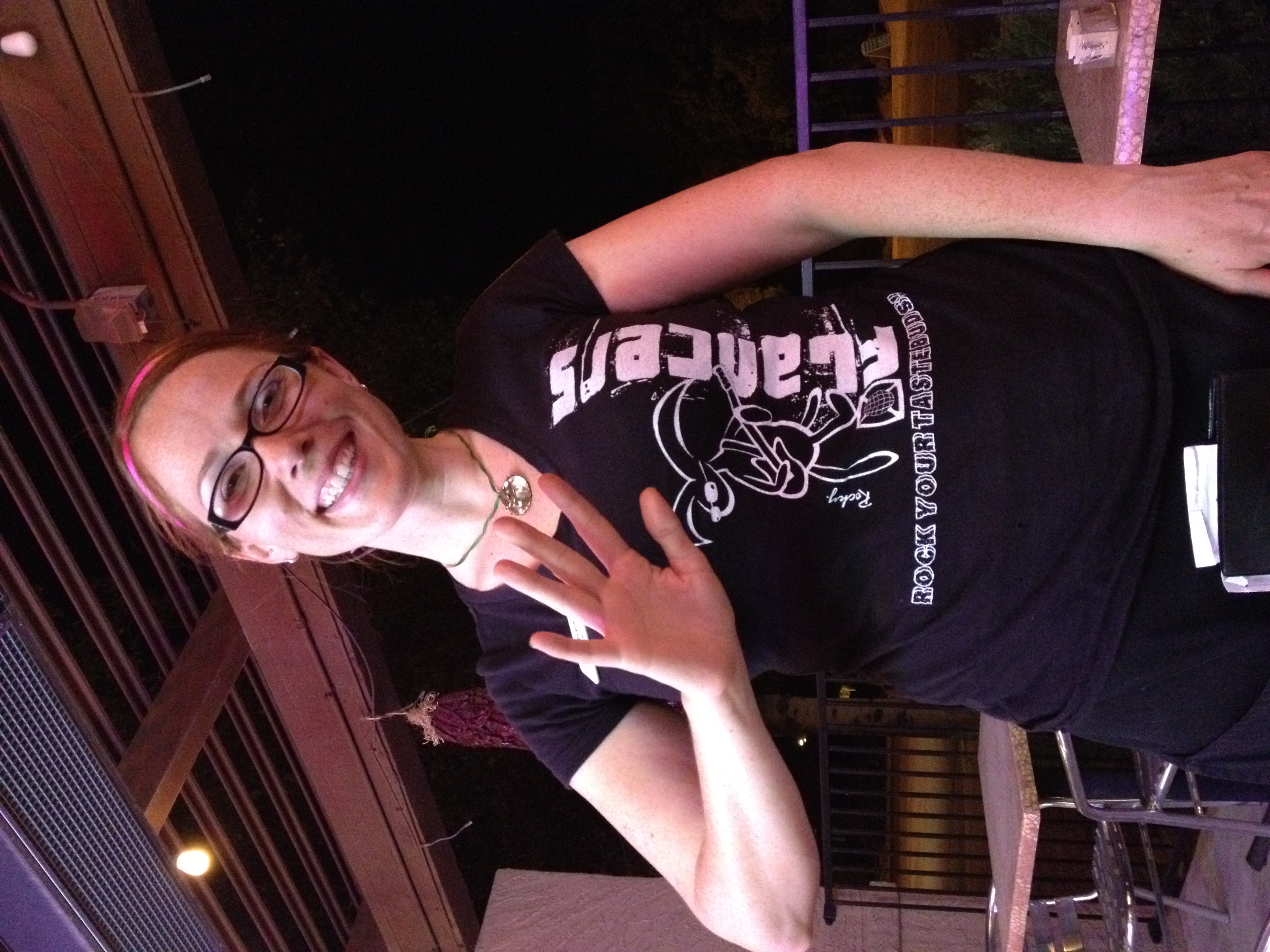
Pictured below is Juliet, one of our all-time favorite servers who has become a great friend. She takes such good care of us. She always remembers our regular orders and makes us feel like VIPs. As you get to know the staff there, you learn that a lot of them, like Juliet, are vibrantly creative. Juliet is an artist who was featured at a gallery downtown. Jimmy, the general manager, is an accomplished musician and artist in his own right. It’s no wonder the atmosphere at Flancer’s is so alive when you have such creative, thoughtful people working there.

We love Juliet! Hugs!!

The fun starts as soon as you walk in the door at Flancer’s. Jimmy is there with great advice on the beer selections that he hand picks every week. Hubby always loves his choices of IPAs. And Kacie is a wisecracker who cracks us up even before seating us. Below, she gets in on the fun as I tried to capture a picture of Hubby on the Flancer’s patio.

Silly, Kacie!

Their patio is one of my favorite spots to eat in the Valley. Even though it sits alongside a busy street, the cafe lights and the great music piped through the speakers overhead–classics from the 60s, 70s, and 80s–make me feel as if I’m on an isolated island where everyone knows my name (Cheers!) and I know all the words to the song. It’s just a very easy place to be.

On this night, we had the patio almost completely to ourselves, but don’t let that fool you! That same night, we had to wait 20 minutes for a table because we got there when the restaurant was completely full.  When we first got seated, the tables on the patio were full. We just linger longer than others and, by the time I took this picture, the patio was almost empty. It is a hopping place and does not take reservations, so be prepared to hang out. It’s worth it!

The patio is dotted with pretty cafe lights and heaters for when it gets cold.

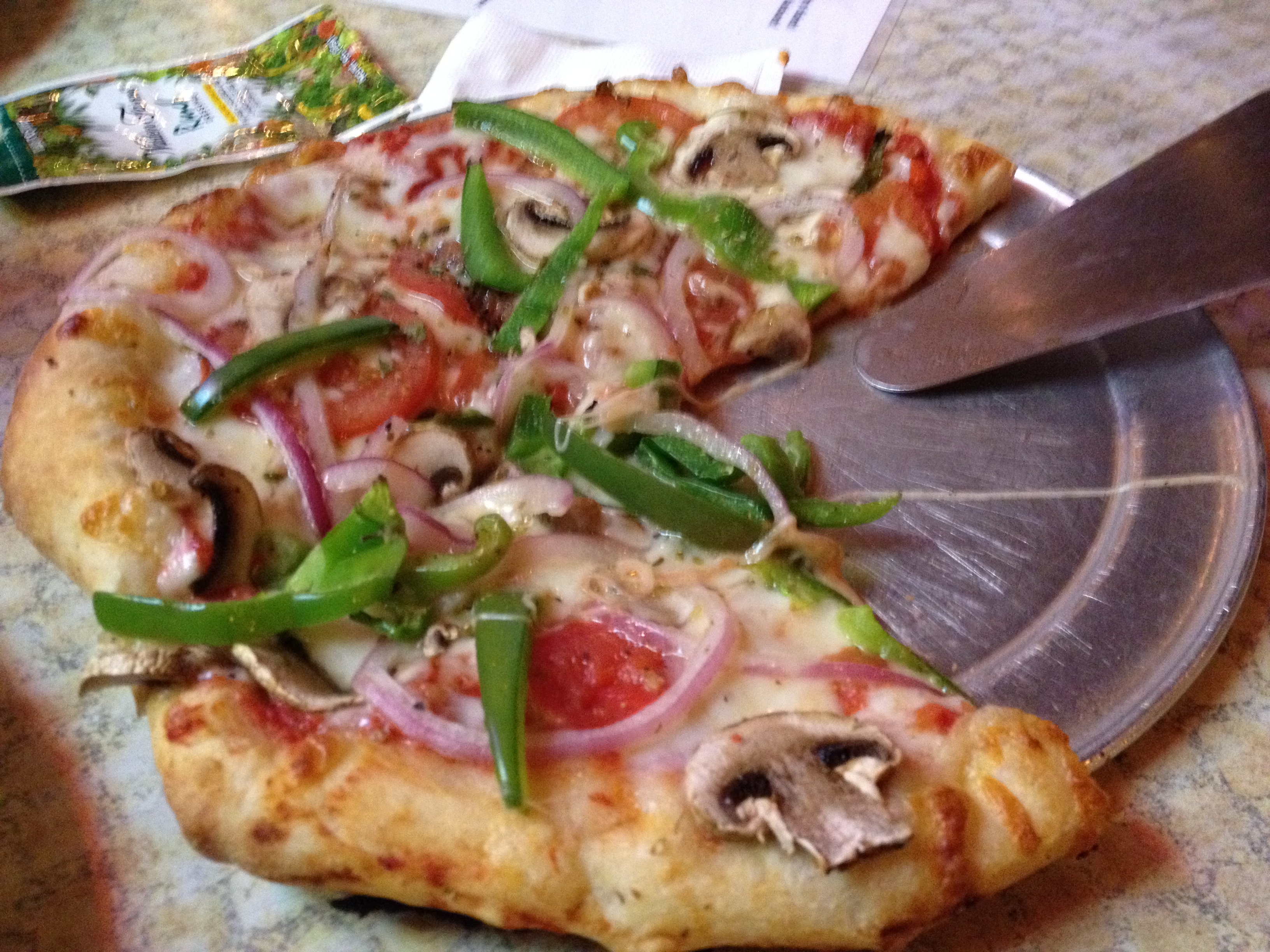
My favorites on the menu for dinner: the Veg Out pizza (pictured here) or the Vibes of Veggie sandwich. Their bread is homemade and slap-your-knee fantastic, so pretty much all their sandwiches are a hit. Hubby likes their buffalo tenders with HOT sauce.

Veg Out Pizza, minus the black olives.

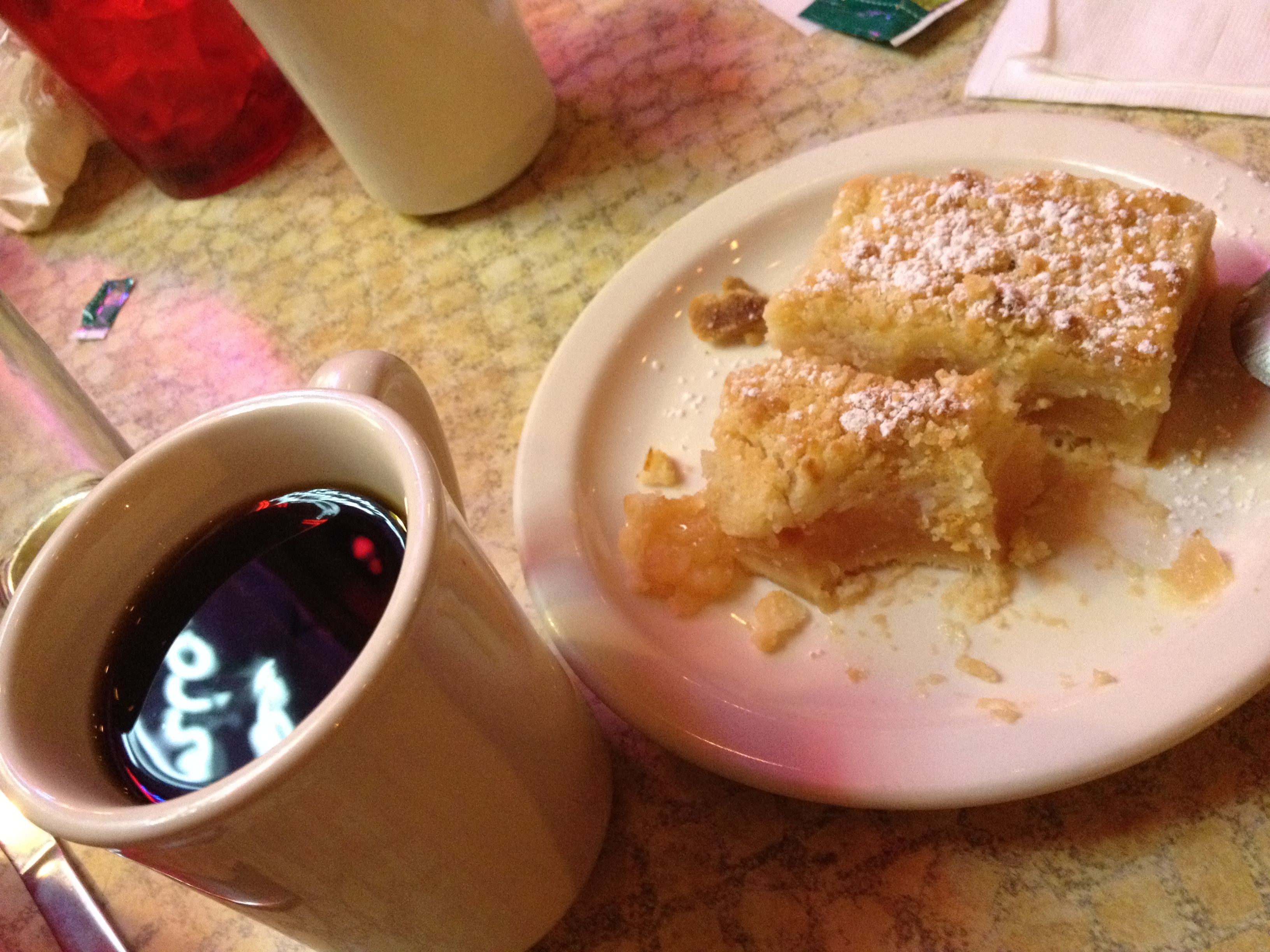
Juliet always puts on a fresh pot of Lavazza coffee when we arrive. It’s fresh and a perfect accompaniment to the cobbler of the week. My favorite is the strawberry cobbler, but shown below is the apple-cinnamon. Yum!

I only eat half of it because I'm keeping track of calories, but it is good enough to inhale the whole thing.

There are two Flancer’s locations, one in Gilbert and one in Mesa.

The Gilbert location can be found at 610 N Gilbert Road, a quarter mile south of Guadalupe, near historic downtown Gilbert. Take out orders can be made by calling 480-926-9077.

The Mesa location is at 1902 N. Higley Road, on the southwest corner of McKellips. Take out orders can be made at this location by calling 480-396-0077.

Flancer’s is rockin’ it seven days a week 10:30am to 9pm. Happy hour is from 3pm to 7pm everyday!

For more info, visit their website, which provides access to their menu, along with information on upcoming events, such as the Charity Beer and Cigar tasting. If delicious food, fun atmosphere, and great people aren’t enough, Flancer’s is big into supporting the community, so many of their events benefit charities. Currently, they are organizing a raffle which will support the Wounded Warrior/Warfighter Sports. When we eat there, we feel great knowing we are supporting a local business that goes on to support others. It’s win-win all around.

Thanks, Flancer’s and all the staff there, for being such a great place we are happy and proud to call home!

In search of the perfect traveling shoes

The summer is approaching and, for me, that means an extended period of travel to different places with different climates. In all the places, Hubby and I will walk at least 5 miles a day. Sometimes we walk to dinner and back. Sometimes we walk to the theater. Other times, we’re just strolling through town, window shopping or cafe hopping. No matter what we’re up to, I have to have comfortable shoes that can see me through all those miles and different situations.

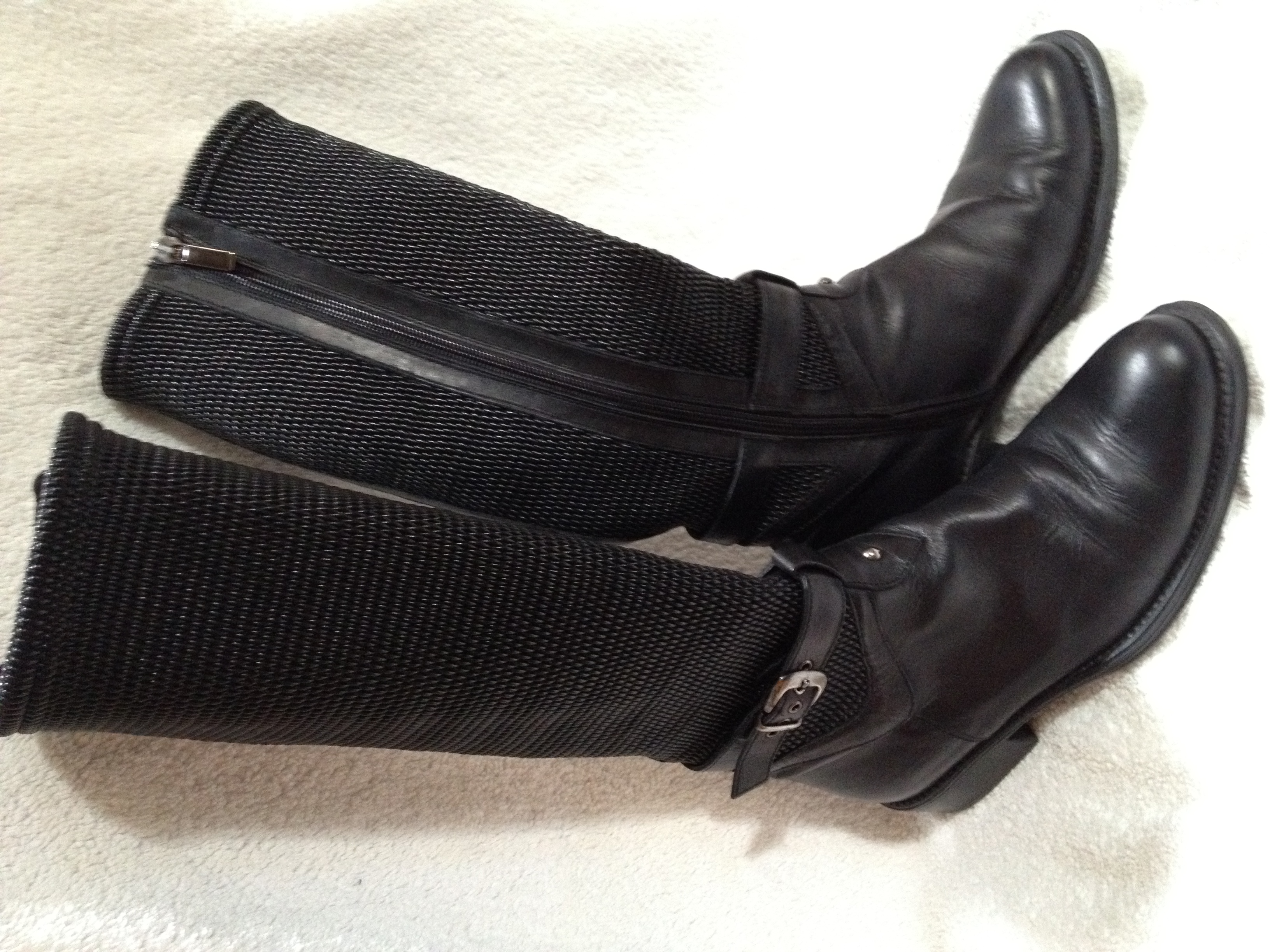
It’s easier in winter to find comfy shoes that look grand in a variety of situations. These boots from Aquatalia by Marvin K saw me through the hills of San Francisco, a downpour in Toronto, dinner and Shakespeare in Stratford, Ontario, and countless other places where I had to walk outside for miles in occasional inclement weather.

Knee-high flat boots from Aquatalia by Marvin K are comfy and weather-proof. They also fit will in a variety of situations.

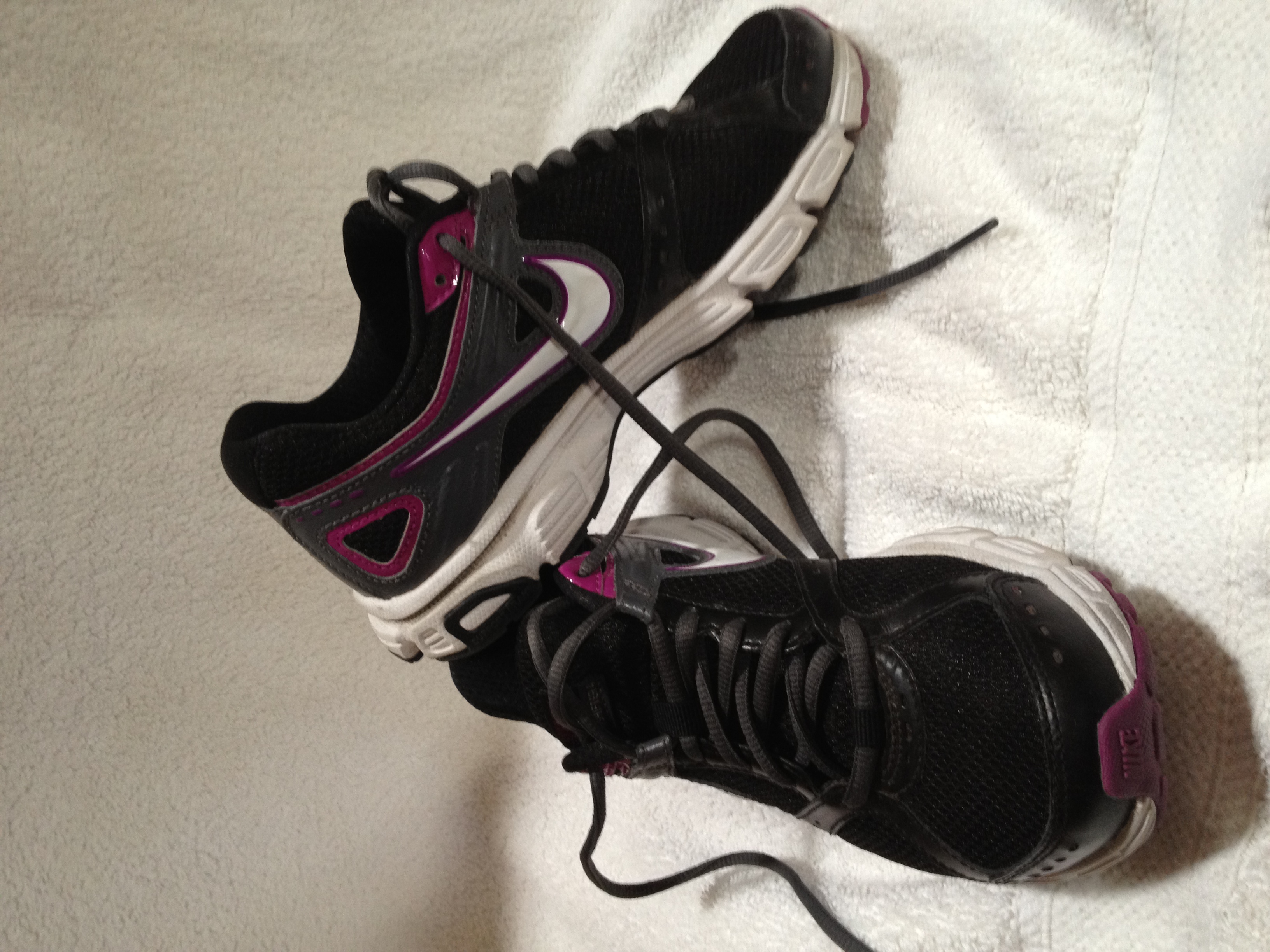
When attire isn’t as much of a concern, or casual wear is the norm, the Nikes below are my go-tos. They’ve seen me through some of those same San Francisco hills, an architectural tour in Palm Springs, a Segway tour in La Jolla and another one in St. Paul, Minnesota. I wore them to dinners at local jive joints with black pants and a top with a jacket for a sporty urban look that was incredibly comfortable. (I actually got compliments from that outfit!)

Nike Air Pegasus sneakers. I think the black color and shine of the fabric help them fit into a few other situations where white sneakers would stick out. Still, I only wear them for casual dinners and events.

With just two pairs of shoes needed for pretty much any situation, it was easy to pack and fairly light to carry. The boots come off quickly for airport security and go back on just as quickly. The sneakers were actually slightly more trouble since they have laces, but they were lighter and easier to pack in an overnight bag.

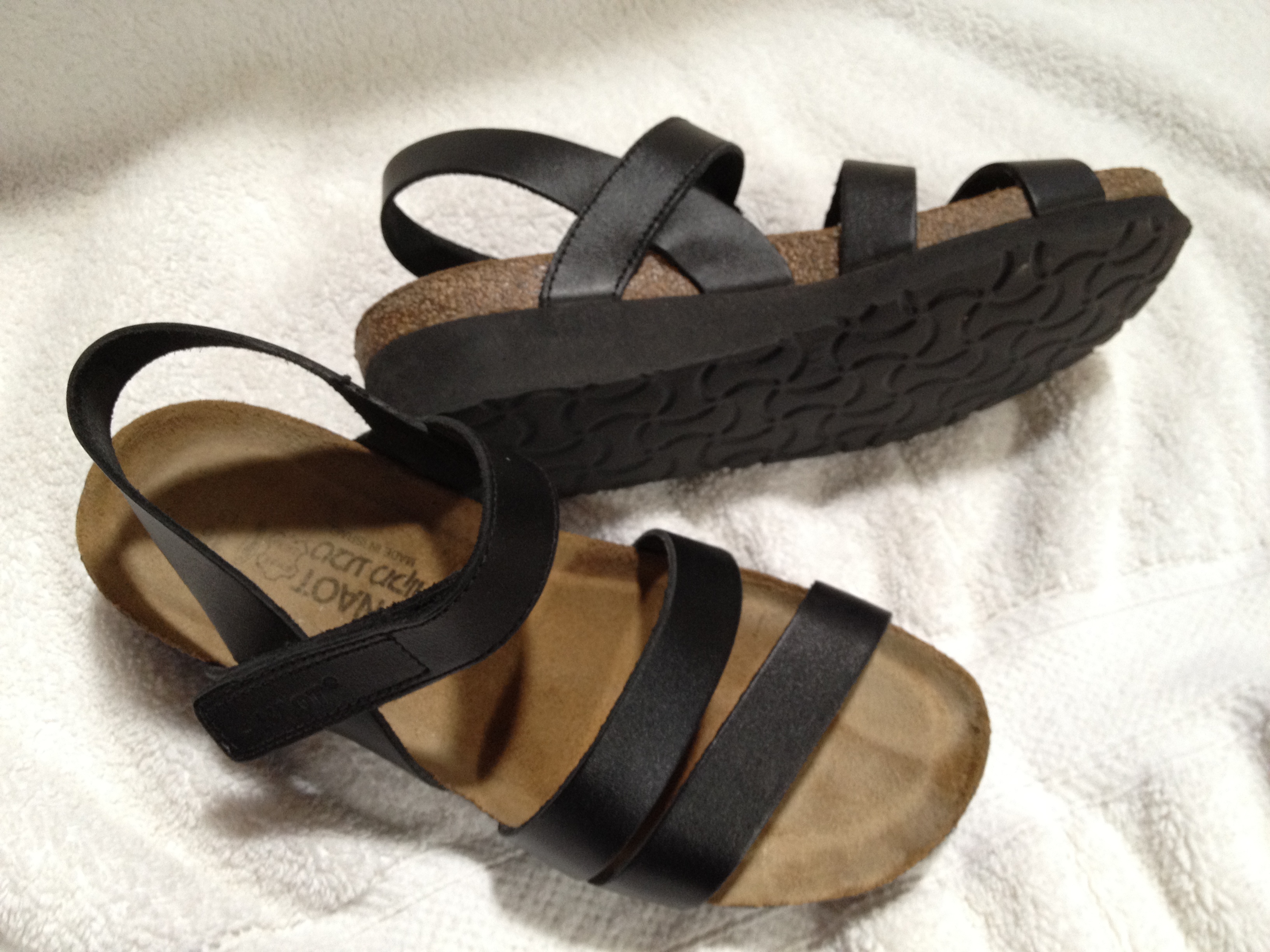
So, now we approach the summer and, as I pour through my closet, I feel woefully unprepared for the summer’s upcoming trips and events. The Nikes can probably transition to summer in the same capacity as before. And I have one pair of sandals that are the most comfortable I have ever owned:

Sandals by Naot. They seem to fit into several different situations and I have walked more than five miles in them in one day without blisters or pain.

These are great for probably 70% of the things I do in a given day and, unlike the Nikes, they look good with long skirts. Still, my problem with relying solely on sandals is that, they’re not as comfortable during those summer rain bursts. And, when I walk long distances through dusty or gravelly areas, I always end up having to stop in order to free the little pebbles that try to hitch a ride under my heel.

Shoes such as those I seek do exist. Last summer, I wore these shoes through visits to St. Paul, Minnesota, Ann Arbor, Michigan, and Mackinaw Island, not to mention return visits to Phoenix and its hot, hot summer:

Suede penny loafers with Nike Air technology by Cole Haan. They looked great with jeans, capris, and certain skirts.

They were far more comfortable than I would have imagined them to be at first. They’re built to look like loafers but they bond to the foot more like flats, thanks to the moldable suede. The difference, though, is that with loafers, the leather is usually stiff and, in flats, the support is usually minimal. Walking miles in either kind of shoe often ends up in blisters and/or incredibly sore feet. These, however, rocked like Elvis’s shoes of the same variety (blue suede), fitting into a variety of situations and going with a lot of different outfits. But, as you can see, they have seen better days, and I’m afraid their support is starting to break down after so much wear.

This brings me to the contenders of new shoes that can be supportive, sporty, dressy, and closed-toed to fit a variety of summertime situations. At 41 years old, my trotting around all day in high heels are over. Still, I can’t help but salivate over these (and I may get them later for those times when I’m going out but not walking far):

Not exactly sporty or closed-toed, but...drool. Karma heel by Aquatalia by Marvin K.

As of yet, I have not found the one that fits all of my requirements. The shoes I have tried either rubbed horrible blisters, made my feet sweat, or they were just downright uncomfortable.

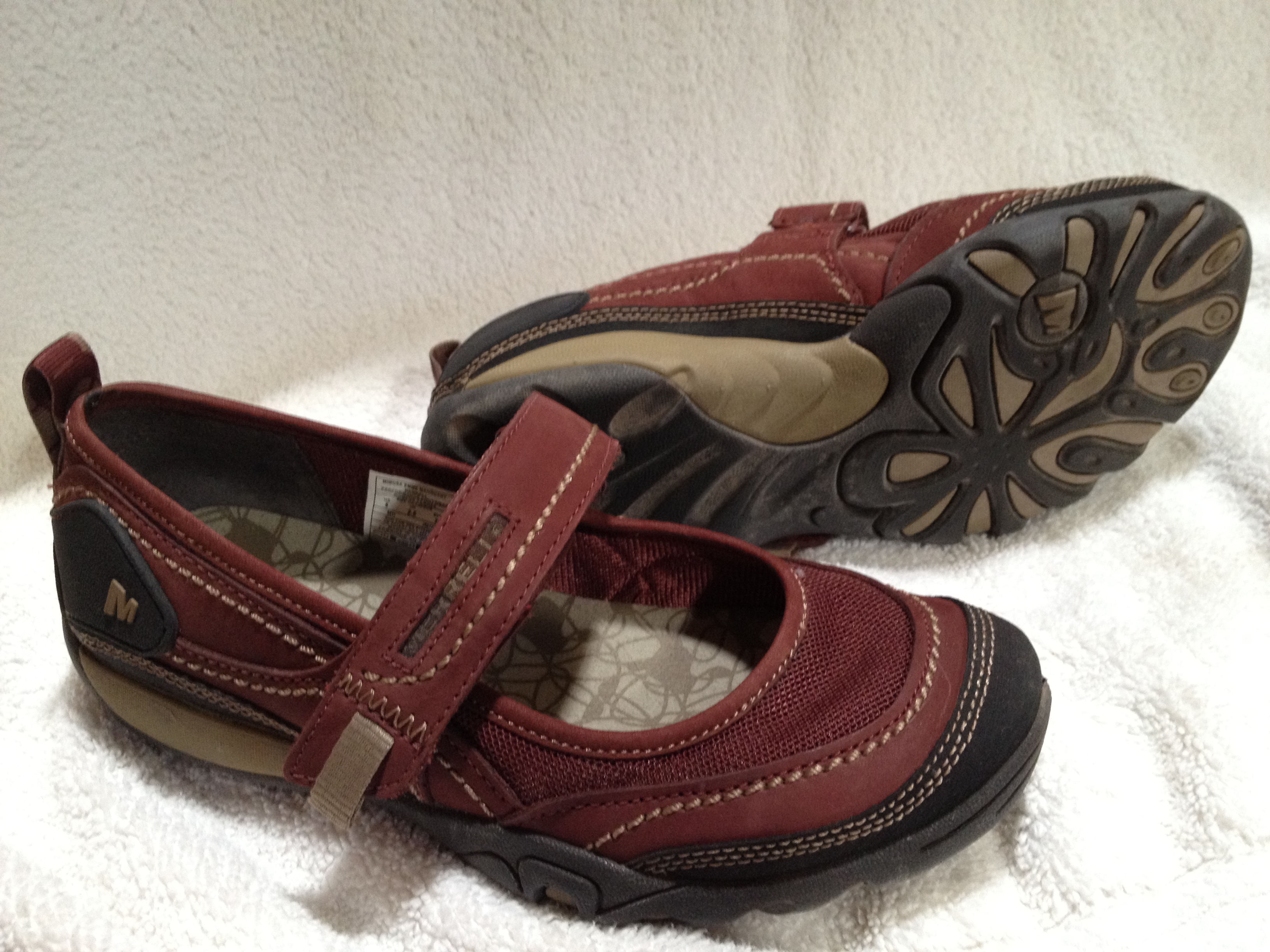
These Merrells had promise, but when I wore them to walk a mile to coffee and back, they drew blood from the blisters they rubbed! Ouch!

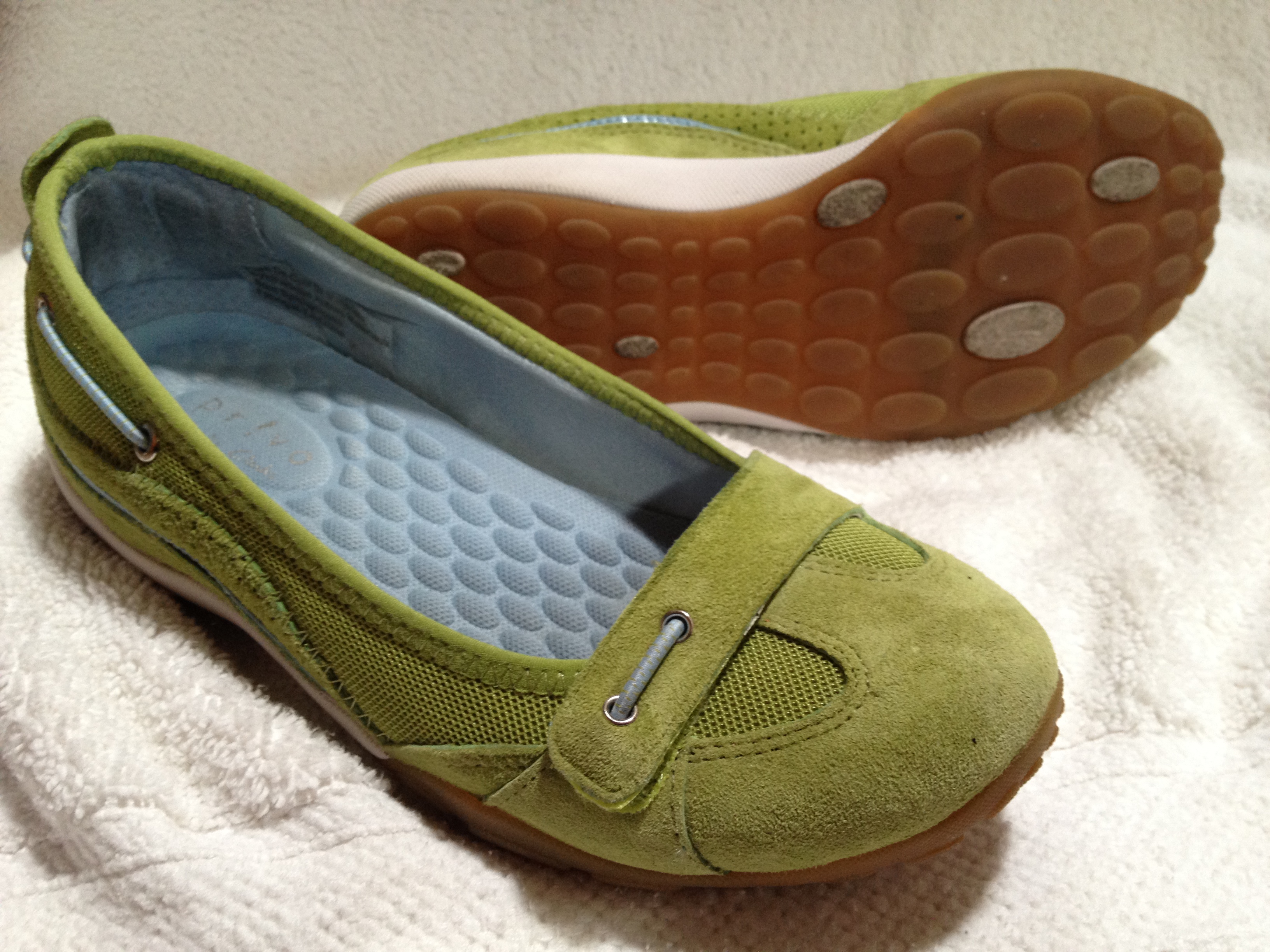
These adorable little shoes from Privo by Clark's are spunky, sporty, and incredibly comfy, but they make my feet sweat. Ewew!

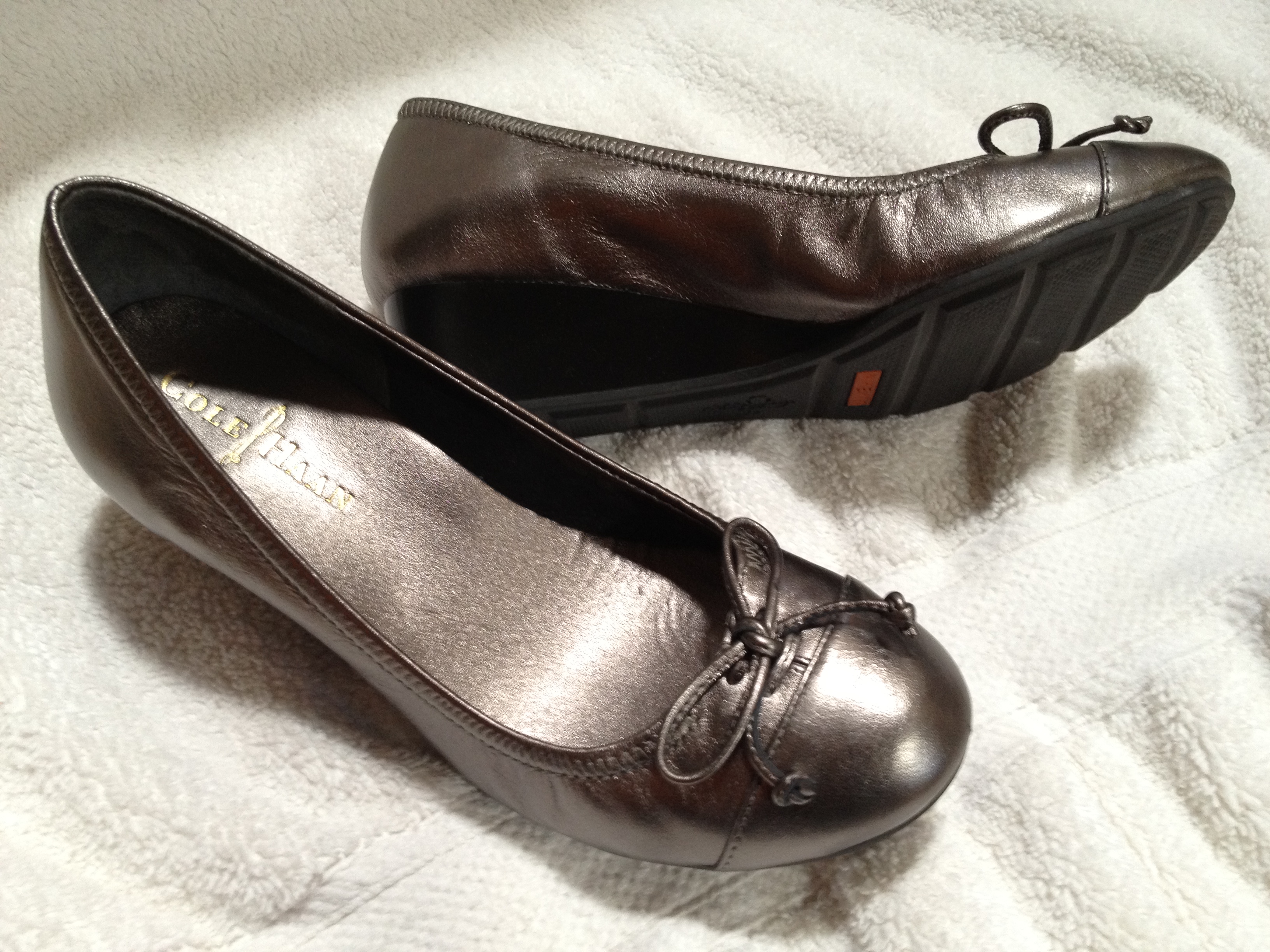
I tried these as a dressier shoe that could fit into dress-up/dress-down situations. I thought since they are by Cole Haan with Nike Air Technology that they might actually work. And they are fairly comfortable. The problem is that they pinch my toes and do not provide the stability I need when walking along uneven sidewalks.

The comfort lines out there, like Ecco, Mephisto, and Clark’s make fine shoes, but a lot of them are either too wide for my dainty feet or they look like a shoe my grandmother would wear. (In fact, I bought my grandmother some Ecco’s for Christmas because she loved them so much.) These lines have started putting out some really great looking shoes lately and I have bought pairs in hopes of finding the one. But, alas, I am still looking for that summer staple.

So now, ladies and gentlemen, I put the question to you: Have you found stylish, comfortable, lightweight, summer shoes that are urban casual AND closed-toed?

If you have great traveling shoes you would like to share, drop me a note! Phoenix, as well as many other parts of the world, it seems, are starting Spring/Summer early. That has me antsy to find what I need to get on the road with style and comfort.

Local artists inspire alongside Mirazozo at the Mesa Festival of Creativity

The bright, blue skies are blanketed today with leftover rainclouds from the weekend. They are the kind of clouds that look like pillow stuffing. They have flat bottoms and, in their journey across the sky, they take on the shapes of animals and objects. The wind beneath them is cold, a reminder of yesterday’s blustery rain and wind. You will never hear me complain of the rain, even if it did feel at times like I was Sisyphus trying to push a boulder through the streets of Phoenix last night.

Sisyphus carrying his burden.

Today, however, the clouds seem content to be their billowing selves, keeping their nurturing rain tucked into their folds. They lope sloth-like through the skies, inspiring all kinds of imaginings to those whose eyes roam skyward and on into daydreams. It is their presence, and that of the accompanying cold wind, that has me hunched over my coffee mug today, doing some daydreaming of my own about adventures had on the weekend before the storms rolled in.

It's coffee time! Second cup, please!

If you have read previous posts of this blog, then you know Hubby and I were alerted to a grand event happening in Mesa over last week–the Festival of Creativity at the fantastic Mesa Arts Center. This festival itself was free and included artistic expressions in several forms, including music and interactive art pieces. Mirazozo was one of the main attractions of the festival, but to get in visitors paid a nominal fee of $5 per person. It was an impressive architectural sculpture made out of thin sheets of colored plastic, and brought to life with air.

Hubby and I went to the festival on Friday night. On the music stage was Tobie Milford, a violinist whose music rolled up and over the exhibits in gentle waves. The sounds were like a benediction. It’s not enough, though, for me to describe it for you. Tobie Milford must be heard to understand his talent. Below is a video to give you a little taste of what it was like to walk around this festival with his looping violin and milky voice mixing with the creative energy in the air:

All along the lane that was set up for the festival there were interactive exhibits. There was a large Lego cactus being built by anyone who wanted to participate. Visitors built smaller pieces and the artists banged them into place on the cactus. Looking closely, one could see the artistic spirit of the community at large. We found a Space Invader among the bright Lego colors. Do you see it in the photo below?

Attendees at the festival were invited to help build a 10-foot tall cactus made out of Legos. Anybody see the Space Invader in the cactus? (Photo by M Dryja.)

As we walked on, we saw a juggler tossing large, illuminated yoyos and bowling pins into the air and catching them with ease. There were long sticks that looked like the big brothers of desert plants rooted into containers. When pushed, the plants made music. One structure looked like a giant, neon agave plant, but when we touched it, we discovered it was made out of pool noodles. Art was projected up onto the blank walls of surrounding buildings and white shade sails overhead. The light from the projections spun before and over us as another artist, perched on a scaffolding, took pictures of people interacting with the art below.

Agave plant made out of pool noodles. The sign on the container invites visitors to touch it. (Photo by M Dryja.)

Illuminated images spun over a blank wall. It was hard to capture how grand and vivid it was, but I did manage to grab a phrase from it: "The Desert is my Playground." That seemed to be a theme for the festival.

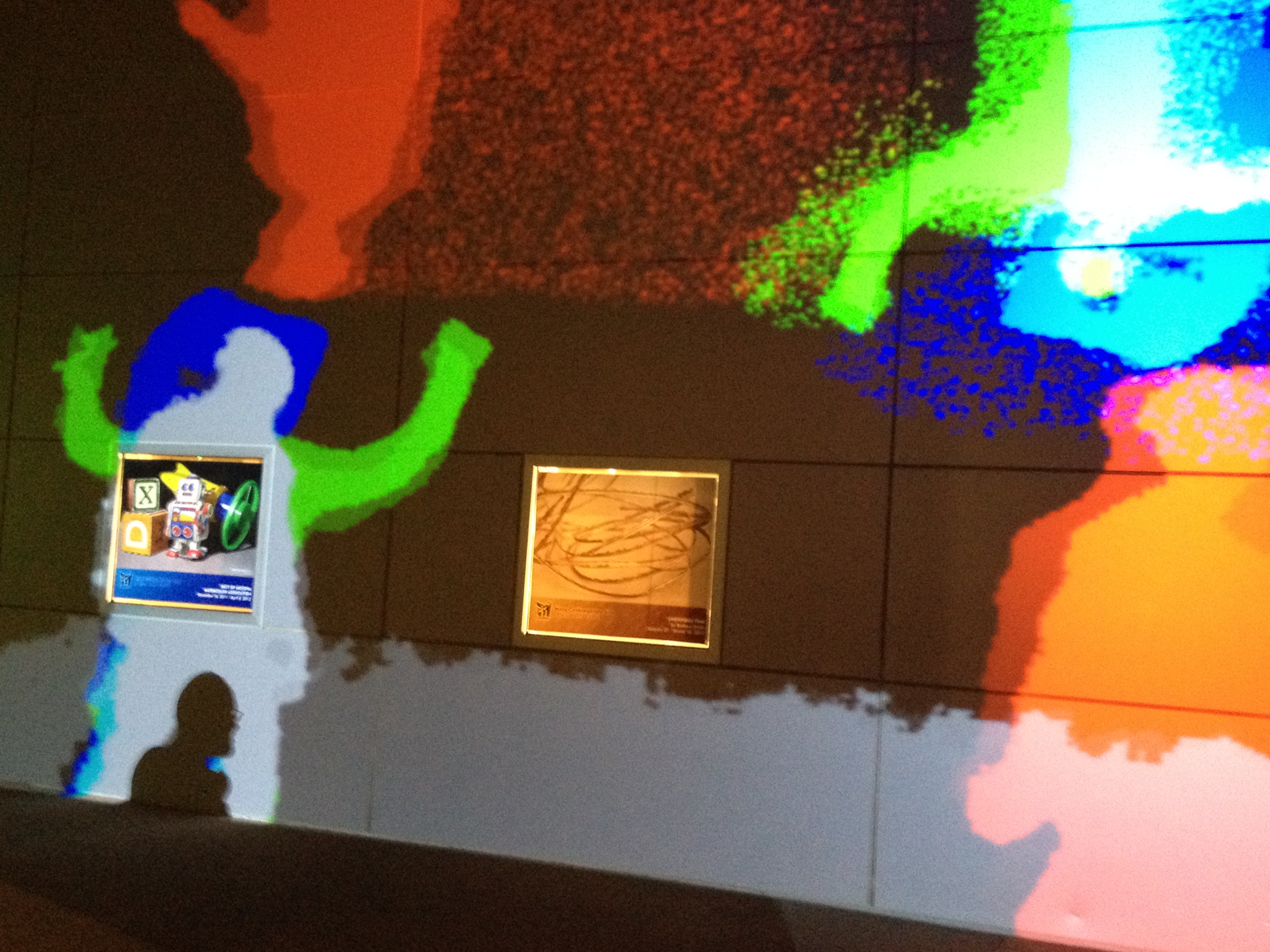
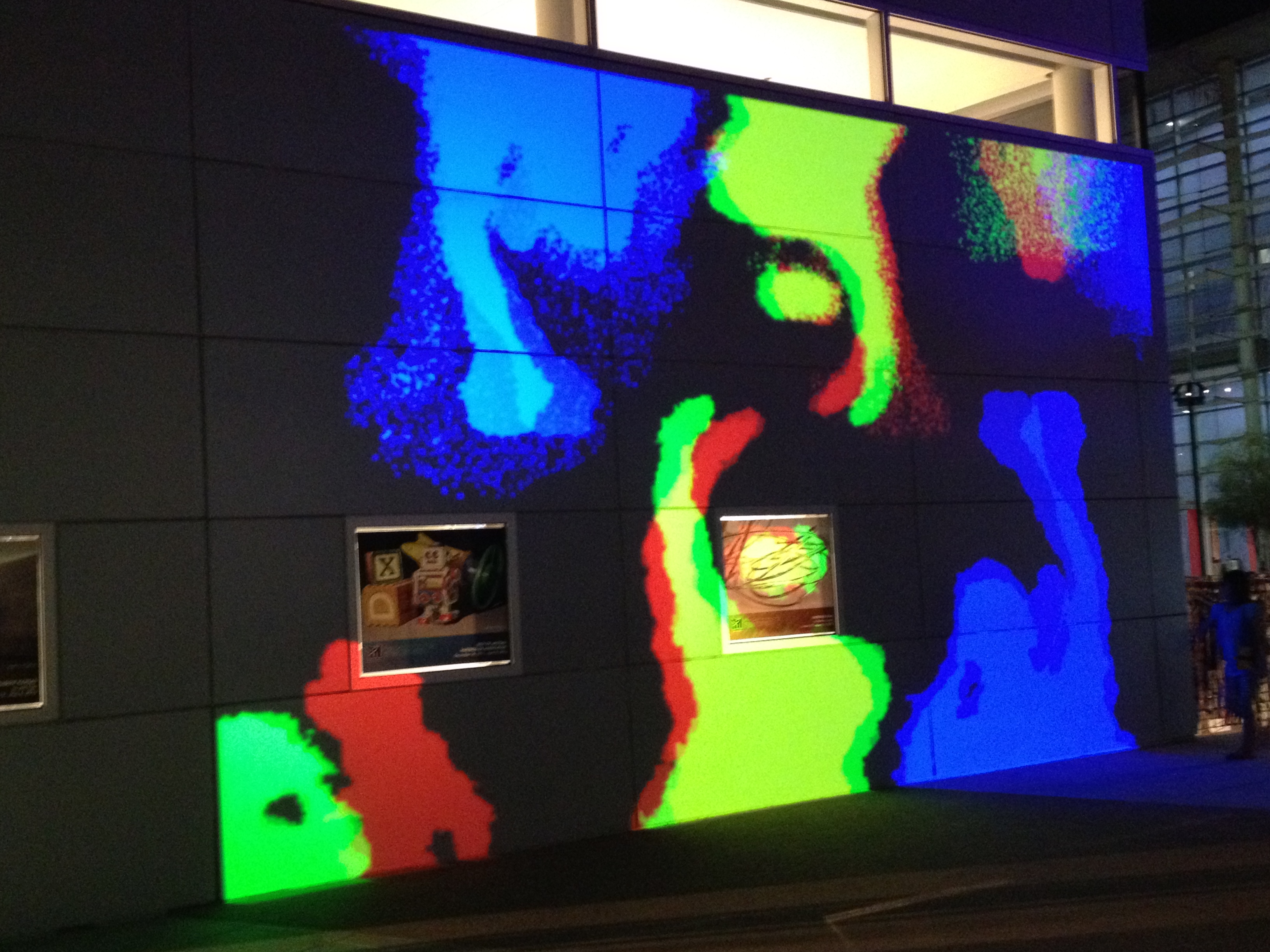
A favorite piece for both of us was the video wall where passersby became the art. As we walked by, a camera caught our silhouettes and projected them on the wall of the Contemporary Art building. When we moved, the projections moved, and then divided and flipped, and suddenly, what was two images of our silhouettes became four and six and upside down. It brought out the kid in everyone who passed by. Old men with canes were trying to make the projections more outlandish than before. Kids were hopping up and down to make the images jump.

Hubby raised his arms and created images that split off, flipped over, and danced across the wall.

A family from very young to what looked like grandparents got involved in creating art on the wall.

We also took the opportunity to walk through the Contemporary Art Museum, another free experience. A lot of the artists in that museum are from the area. It was a good reminder to see how talented people in the Phoenix area are. I have known that for a while, given the number of art walks and festivals held each month in various cities in the metro area, but this was a permanent reminder to the the community at large. Sadly, I was not able to take pictures inside the museum, but the building and surrounding gardens were works of art on their own, so Hubby and I took lots of photos of the outside.

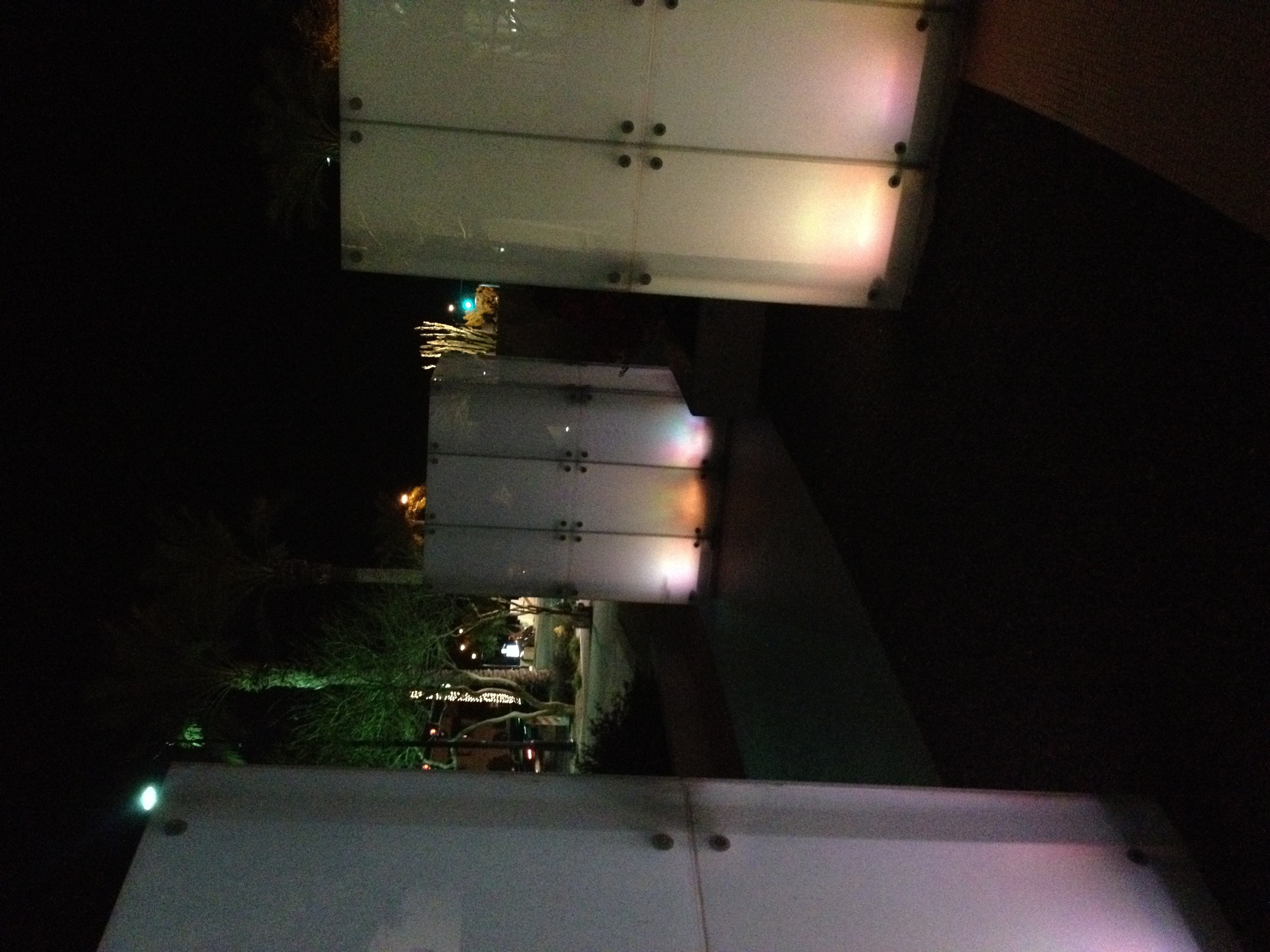
Lighted glass structures are on permanent display in the garden outside the Contemporary Art Museum. (Photo by M Dryja.)

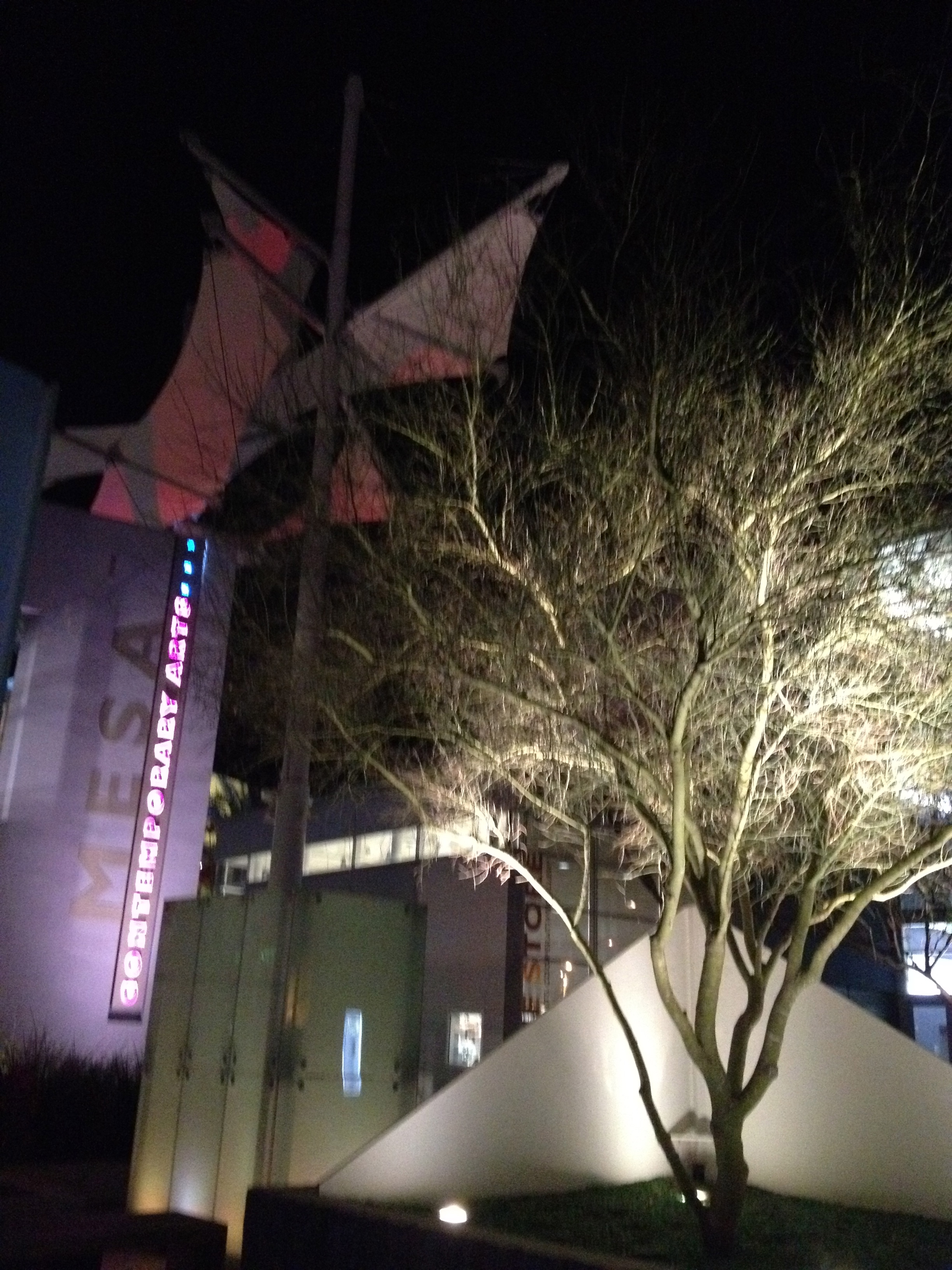
The entire Mesa Arts Center plaza is rather impressive with contemporary architecture, creative landscaping, and the way it is lit.

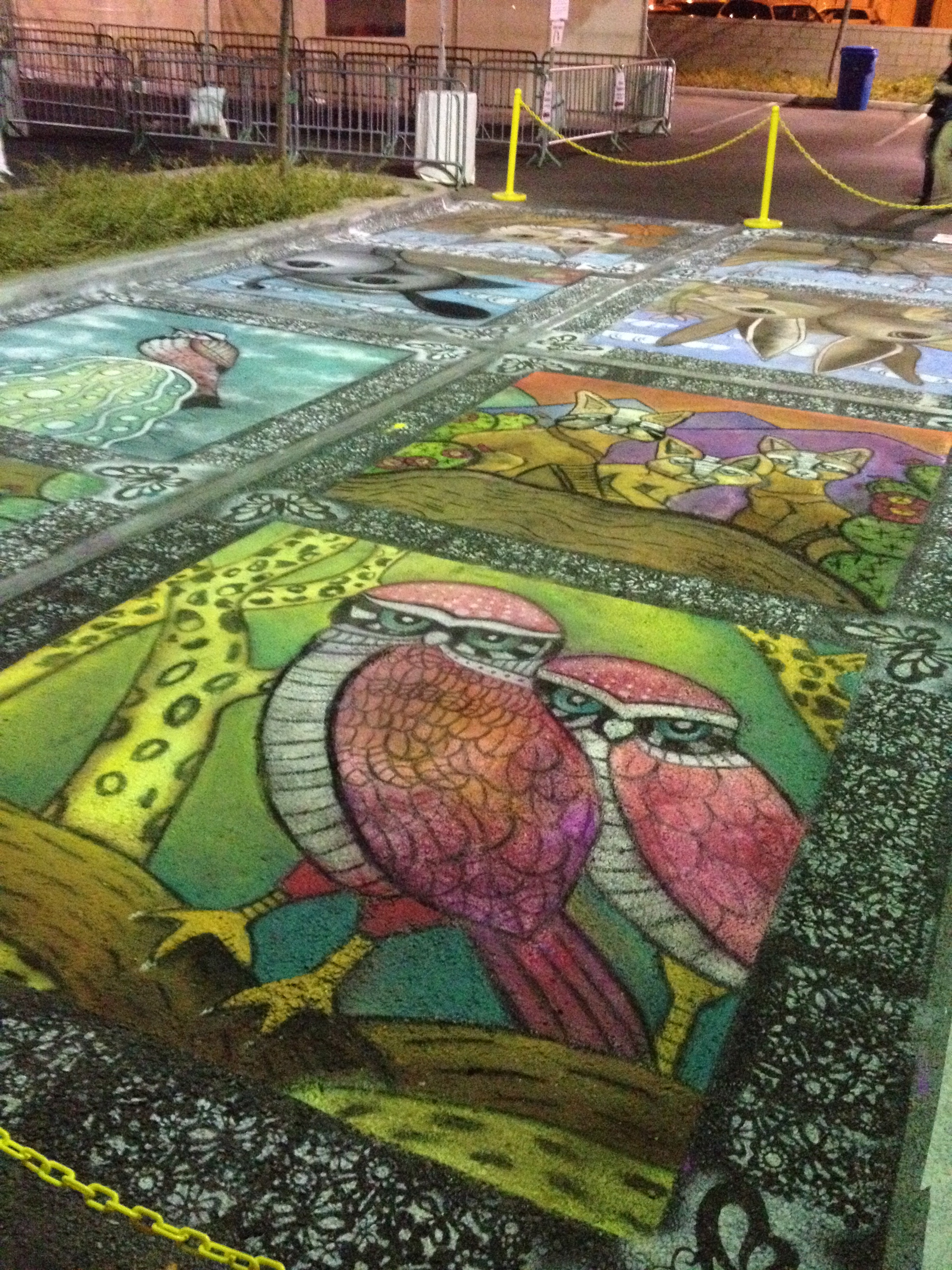
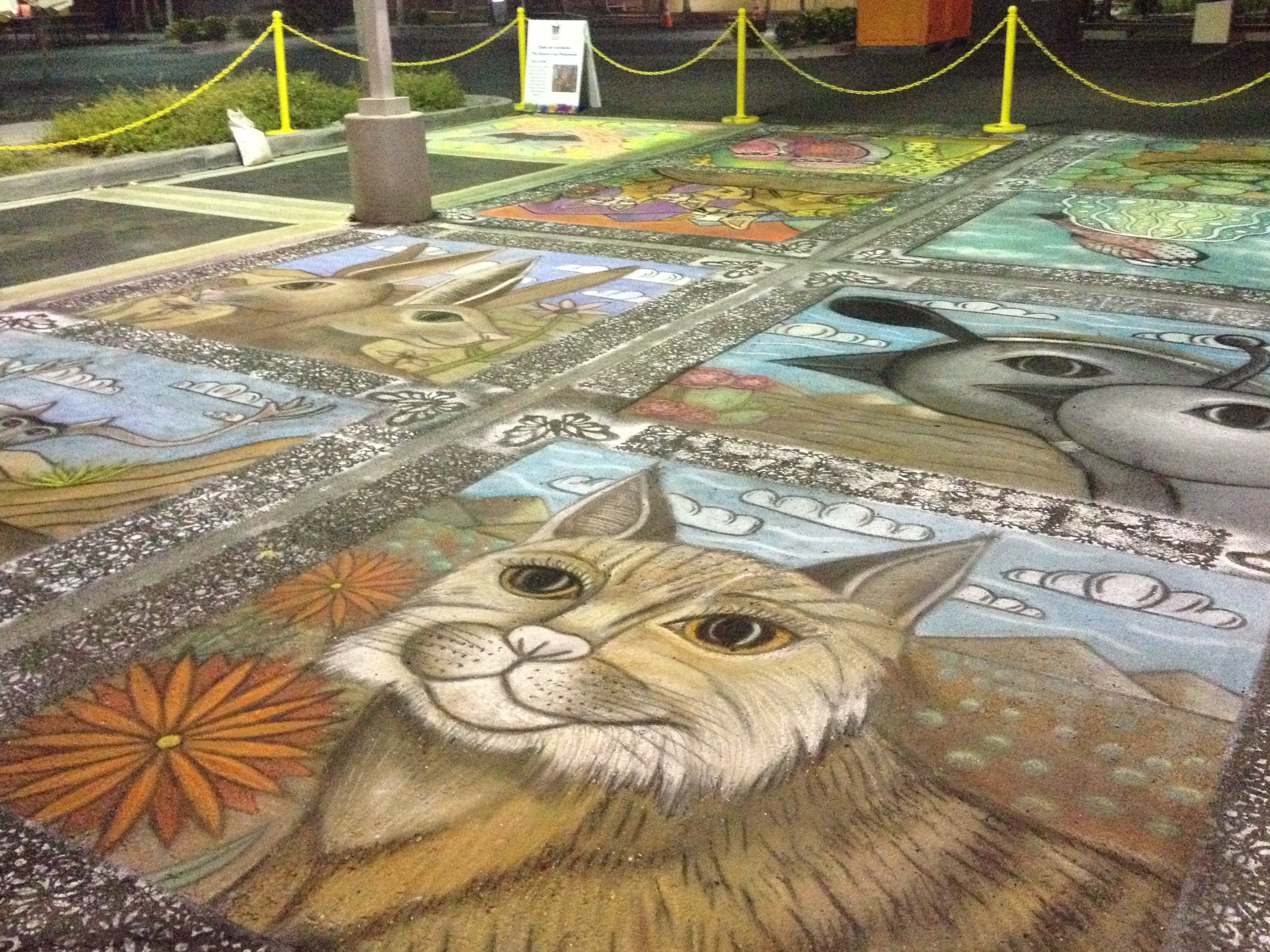
I’m sorry to admit that we were not originally there for those local artists. We were there for Mirazozo. The reason I did not start this article with Mirazozo, however, is because, although it is larger and more well-known than the others we saw, I was just as impressed by some of the exhibits produced by local talent, and they deserve to be showcased. For instance, just outside Mirazozo’s luminarium was a group of pictures created by local chalk artists. It was impressive to see the depth of color and detail they could get over the stubbly, bumpy blacktop of the parking lot.

One of our favorite images by the chalk artists, a desert tortoise. Hubby claimed that's what he looks like in the morning before his first cup of coffee.

One of the groupings of chalk art.

The chalk art from another vantage point.

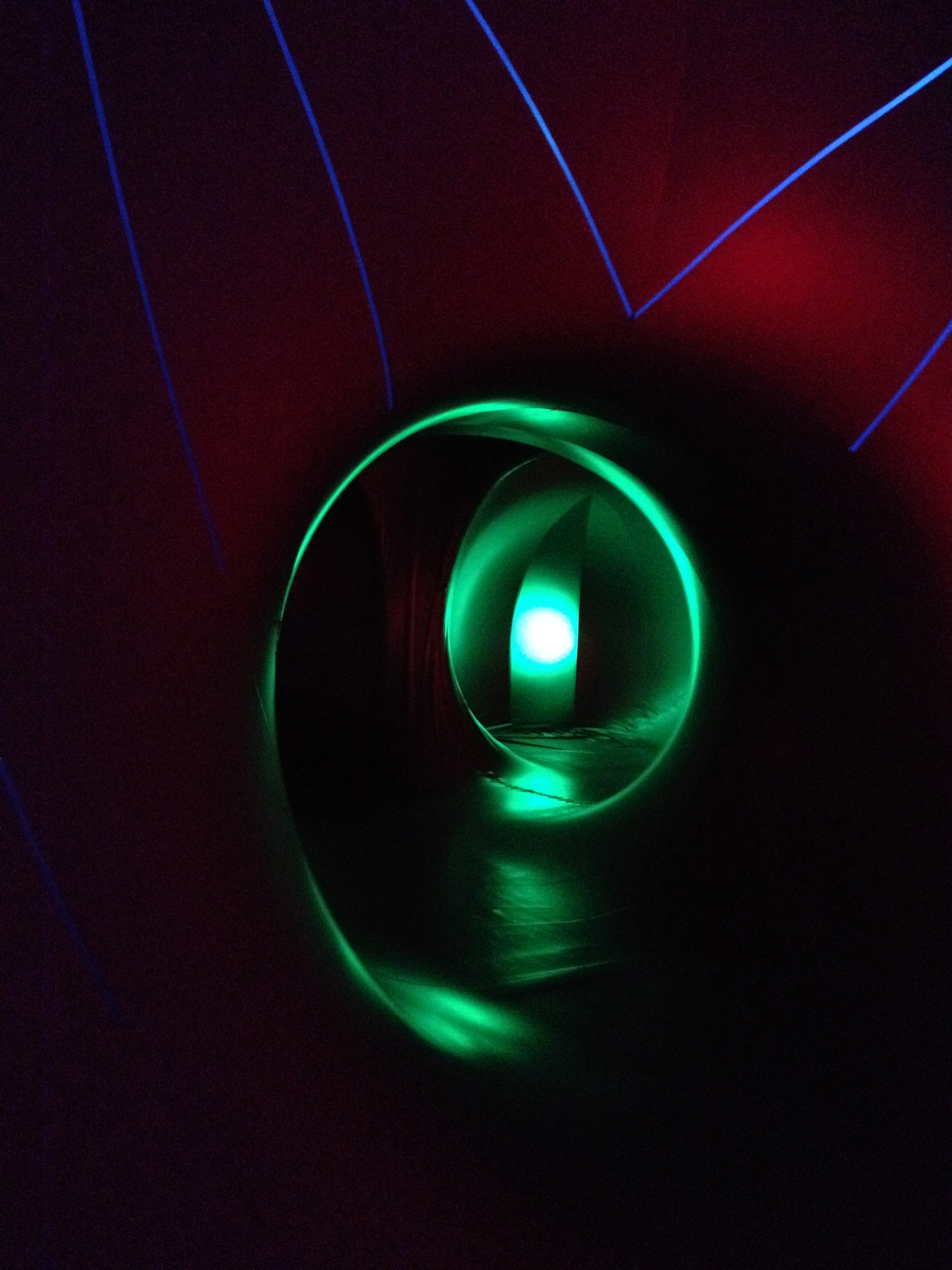
As for the main exhibit, Mirazozo, it’s hard to describe what it is, exactly. It sort of feels like part bounce-house, part cathedral. The walls are made of thin sheets of plastic, so thin that they are flexible and feel like fabric. Air is pumped into the structure and light from outside filters through stripes and designs to create a stained-glass effect.

Hubby explores Mirazozo.

Hubby is dazzled. And maybe a little dazed.

The structure is laid out very much in the way a cathedral or basilica might be, with little transepts off to the side and a central nave in the middle. In fact, the structure of Mirazozo actually reminded me of that of St. Peter’s Basilica in Rome.

The layout of St. Peter's Basilica in Rome.

Layout of Mirazozo.

Reading more about Mirazozo, I learned that it was “inspired by the beauty of natural geometry and by Islamic architecture.”

We were there because friends had told us that it was a sight to behold. This big, silver bubbly structure that sat in the parking lot promised to dazzle us with its colors. It was astounding to consider the immense size of the thing, how it was made, and how it was held together, as all that air pushed in to give it life.

Mirazozo from the outside looks much like a Middle Eastern circus tent. Apparently, the small domes and repetitious forms found in the bazaars of Iran inspired the design of Mirazozo. (Photo by M Dryja.)

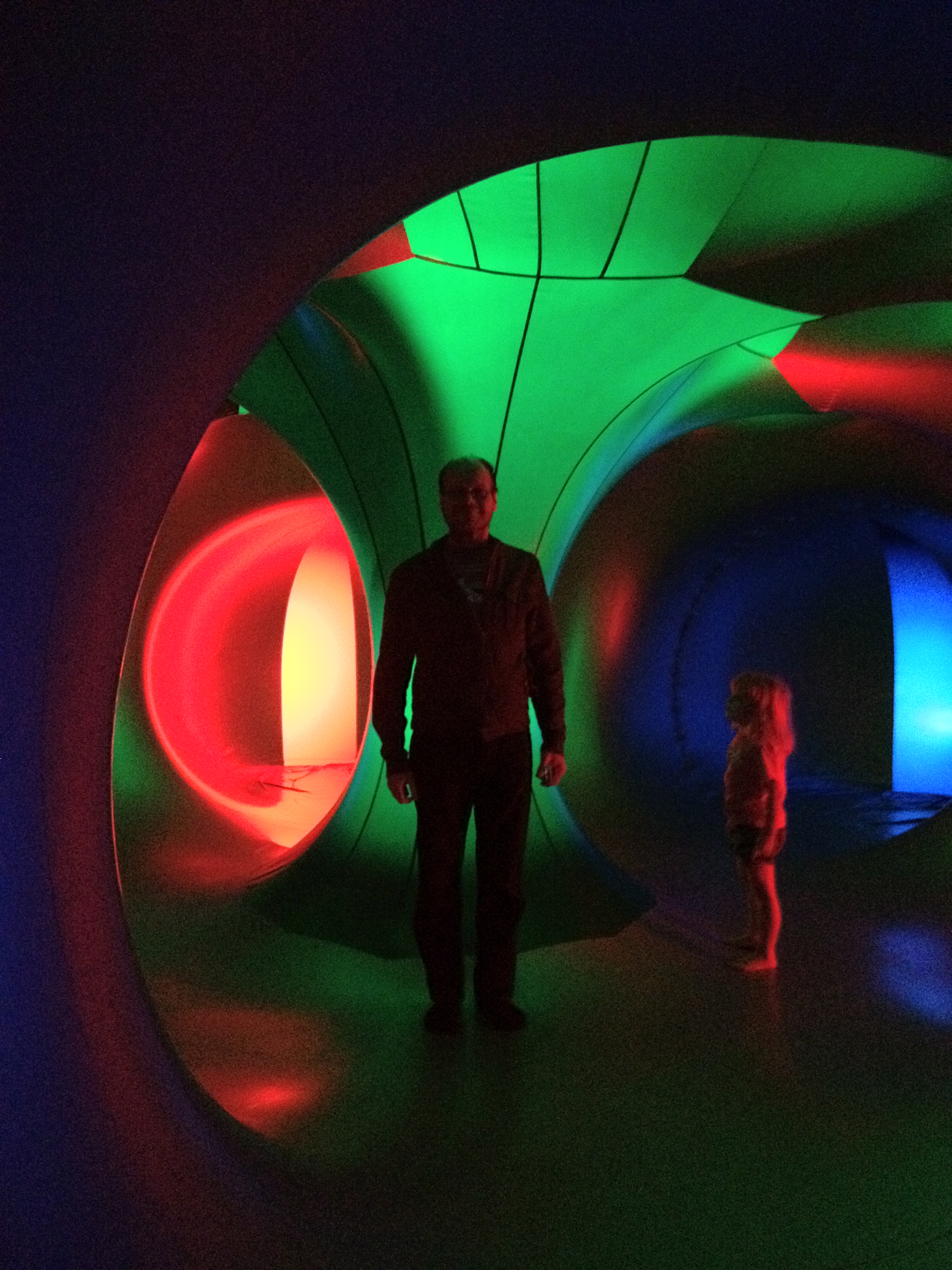
Inside, it was sacred and psychedelic. People lounged on parts of the floor that poofed up where the walls met the ground. I couldn’t help but think of stoned hippies seeing them lounge barefoot like that so peacefully. It’s not something you see at most art exhibits, but it also didn’t feel out of place either. We were all barefoot so as not to damage the plastic flooring. (In fact, the inside did smell a bit like feet.) Still, whatever it was–the lighting, the music by David Bickley bouncing off the soft walls, the muffled whispers–it was an easy place to be, relaxing and a little mind-altering.

Inside were tunnels which led to other rooms and nooks.

Spidery lines curved and angled across the ceiling.

A little girl looks around as Hubby posed in front of a green "tree".

More lines trumpet out from the ceiling.

Below is a slideshow with far more pictures from Mirazozo and the Festival of Creativity. Grab yourself a cup of coffee, relax, and enjoy.

This slideshow requires JavaScript.

Watching Detroit come back, with hope for the rest of us

Eminem started it last year during the Superbowl with the award-winning Chrysler ad. It was a call to the strength and resiliency Detroit is capable of.

Eastwood continued the call but broadened it to all of America, using Detroit as the epitome of what it looks like to return to glory.

Detroit’s image is looking up, thanks to the new pioneers who have decided the city is worth saving. I see article after article about the energy buzzing through town. People are coming together to reclaim the history–all of it, even the hard stuff–and remake what’s there into something even better. Sure it has a long way to go, but from the sounds of it, there is an understanding that their work is for the long-term. There isn’t a silver bullet that will solve all problems overnight.

Still, they work and they open their hearts and hands to what needs done. They look to each other and dig deep into the rich wells of their bold, creative spirits and release what is there.

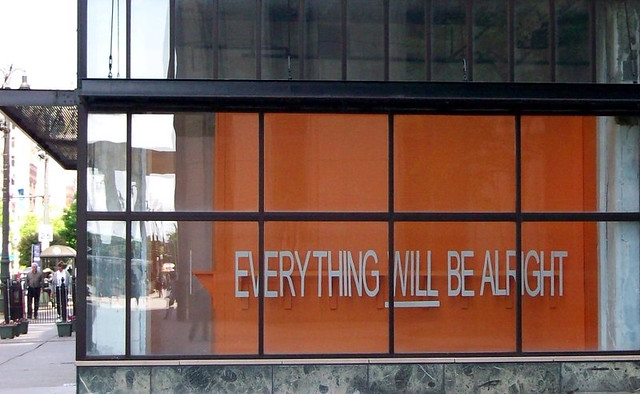
People Mover Station in Detroit. (Photo used with thanks to Maia C.)

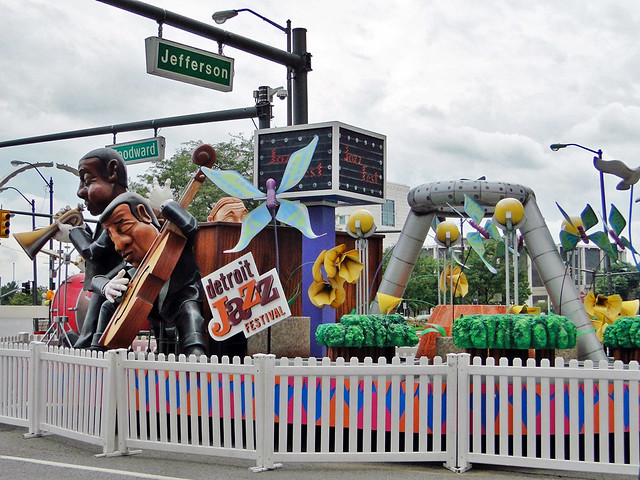
The Thanksgiving Parade float for the International Jazz Festival, on display during the festival. (Photo used with thanks to Maia C.)

Fisher Theater in Detroit. (Photo used with thanks to cseeman.)

And now we can taste the fruits of their labors. We can learn from them. We can warm ourselves to the hope they have sparked and take it with us to the corners of our own worlds, bringing that kind of hope borne out of hard work and belief in what’s possible. They represent what’s possible because they’ve seen the worst of it. If Detroit can come back, maybe the rest of us can too.

American flag on a building in downtown Detroit. (Photo used with thanks to cseeman.)

That is the inspiration that is rippling out from Motor City and touching the hearts of people in Michigan as well as points beyond. Thanks to people like Dan Austin, who is an historian of Detroit and founder of HistoricDetroit.org, the story of this city is being told. His website shares all the news about what’s happening architecturally and historically through the eyes of people that live there. He was kind enough to share with me on Facebook the name of several organizations in the area which offer tours of all shapes and kinds. I will be in Michigan in June and you can bet I will be participating in at least one of them.

Detail on a Detroit building. (Photo used with thanks to cseeman.)

  • Inside Detroit has the inside scoop on what’s happening in the city. Their mission is to “to educate the public about Detroit’s history, culture, community, and livability in order to spur economic development.” They offer a variety of tours: walking, biking, Segway, and bus. They also have unique Bar Tours, which take you to different bars in the area on special occasions, such as St. Patty’s Day and Summer Kick Off.
  • The Detroit Historical Society has been around since 1921. Their mission is to “educate and inspire our community and visitors by preserving and portraying our region’s shared history through dynamic exhibits and experiences.” Their tours are specific to the Detroit Historical Museum and the Dossin Great Lakes Museum, but their exhibits, events, and resources provide a sturdy foundation for learning all you might want to know about the city before heading out to explore it on a city tour.
  • Preservation Wayne has been around since 1975 and is Detroit’s “oldest and largest architectural preservation organization.” They offer lots of different walking tours beginning in May and running through September.

These stories, these dreams, give me hope and inspire me to believe that we can make it and become an even better country, an even better world.

Belief in downtown Detroit. (With thanks to Maia C for the excellent photos of a city she clearly loves.)

I haven’t even arrived in Michigan, yet I am inspired by what I’m hearing and seeing about the “new” Detroit.

Where do you find inspiration?